E-bok, Engelska, 2005
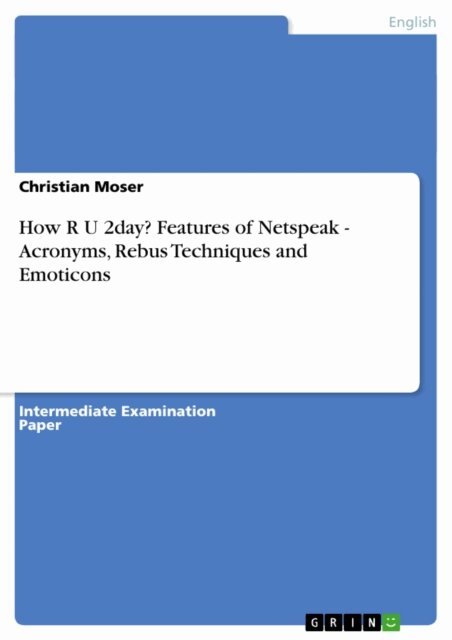
How R U 2day? Features of Netspeak - Acronyms, Rebus Techniques and Emoticons
213 kr
Läs direkt i Bokus Reader – eller ladda ned till din enhet (PDF kräver ofta zoom och scroll på små skärmar).
Beskrivning
Intermediate Examination Paper from the year 2004 in the subject English Language and Literature Studies - Linguistics, grade: None, University of Bern, language: English, abstract: In the course of this paper I shall analyse abbreviations found in four chat sessions. My main hypothesis is that Internet users have adopted several ways of abbreviating in order to make their contributions more efficient. Furthermore, a great number of these abbreviations indicate, or are trying to render, the emotional state of the speaker and in doing so make the interpretation of an utterance easier. In addition, it appears that another reason for abbreviating is to compensate for a lack of information, such as tone and mood of a speaker. This deficit arises, possibly, from the lack of personal contact between the speakers and is characteristic of the use of abbreviations as used in English on the Internet. Taking a more general approach, Crystal included the computer mediated variant of English in his term "e;Netspeak"e;; firstly, in hisLanguage and the Internet(Crystal 2001: 17) and, three years later, inThe Language Revolution.(Crystal 2004: 65) I shall take a slightly closer look at the concept in section two. Section three deals with two issues connected to the material I collected. Firstly, I comment in section 3.1 on how I reproduced the logged chat sessions and most importantly why I deleted certain contributions I identified as not being part of the ongoing conversation. Section 3.1 also contains a short description of the chats I used as the data for my analysis. The following subsection 3.2 deals with the problem of the anonymity of the Internet users and the resulting problems for research. Section four consists of the analysis of the collected data. I decided to deal only with abbreviations as they occur in written Internet communication, whereas I use written here in its literal meaning, i.e. in the sense of typed in via keyboard. I divided these abbreviations into three types, namely acronyms, rebus techniques, or phonetic spellings, and emoticons. These are discussed in the respective sub sections. In addition to this, I divided the subsection on emoticons into two parts, discussing the absence of both smileys and shorthands. The last section presents my conclusions for this analysis of three features of Netspeak. Furthermore, I shall point out further possible directions for research.
Produktinformation
- Utgivningsdatum: 2005-12-18
- Språk: Engelska
- Filformat: PDF
- Kopieringsskydd: LCP
- ISBN: 9783638448826
- Förlag: GRIN Verlag
Utforska kategorier
Betyg & recensioner
0 recensioner
Inga recensioner tillgängliga.