E-bok, Engelska, 2009
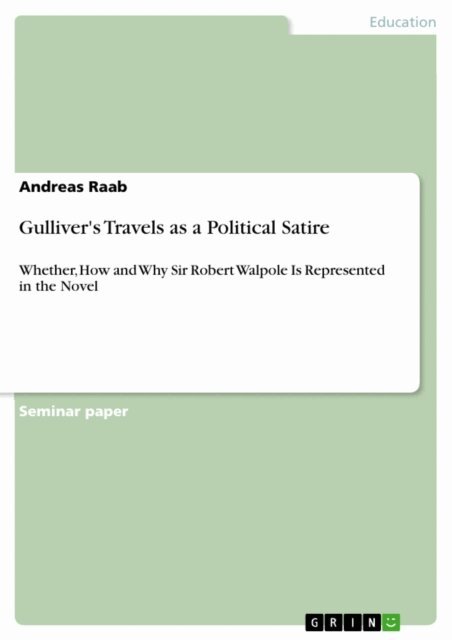
Gulliver's Travels as a Political Satire
Av Andreas Raab
188 kr
Skickas tisdag 13/10
Beskrivning
Seminar paper from the year 2005 in the subject Didactics for the subject English - Literature, Works, grade: 1, University of Vienna, course: 18th Century Satire and Satirical Literature, language: English, abstract: In this term paper I focus on Jonathan Swift's Gulliver's Travels, first published in 1726, as a political satire, a book rich in its topics and possible interpretations. However, the novel's function as a political satire - which I exemplarily examine in this paper - is one of its most discussed and obvious ones. Thus, I have a close look at whether, why and how the politician Sir Robert Walpole, a contemporary of Jonathan Swift, is - satirically - represented in Gulliver's Travels. In order to fully grasp this issue, I start with a summary and comparison of both Jonathan Swift's and Robert Walpole's (political) backgrounds, beliefs, values and ideas, embedded in the historical context of the early 18th century. Then I continue with a discussion that mainly focuses on the following questions: Does the character Flimnap merely represent Robert Walpole or does it rather stand for politicians in general? What could have been Jonathan Swift's (political) intentions to do so? And, finally: How does satire as such then function in this case?
Produktinformation
- Utgivningsdatum: 2009-04-09
- Språk: Engelska
- Filformat: PDF
- Kopieringsskydd: LCP
- ISBN: 9783640309429
- Förlag: GRIN Verlag
Utforska kategorier
Betyg & recensioner
0 recensioner
Inga recensioner tillgängliga.