

Sovereign debt default and financial crisis in Argentina 2001
E-bok
PDF, Engelska, 2010196 kr
Läs direkt i Bokus Reader – eller ladda ned till din enhet (PDF kräver ofta zoom och scroll på små skärmar).
Beskrivning
Seminar paper from the year 2010 in the subject Economics - Economic Cycle and Growth, grade: 1,7, Otto-von-Guericke-University Magdeburg (Internationale Wirtschaft), course: Seminar on financial crisis, language: English, abstract: In order to understand the causes of the Argentine economic crisis one has at least to know something about the Plan Cavallo which was established in Argentina in the year 1991. At the end of the 1980s the country suffered from hyperinflation with prices increasing above 3000 percent per year. This currency crisis was accompanied by an accumulated decrease of GDP between 1988 and 1990 of about 10 percent. After several failed attempts to stop this development the newly appointed minister of economic affairs, Cavallo, established two laws which improved the situation. First, the Ley De Convertibilidad came into effect that fixed the exchange rate between the Argentine currency and the U.S. dollar. Second, the Ley de Carta Organica del Banco Central emerged which obligated the central bank not to finance budget deficits anymore. These two laws became generally known as the Plan Cavallo. The incentive was to reestablish confidence in the sense that Argentina would not inflate away its domestic debt anymore. The Plan Cavallo operated very well until the crisis with respect to two macroeconomic quantities: On the one hand, the exchange rate was kept constant at a one-to-one level towards the U.S. dollar. On the other hand, the inflation rate declined from still 84 percent in the year 1991 to 1.6 percent in the year 1995. Since then it was kept between -1.8 and 0.7 percent until the year 2000. Furthermore, a lot of privatization took place in the first half of the 1990s and the whole decade was characterized by an increase of foreign direct investment above 500 percent. Altogether, Argentina was a star country in the perspective of international organizations. Nonetheless, there were some erroneous trends. First, there was a real revaluation of the Argentine peso with respect to the U.S. dollar: While the nominal exchange rate stayed constant, prices in Argentina rose by 153 percent, prices in the United States only by 30 percent from 1991 to 2000. In other words, assuming that prices of export and import goods increased by the same relation, exports from Argentina to the United States doubled in prices while imports to Argentina from the United States halved in prices during this period. Second, the debt ratio increased from 38.8 percent in the year 1991 to 50.8 percent in the year 2000 despite the fact that GDP grew by 4.2 percent on average during this period. In other words, the Argentine government pursued a pro-cyclical policy in the considered period.
Produktinformation
Utforska kategorier
Hoppa över listan








Mer från samma författare
Tlbd 1: §§ 238-289. Tlbd 2: §§ 290-342a
Gerhard Dannecker, Peter Hommelhoff, Uwe Hüffer, Rainer Hüttemann, Peter Kindler, Detlef Kleindieck, Ernst Thomas Kraft, Daniel Zimmer
Inbunden, 2002
10 247 kr
Tlbd 1: §§ 238-289. Tlbd 2: §§ 290-342a
Daniel Zimmer, Ernst Thomas Kraft, Detlef Kleindieck, Peter Kindler, Rainer Huttemann, Uwe Huffer, Peter Hommelhoff, Gerhard Dannecker
E-bok
20139 658 kr
Hoppa över listan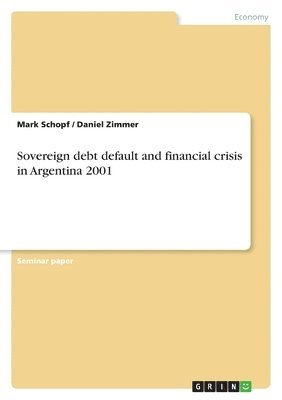


Du kanske också är intresserad av
Sovereign debt default and financial crisis in Argentina 2001
Mark Schopf, Daniel Zimmer
Häftad, 2010
389 kr
Methoden der Internalisierung externer Effekte am Beispiel des Klimaproblems
Mark Schopf
Häftad, 2010
532 kr
Tlbd 1: §§ 238-289. Tlbd 2: §§ 290-342a
Gerhard Dannecker, Peter Hommelhoff, Uwe Hüffer, Rainer Hüttemann, Peter Kindler, Detlef Kleindieck, Ernst Thomas Kraft, Daniel Zimmer
Inbunden, 2002
10 247 kr
Tlbd 1: §§ 238-289. Tlbd 2: §§ 290-342a
Daniel Zimmer, Ernst Thomas Kraft, Detlef Kleindieck, Peter Kindler, Rainer Huttemann, Uwe Huffer, Peter Hommelhoff, Gerhard Dannecker
E-bok
20139 658 kr
Neue Gemeinwohlherausforderungen - Konsequenzen für Wettbewerbsrecht und Regulierung
Daniel Zimmer, Jurgen Kuhling
E-bok
2020804 kr