• Fri frakt över 249 kr
  • •
  • Snabba leveranser
  • •
  • Billiga böcker
Kundservice

Du är på sajten för privatpersoner.

Företag, bibliotek eller offentlig verksamhet?

Du handlar på classic.bokus.com, där alla dina funktioner finns intakta.
Till classic.bokus.com
Bokus logotyp. Gå till startsidan.
  • Erbjudanden
  • Student
  • Topplistor
  • Barn & ungdom
  • Bokus Play
  • E-böcker
  • Ljudböcker
  • Pocketböcker
  • Spel och pussel

5% studentrabatt – använd koden KURSBOK27 →

Sidfot

Mina sidor

    Hjälp

    • Kundservice
    • Vanliga frågor och svar
    • Frakt och leverans
    • Retur vid ångerrätt
    • Reklamera vara
    • Betalning
    • Köpvillkor
    • Allmänna villkor
    • Information om webbplatsens tillgänglighet

    Om Bokus

    • Om oss
    • Pressrum
    • För studenter
    • För företag
    • För bibliotek och offentlig verksamhet
    • För leverantörer
    • Hållbarhet

    Populärt

    • Aktuella erbjudanden
    • Presentkort
    • Studentlitteratur
    • Nya böcker
    • Topplistor
    • Signerade böcker
    • Engelska böcker

    Inspiration

    • Boktips
    • BookTok
    • Barnbokskaraktärer
    • Populära författare
    Logotyp för Bokus
    Följ oss på Facebook (extern länk)Följ oss på Instagram (extern länk)Följ oss på YouTube (extern länk)Följ oss på TikTok (extern länk)
    bokus @ CookiesAnpassa cookiesIntegritetspolicyKöpvillkor
    Till Citymail hemsida (extern länk)Till Budbee hemsida (extern länk)Till Postnord hemsida (extern länk)Till Schenker hemsida (extern länk)Till Early Bird hemsida (extern länk)Till Walleys hemsida (extern länk)
    1. Data och IT
    2. Systemvetenskap och AI

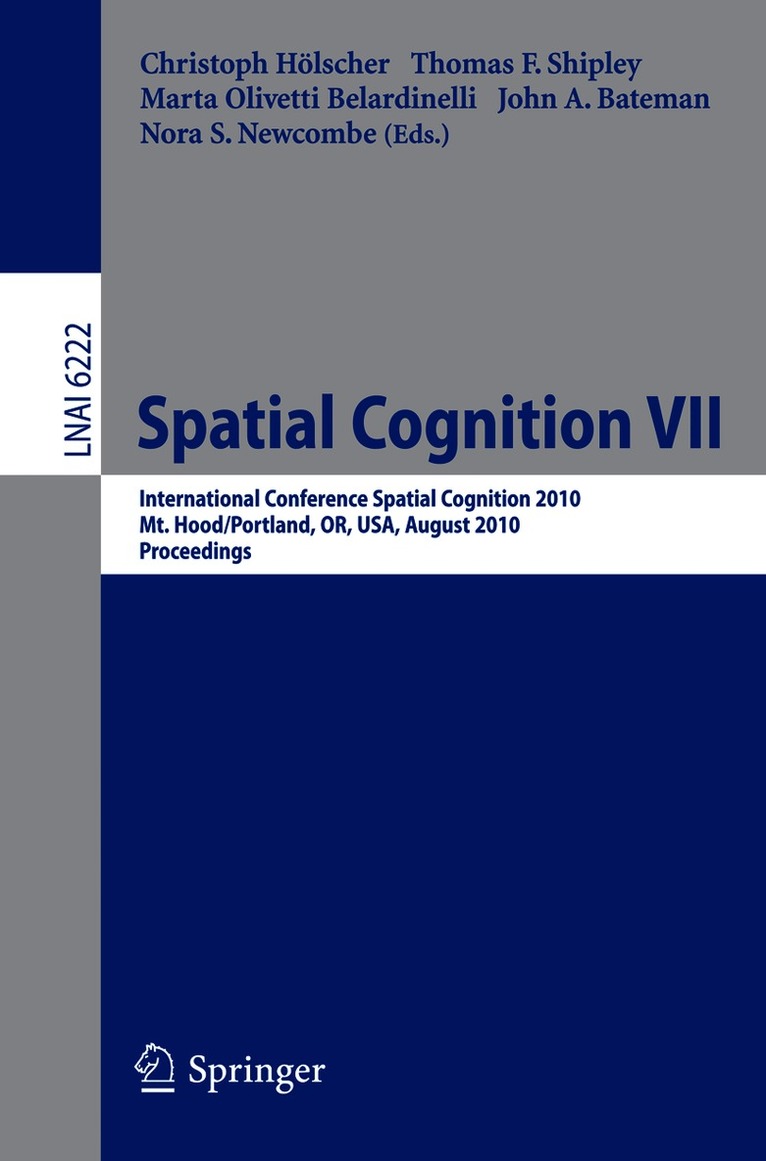
    Spatial Cognition VII

    International Conference, Spatial Cognition 2010, Mt. Hood/Portland, OR, USA, August 15-19,02010, Proceedings

    AvChristoph Hölscher,Thomas F. Shipley

    Häftad, Engelska, 2010

    Del i serien Lecture Notes in Computer Science

    561 kr

    Beställningsvara. Skickas inom 5-8 vardagar. Fri frakt över 249 kr.

    Beskrivning

    This is the seventh volume of a series of books on fundamental research in spatial cognition. As with past volumes, the research presented here spans a broad range of research traditions, for spatial cognition concerns not just the basic spatial behavior of biological and artificial agents, but also the reasoning processes that allow spatial planning across broad spatial and temporal scales. Spatial information is critical for coordinated action and thus agents interacting with objects and moving among objects must be able to perceive spatial relations, learn about these relations, and act on them, or store the information for later use, either by themselves or communicated to others. Research on this problem has included both psychology, which works to understand how humans and other mobile organisms solve these problems, and computer science, which considers the nature of the information available in the world and a formal consideration of how these problems might be solved. Research on human spatial cognition also involves the application of representations and processes that may have evolved to handle object and location information to reasoning about higher-order problems, such as displaying non-spatial information in diagrams. Thus, work in s- tial cognition extends beyond psychology and computer science into many disciplines including geography and education. The Spatial Cognition conference offers one of the few forums for consideration of the issues spanning this broad academic range.

    Produktinformation

    • Utgivningsdatum:2010-07-30
    • Format:Häftad
    • Språk:Engelska
    • Serie:Lecture Notes in Computer Science
    • Antal sidor:347
    • Förlag:Springer-Verlag Berlin and Heidelberg GmbH & Co. KG
    • ISBN:9783642147487

    Utforska kategorier

    • Systemvetenskap och AI inom Data och IT

    Innehållsförteckning

    • Invited Talks.- Individual Differences in Spatial Language and Way-Finding: The Role of Cognition, Emotion and Motivation.- CogSketch: Sketch Understanding for Cognitive Science Research and for Education.- The Refraction of Space: A Radical Reversal of Direction.- Distance and Time.- Investigating the Role of Goals and Environmental Structure on Memory for Distance and Time in Virtual Environments.- The Spatial and Temporal Underpinnings of Social Distance.- Navigation.- The Role of Slope in Human Reorientation.- Influence of Geometry and Objects on Local Route Choices during Wayfinding.- Testing Landmark Identification Theories in Virtual Environments.- Men to the East and Women to the Right: Wayfinding with Verbal Route Instructions.- Science Education and Spatial Skill.- Do All Science Disciplines Rely on Spatial Abilities? Preliminary Evidence from Self-report Questionnaires.- Gestures in Geology: The Roles of Spatial Skills, Expertise, and Communicative Context.- Using Analogical Mapping to Assess the Affordances of Scale Models Used in Earth and Environmental Science Education.- Language.- Aligning Spatial Perspective in Route Descriptions.- The Role of Grammatical Aspect in the Dynamics of Spatial Descriptions.- Implicit Spatial Length Modulates Time Estimates, But Not Vice Versa.- Computational Modelling.- Bio-inspired Architecture for Active Sensorimotor Localization.- Color Binding in Visuo-Spatial Working Memory.- Reference Frames.- Human EEG Correlates of Spatial Navigation within Egocentric and Allocentric Reference Frames.- Putting Egocentric and Allocentric into Perspective.- Reference Frames Influence Spatial Memory Development within and Across Sensory Modalities.- Do We Need to Walk for Effective Virtual Reality Navigation? Physical Rotations Alone May Suffice.- Visual Attention in Spatial Reasoning.- Eye Movements Reflect Reasoning with Mental Images but Not with Mental Models in Orientation Knowledge Tasks.- An Eye-Tracking Study of Integrative Spatial Cognition over Diagrammatic Representations.- Maps and Assistance.- Enriching Spatial Knowledge through a Multiattribute Locational System.- Interactive Assistance for Tour Planning.- Verbally Annotated Tactile Maps – Challenges and Approaches.- Generating Adaptive Route Instructions Using Hierarchical Reinforcement Learning.- Language, Neuroscience and Education.- Can Mirror-Reading Reverse the Flow of Time?.