• Fri frakt över 249 kr
  • •
  • Snabba leveranser
  • •
  • Billiga böcker
Kundservice

Du är på sajten för privatpersoner.

Företag, bibliotek eller offentlig verksamhet?

Du handlar på classic.bokus.com, där alla dina funktioner finns intakta.
Till classic.bokus.com
Bokus logotyp. Gå till startsidan.
  • Erbjudanden
  • Nyheter
  • Student
  • Topplistor
  • Barn & ungdom
  • Bokus Play
  • E-böcker
  • Pocketböcker
  • Spel & pussel

10% rabatt på allt med kod NYSTART10 →

Sidfot

Mina sidor

    Hjälp

    • Kundservice
    • Vanliga frågor och svar
    • Frakt och leverans
    • Retur vid ångerrätt
    • Reklamera vara
    • Betalning
    • Köpvillkor
    • Allmänna villkor
    • Information om webbplatsens tillgänglighet

    Om Bokus

    • Om oss
    • Pressrum
    • För studenter
    • För företag
    • För bibliotek och offentlig verksamhet
    • För leverantörer
    • Hållbarhet

    Populärt

    • Aktuella erbjudanden
    • Presentkort
    • Studentlitteratur
    • Nya böcker
    • Topplistor
    • Signerade böcker
    • Engelska böcker

    Inspiration

    • Boktips
    • BookTok
    • Populära bokserier
    • Barnbokskaraktärer
    • Populära författare
    Logotyp för Bokus
    Följ oss på Facebook (extern länk)Följ oss på Instagram (extern länk)Följ oss på YouTube (extern länk)Följ oss på TikTok (extern länk)
    bokus @ CookiesAnpassa cookiesIntegritetspolicyKöpvillkor
    Till Citymail hemsida (extern länk)Till Budbee hemsida (extern länk)Till Postnord hemsida (extern länk)Till Schenker hemsida (extern länk)Till Early Bird hemsida (extern länk)Till Walleys hemsida (extern länk)
    1. Data och IT
    2. Systemvetenskap och AI

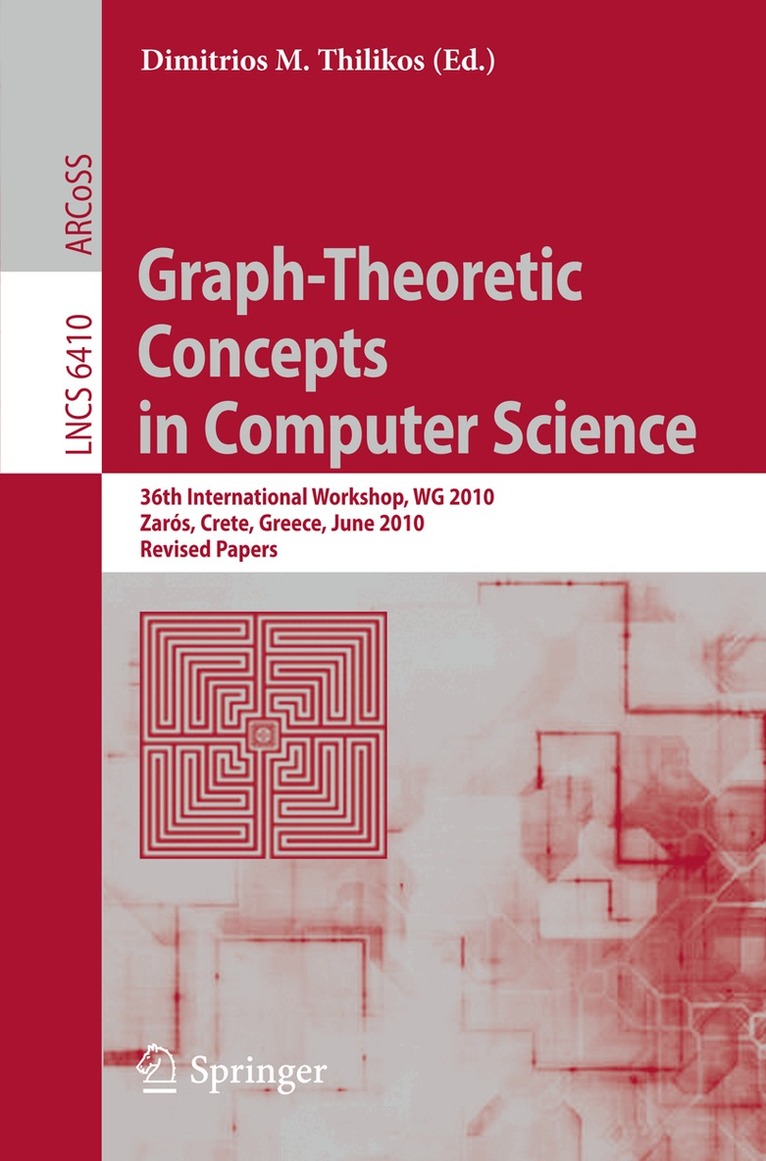
    Graph-Theoretic Concepts in Computer Science

    36th International Workshop, WG 2010, Zarós, Crete, Greece, June 28-30, 2010, Revised Papers

    AvDimitrios M. Thilikos

    Häftad, Engelska, 2010

    Del i serien Lecture Notes in Computer Science

    546 kr

    Beställningsvara. Skickas inom 10-15 vardagar. Fri frakt över 249 kr.

    Beskrivning

    The 36th International Workshop on Graph-Theoretic Concepts in Computer Science (WG 2010) took place in Zar´ os, Crete, Greece, June 28–30, 2010. About 60 mathematicians and computer scientists from all over the world (Australia, Canada, Czech Republic, France, Germany, Greece, Hungary, Israel, Japan, The Netherlands, Norway, Poland, Switzerland, the UK, and the USA) attended the conference. WG has a long tradition. Since 1975, WG has taken place 21 times in Germany, four times in The Netherlands, twice in Austria, twice in France and once in the Czech Republic, Greece, Italy, Norway, Slovakia, Switzerland, and the UK. WG aims at merging theory and practice by demonstrating how concepts from graph theory can be applied to various areas in computer science, or by extracting new graph theoretic problems from applications. The goal is to presentemergingresearchresultsand to identify and exploredirections of future research.The conference is well-balanced with respect to established researchers and young scientists. There were 94 submissions, two of which where withdrawn before entering the review process. Each submission was carefully reviewed by at least 3, and on average 4.5, members of the Program Committee. The Committee accepted 28 papers, which makes an acceptance ratio of around 30%. I should stress that, due to the high competition and the limited schedule, there were papers that were not accepted while they deserved to be.

    Produktinformation

    • Utgivningsdatum:2010-10-29
    • Format:Häftad
    • Språk:Engelska
    • Serie:Lecture Notes in Computer Science
    • Antal sidor:338
    • Förlag:Springer-Verlag Berlin and Heidelberg GmbH & Co. KG
    • ISBN:9783642169250

    Utforska kategorier

    • Systemvetenskap och AI inom Data och IT
    • Matematik inom Naturvetenskap och teknik
    • Programmeringsböcker inom Data och IT

    Innehållsförteckning

    • Invited Talks.- Algorithmic Barriers from Phase Transitions in Graphs.- Algorithmic Graph Minors and Bidimensionality.- Regular Talks.- Complexity Results for the Spanning Tree Congestion Problem.- max-cut and Containment Relations in Graphs.- The Longest Path Problem is Polynomial on Cocomparability Graphs.- Colorings with Few Colors: Counting, Enumeration and Combinatorial Bounds.- On Stable Matchings and Flows.- Narrowing Down the Gap on the Complexity of Coloring P k -Free Graphs.- Computing the Cutwidth of Bipartite Permutation Graphs in Linear Time.- Solving Capacitated Dominating Set by Using Covering by Subsets and Maximum Matching.- Efficient Algorithms for Eulerian Extension.- On the Small Cycle Transversal of Planar Graphs.- Milling a Graph with Turn Costs: A Parameterized Complexity Perspective.- Graphs that Admit Right Angle Crossing Drawings.- Kernelization Hardness of Connectivity Problems in d-Degenerate Graphs.- On the Boolean-Width of a Graph: Structure and Applications.- Generalized Graph Clustering: Recognizing (p,q)-Cluster Graphs.- Colouring Vertices of Triangle-Free Graphs.- A Quartic Kernel for Pathwidth-One Vertex Deletion.- Network Exploration by Silent and Oblivious Robots.- Uniform Sampling of Digraphs with a Fixed Degree Sequence.- Measuring Indifference: Unit Interval Vertex Deletion.- Parameterized Complexity of the Arc-Preserving Subsequence Problem.- From Path Graphs to Directed Path Graphs.- Connections between Theta-Graphs, Delaunay Triangulations, and Orthogonal Surfaces.- Efficient Broadcasting in Random Power Law Networks.- Graphs with Large Obstacle Numbers.- The Complexity of Vertex Coloring Problems in Uniform Hypergraphs with High Degree.- The Number of Bits Needed to Represent a Unit Disk Graph.- Lattices and Maximum FlowAlgorithms in Planar Graphs.