E-bok, Engelska, 2011
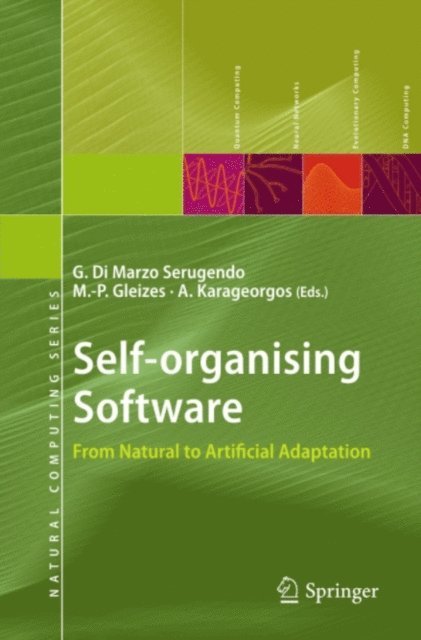
Self-organising Software
Av Anthony Karageorgos, Marie-Pierre Gleizes, Giovanna Di Marzo Serugendo
1459 kr
Skickas måndag 12/10
Beskrivning
Self-organisation, self-regulation, self-repair and self-maintenance are promising conceptual approaches for dealing with complex distributed interactive software and information-handling systems. Self-organising applications dynamically change their functionality and structure without direct user intervention, responding to changes in requirements and the environment. This is the first book to offer an integrated view of self-organisation technologies applied to distributed systems, particularly focusing on multiagent systems.
The editors developed this integrated book with three aims: to explain self-organisation concepts and principles, using clear definitions and a strong theoretical background; to examine how self-organising behaviour can be modelled, analysed and systematically engineered into agent behaviour; and to assess the types of problems that can be solved using self-organising multiagent systems. The book comprises chapters covering all three dimensions, synthesising up-to-date research work and the latest technologies and applications. The book offers dedicated chapters on concepts such as self-organisation, emergence in natural systems, software agents, stigmergy, gossip, cooperation and immune systems. The book then explains how to engineer artificial self-organising software, in particular it examines methodologies and middleware infrastructures. Finally, the book presents diverse applications of self-organising software, such as constraint satisfaction, trust management, image recognition and networking.
The book will be of interest to researchers working on emergent phenomena and adaptive systems. It will also be suitable for use as a graduate textbook, with chapter summaries and exercises, and an accompanying website that includes teaching slides, exercise solutions and research project outlines.
Self-organisation, self-regulation, self-repair and self-maintenance are promising conceptual approaches for dealing with complex distributed interactive software and information-handling systems. Self-organising applications dynamically change their functionality and structure without direct user intervention, responding to changes in requirements and the environment. This is the first book to offer an integrated view of self-organisation technologies applied to distributed systems, particularly focusing on multiagent systems.
The editors developed this integrated book with three aims: to explain self-organisation concepts and principles, using clear definitions and a strong theoretical background; to examine how self-organising behaviour can be modelled, analysed and systematically engineered into agent behaviour; and to assess the types of problems that can be solved using self-organising multiagent systems. The book comprises chapters covering all three dimensions, synthesising up-to-date research work and the latest technologies and applications. The book offers dedicated chapters on concepts such as self-organisation, emergence in natural systems, software agents, stigmergy, gossip, cooperation and immune systems. The book then explains how to engineer artificial self-organising software, in particular it examines methodologies and middleware infrastructures. Finally, the book presents diverse applications of self-organising software, such as constraint satisfaction, trust management, image recognition and networking.
The book will be of interest to researchers working on emergent phenomena and adaptive systems. It will also be suitable for use as a graduate textbook, with chapter summaries and exercises, and an accompanying website that includes teaching slides, exercise solutions and research project outlines.
Produktinformation
- Utgivningsdatum: 2011-09-15
- Format: E-bok
- Språk: Engelska
- Förlag: Springer Berlin Heidelberg
- ISBN: 9783642173486
Utforska kategorier
Betyg & recensioner
0 recensioner
Inga recensioner tillgängliga.