• Fri frakt över 249 kr
  • •
  • Snabba leveranser
  • •
  • Billiga böcker
Kundservice

Du är på sajten för privatpersoner.

Företag, bibliotek eller offentlig verksamhet?

Du handlar på classic.bokus.com, där alla dina funktioner finns intakta.
Till classic.bokus.com
Bokus logotyp. Gå till startsidan.
  • Erbjudanden
  • Nyheter
  • Student
  • Topplistor
  • Barn & ungdom
  • Bokus Play
  • E-böcker
  • Pocketböcker
  • Spel & pussel

10% studentrabatt med kod TERM26

Sidfot

Mina sidor

    Hjälp

    • Kundservice
    • Vanliga frågor och svar
    • Frakt och leverans
    • Retur vid ångerrätt
    • Reklamera vara
    • Betalning
    • Köpvillkor
    • Allmänna villkor
    • Information om webbplatsens tillgänglighet

    Om Bokus

    • Om oss
    • Pressrum
    • För studenter
    • För företag
    • För bibliotek och offentlig verksamhet
    • För leverantörer
    • Hållbarhet

    Populärt

    • Aktuella erbjudanden
    • Presentkort
    • Studentlitteratur
    • Nya böcker
    • Topplistor
    • Signerade böcker
    • Engelska böcker

    Inspiration

    • Boktips
    • BookTok
    • Populära bokserier
    • Barnbokskaraktärer
    • Populära författare
    Logotyp för Bokus
    Följ oss på Facebook (extern länk)Följ oss på Instagram (extern länk)Följ oss på YouTube (extern länk)Följ oss på TikTok (extern länk)
    bokus @ CookiesAnpassa cookiesIntegritetspolicyKöpvillkor
    Till Citymail hemsida (extern länk)Till Budbee hemsida (extern länk)Till Postnord hemsida (extern länk)Till Schenker hemsida (extern länk)Till Early Bird hemsida (extern länk)Till Walleys hemsida (extern länk)
    1. Naturvetenskap och teknik
    2. Matematik och naturvetenskap
    3. Kemi
    4. Fysikalisk kemi

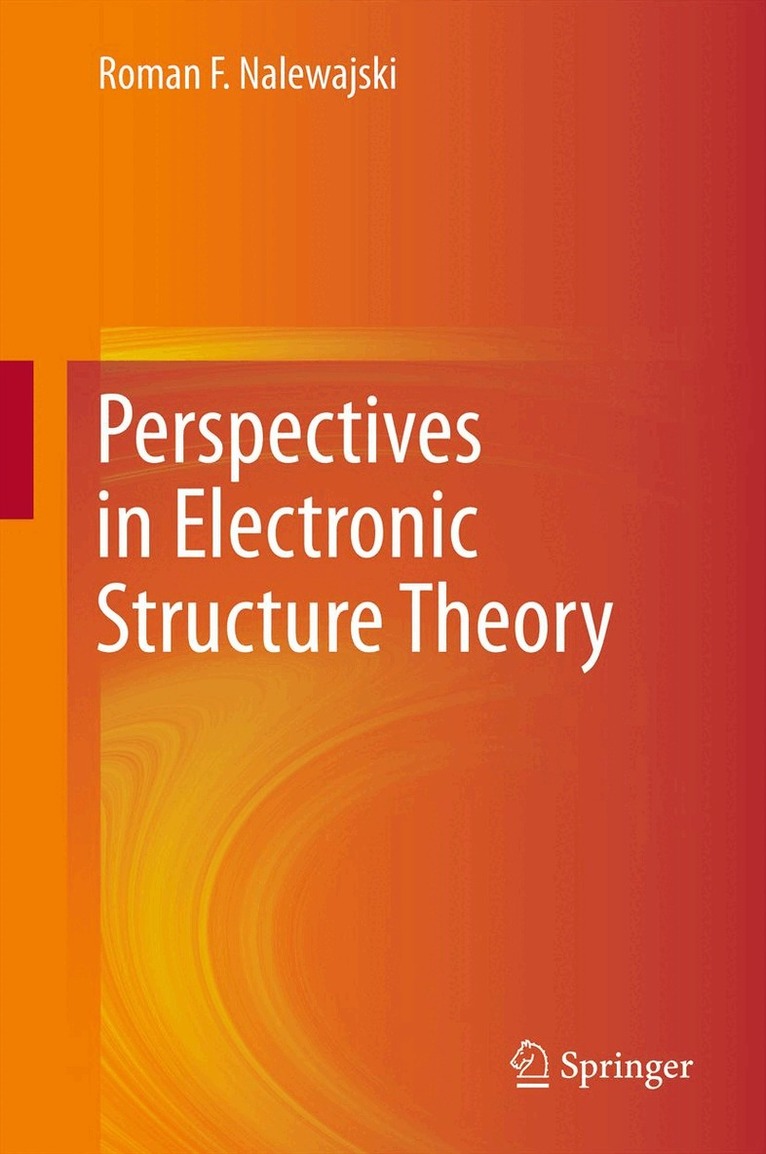
    Perspectives in Electronic Structure Theory

    AvRoman F. Nalewajski

    Häftad, Engelska, 2014

    1 634 kr

    Beställningsvara. Skickas inom 10-15 vardagar. Fri frakt över 249 kr.

    Fler format och utgåvor

    Inbunden

    1 634 kr

    E-bok

    2 049 kr

    Beskrivning

    The understanding in science implies insights from several different points of view. Alternative modern outlooks on electronic structure of atoms and molecules, all rooted in quantum mechanics, are presented in a single text. Together these complementary perspectives provide a deeper understanding of the localization of electrons and bonds, the origins of chemical interaction and reactivity behavior, the interaction between the geometric and electronic structure of molecules, etc. In the opening two parts the basic principles and techniques of the contemporary computational and conceptual quantum chemistry are presented, within both the wave-function and electron-density theories. This background material is followed by a discussion of chemical concepts, including stages of the bond-formation processes, chemical valence and bond-multiplicity indices, the hardness/softness descriptors of molecules and reactants, and general chemical reactivity/stability principles. The insights from Information Theory, the basic elements of which are briefly introduced, including the entropic origins and Orbital Communication Theory of the chemical bond, are the subject of Part IV. The importance of the non-additive (interference) information tools in exploring patterns of chemical bonds and their covalent and ionic components will be emphasized.

    Produktinformation

    • Utgivningsdatum:2014-04-13
    • Mått:155 x 235 x 40 mm
    • Vikt:1 101 g
    • Format:Häftad
    • Språk:Engelska
    • Antal sidor:720
    • Förlag:Springer-Verlag Berlin and Heidelberg GmbH & Co. KG
    • ISBN:9783642433115

    Utforska kategorier

    • Fysikalisk kemi inom Naturvetenskap och teknik

    Innehållsförteckning

    • Sources.- Mathematical apparatus.- Basic concepts and axioms.- Hydrogen-like atom.- Approximating N-electron Schrödinger equation.- Wave function methods.- Density-Functional Theory.- Bonded subsystems and chemical bonds.- Concepts for chemical reactivity.- Adiabatic coupling between electronic and geometric structures.- Elements of information theory.- Schrödinger equation as information principle.- Electron probabilities as carriers of information in molecules.- Bonded atoms from information theory.- Molecular communication systems.- Orbital communication theory of the chemical bond.- "Thermodynamic" description.