• Fri frakt över 249 kr
  • •
  • Snabba leveranser
  • •
  • Billiga böcker
Kundservice

Du är på sajten för privatpersoner.

Företag, bibliotek eller offentlig verksamhet?

Du handlar på classic.bokus.com, där alla dina funktioner finns intakta.
Till classic.bokus.com
Bokus logotyp. Gå till startsidan.
  • Erbjudanden
  • Nyheter
  • Student
  • Topplistor
  • Barn & ungdom
  • Bokus Play
  • E-böcker
  • Pocketböcker
  • Spel & pussel

10% rabatt på allt med kod: NYSTART10 →

Sidfot

Mina sidor

    Hjälp

    • Kundservice
    • Vanliga frågor och svar
    • Frakt och leverans
    • Retur vid ångerrätt
    • Reklamera vara
    • Betalning
    • Köpvillkor
    • Allmänna villkor
    • Information om webbplatsens tillgänglighet

    Om Bokus

    • Om oss
    • Pressrum
    • För studenter
    • För företag
    • För bibliotek och offentlig verksamhet
    • För leverantörer
    • Hållbarhet

    Populärt

    • Aktuella erbjudanden
    • Presentkort
    • Studentlitteratur
    • Nya böcker
    • Topplistor
    • Signerade böcker
    • Engelska böcker

    Inspiration

    • Boktips
    • BookTok
    • Populära bokserier
    • Barnbokskaraktärer
    • Populära författare
    Logotyp för Bokus
    Följ oss på Facebook (extern länk)Följ oss på Instagram (extern länk)Följ oss på YouTube (extern länk)Följ oss på TikTok (extern länk)
    bokus @ CookiesAnpassa cookiesIntegritetspolicyKöpvillkor
    Till Citymail hemsida (extern länk)Till Budbee hemsida (extern länk)Till Postnord hemsida (extern länk)Till Schenker hemsida (extern länk)Till Early Bird hemsida (extern länk)Till Walleys hemsida (extern länk)
    1. Data och IT
    2. Systemvetenskap och AI

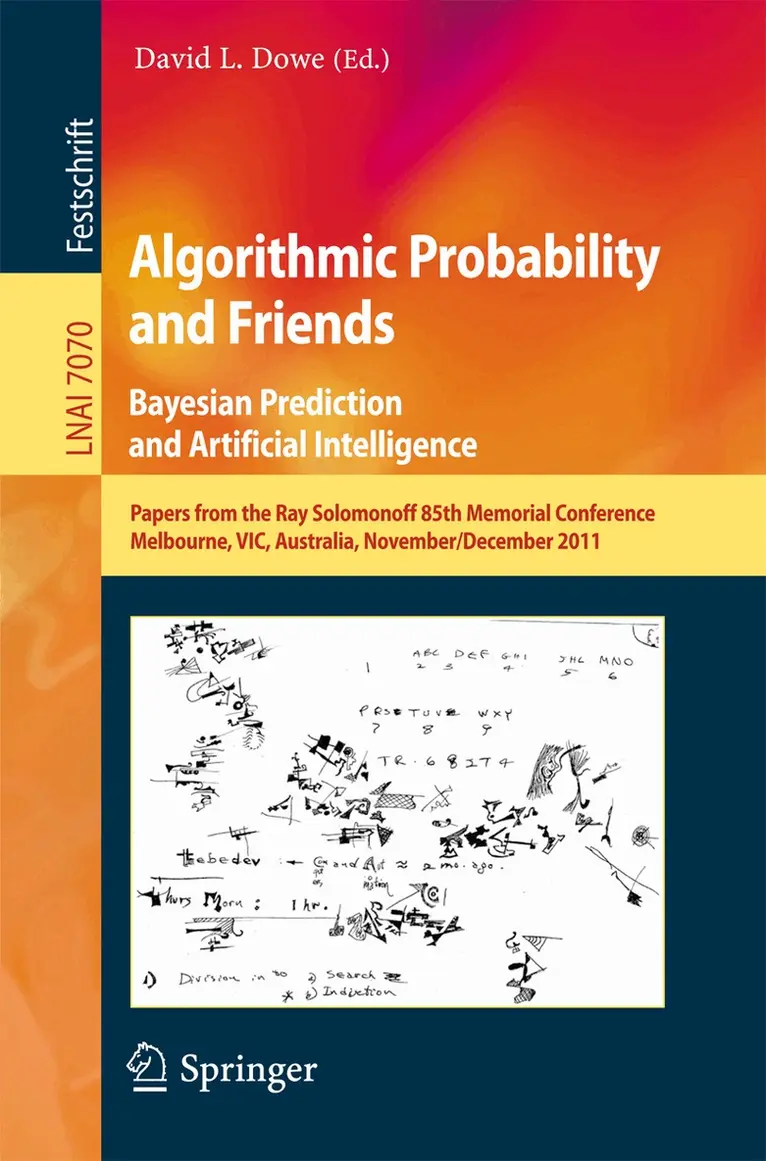
    Algorithmic Probability and Friends. Bayesian Prediction and Artificial Intelligence

    Papers from the Ray Solomonoff 85th Memorial Conference, Melbourne, VIC, Australia, November 30 -- December 2, 2011

    AvDavid L. Dowe

    Häftad, Engelska, 2013

    Del i serien Lecture Notes in Computer Science

    563 kr

    Beställningsvara. Skickas inom 10-15 vardagar. Fri frakt över 249 kr.

    Beskrivning

    Algorithmic probability and friends: Proceedings of the Ray Solomonoff 85th memorial conference is a collection of original work and surveys. The Solomonoff 85th memorial conference was held at Monash University's Clayton campus in Melbourne, Australia as a tribute to pioneer, Ray Solomonoff (1926-2009), honouring his various pioneering works - most particularly, his revolutionary insight in the early 1960s that the universality of Universal Turing Machines (UTMs) could be used for universal Bayesian prediction and artificial intelligence (machine learning). This work continues to increasingly influence and under-pin statistics, econometrics, machine learning, data mining, inductive inference, search algorithms, data compression, theories of (general) intelligence and philosophy of science - and applications of these areas. Ray not only envisioned this as the path to genuine artificial intelligence, but also, still in the 1960s, anticipated stages of progress in machine intelligence which would ultimately lead to machines surpassing human intelligence. Ray warned of the need to anticipate and discuss the potential consequences - and dangers - sooner rather than later. Possibly foremostly, Ray Solomonoff was a fine, happy, frugal and adventurous human being of gentle resolve who managed to fund himself while electing to conduct so much of his paradigm-changing research outside of the university system. The volume contains 35 papers pertaining to the abovementioned topics in tribute to Ray Solomonoff and his legacy.

    Produktinformation

    • Utgivningsdatum:2013-11-11
    • Mått:155 x 235 x 25 mm
    • Vikt:698 g
    • Format:Häftad
    • Språk:Engelska
    • Serie:Lecture Notes in Computer Science
    • Antal sidor:445
    • Förlag:Springer-Verlag Berlin and Heidelberg GmbH & Co. KG
    • ISBN:9783642449574

    Utforska kategorier

    • Systemvetenskap och AI inom Data och IT

    Innehållsförteckning

    • Introduction to Ray Solomonoff 85th Memorial Conference.- Ray Solomonoff and the New Probability.- Universal Heuristics: How Do Humans Solve “Unsolvable” Problems?.- Partial Match Distance.- Falsification and Future Performance.- The Semimeasure Property of Algorithmic Probability – “Feature” or “Bug”?.- Inductive Inference and Partition Exchangeability in Classification.- Learning in the Limit: A Mutational and Adaptive Approach.- Algorithmic Simplicity and Relevance.- Categorisation as Topographic Mapping between Uncorrelated Spaces.- Algorithmic Information Theory and Computational Complexity.- A Critical Survey of Some Competing Accounts of Concrete Digital Computation.- Further Reflections on the Timescale of AI.- Towards Discovering the Intrinsic Cardinality and Dimensionality of Time Series Using MDL.- Complexity Measures for Meta-learning and Their Optimality.- Design of a Conscious Machine.- No Free Lunch versus Occam’s Razor in Supervised Learning.- An Approximation of the Universal Intelligence Measure.- Minimum Message Length Analysis of the Behrens–Fisher Problem.- MMLD Inference of Multilayer Perceptrons.- An Optimal Superfarthingale and Its Convergence over a Computable Topological Space.- Diverse Consequences of Algorithmic Probability.- An Adaptive Compression Algorithm in a Deterministic World.- Toward an Algorithmic Metaphysics.- Limiting Context by Using the Web to Minimize Conceptual Jump Size.- Minimum Message Length Order Selection and Parameter Estimation of Moving Average Models.- Abstraction Super-Structuring Normal Forms: Towards a Theory of Structural Induction.- Locating a Discontinuity in a Piecewise-Smooth Periodic Function Using Bayes Estimation.- On the Application of Algorithmic Probability to Autoregressive Models.- Principles of Solomonoff Induction and AIXI.- MDL/Bayesian Criteria Based on Universal Coding/Measure.- Algorithmic Analogies to Kamae-Weiss Theorem on Normal Numbers.- (Non-)Equivalence ofUniversal Priors.- A Syntactic Approach to Prediction.- Developing Machine Intelligence within P2P Networks Using a Distributed Associative Memory.