• Fri frakt över 249 kr
  • •
  • Snabba leveranser
  • •
  • Billiga böcker
Kundservice

Du är på sajten för privatpersoner.

Företag, bibliotek eller offentlig verksamhet?

Du handlar på classic.bokus.com, där alla dina funktioner finns intakta.
Till classic.bokus.com
Bokus logotyp. Gå till startsidan.
  • Erbjudanden
  • Student
  • Topplistor
  • Barn & ungdom
  • Bokus Play
  • E-böcker
  • Ljudböcker
  • Pocketböcker
  • Spel och pussel

Pocketfynda! Hundratals böcker för 49 kr/st →

Sidfot

Mina sidor

    Hjälp

    • Kundservice
    • Vanliga frågor och svar
    • Frakt och leverans
    • Retur vid ångerrätt
    • Reklamera vara
    • Betalning
    • Köpvillkor
    • Allmänna villkor
    • Information om webbplatsens tillgänglighet

    Om Bokus

    • Om oss
    • Pressrum
    • För studenter
    • För företag
    • För bibliotek och offentlig verksamhet
    • För leverantörer
    • Hållbarhet

    Populärt

    • Aktuella erbjudanden
    • Presentkort
    • Studentlitteratur
    • Nya böcker
    • Topplistor
    • Signerade böcker
    • Engelska böcker

    Inspiration

    • Boktips
    • BookTok
    • Barnbokskaraktärer
    • Populära författare
    Logotyp för Bokus
    Följ oss på Facebook (extern länk)Följ oss på Instagram (extern länk)Följ oss på YouTube (extern länk)Följ oss på TikTok (extern länk)
    bokus @ CookiesAnpassa cookiesIntegritetspolicyKöpvillkor
    Till Citymail hemsida (extern länk)Till Budbee hemsida (extern länk)Till Postnord hemsida (extern länk)Till Schenker hemsida (extern länk)Till Early Bird hemsida (extern länk)Till Walleys hemsida (extern länk)
    1. Psykologi och pedagogik
    2. Psykologi

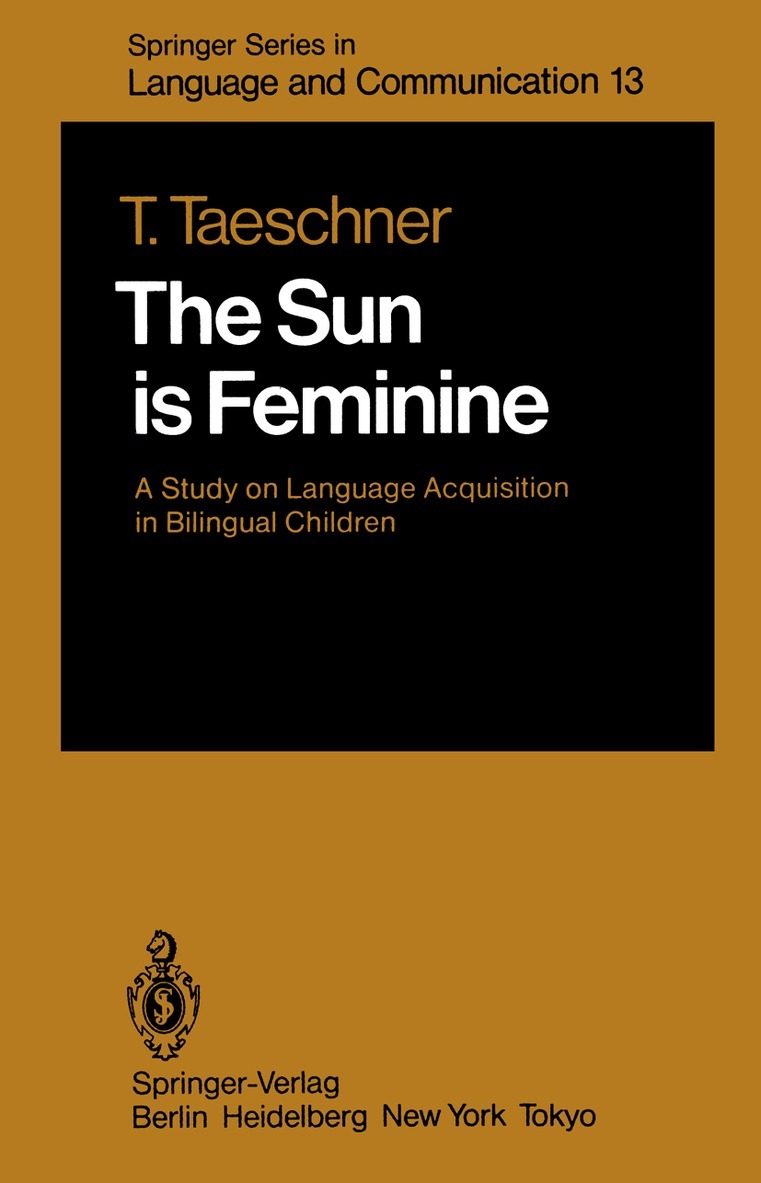
    Sun is Feminine

    A Study on Language Acquisition in Bilingual Children

    AvTraute Taeschner

    Häftad, Engelska, 2012

    Del 13 i serien Springer Series in Language and Communication

    527 kr

    Beställningsvara. Skickas inom 10-15 vardagar. Fri frakt över 249 kr.

    Fler format och utgåvor

    E-bok

    690 kr

    Beskrivning

    Lisa is 4 years and 5 months old and Giulia 3 years and 4 months. One morning, the girls' father is taking them to nursery school. L: ... e bravissima, ha riscaldato l'auto. E' bravissima, vera? In praising the sun for having warmed up the car, Lisa has referred to it in the feminine gender, as in the German die Sonne. Her father corrects her by using the masculine gender. F: E' bravissimo. E' if sale. L: E' un maschietto, if sale? (Is the sun a little boy?) F: E'maschife. (It's masculine.) G [determined]: E' una femmina! (No, it's a girl!) F: Forse in tedesco. (Perhaps it is in German.) is left disoriented, speechless. Giulia This book is devoted to language acquisition in children who have been expos­ ed to two languages since birth. It has often been said that the study of simultaneous bilingualism is the "most fertile ground" for the formulation of general theories on language acquisition processes, and indeed, most of the studies on early bilingualism aim in this direction. But in a sense this book serves the reverse purpose. Using the results of psycholinguistic research as a basis, I have sought to understand the peculiarities of the process of language organization in the child who faces the problem of learning two languages when other children are learning only one. Thus, the recurring theme of my study is the diversity of bilingual as opposed to monolingual acquisition.

    Produktinformation

    • Utgivningsdatum:2012-03-27
    • Mått:155 x 235 x 15 mm
    • Vikt:406 g
    • Format:Häftad
    • Språk:Engelska
    • Serie:Springer Series in Language and Communication
    • Antal sidor:248
    • Förlag:Springer-Verlag Berlin and Heidelberg GmbH & Co. KG
    • ISBN:9783642483318

    Utforska kategorier

    • Psykologi inom Psykologi och pedagogik

    Innehållsförteckning

    • 1. An Overview of Research on Bilingualism.- 1.1 The Definition of Bilingualism.- 1.2 Previous Research.- 1.3 Description of the Present Research.- 2. Word Acquisition.- 2.1 The First Stage: The Bilingual Child Has No Equivalents.- 2.2 The Second Stage: The Child Begins to Build a System of Equivalents.- 2.3 Does the Bilingual Child Have Twice as Many Words as the Monolingual Child?.- 2.4 Summary.- 3. Development of Basic Sentence Structure.- 3.1 Sentence Structure Analysis.- 3.2 Results.- 3.3 Summary.- 4. Several Aspects in the Acquisition of Morphology and Syntax.- 4.1 Verb Tenses and Conjugations.- 4.2 Past Perfect.- 4.3 Intralanguage Hypercorrection.- 4.4 “Mistakes” of Agreement.- 4.5 Diminutive and Augmentative.- 4.6 Articles.- 4.7 Participle and Infinitive.- 4.8 Pronouns and Gerunds.- 4.9 Understanding Subtle Differences.- 4.10 Superextension of Forms into Both Languages.- 4.11 Negation, the Adjective, the Possessive, and Subject-Verb Inversion.- 4.12 Word Order.- 4.13 Summary.- 5. Interferences.- 5.1 Definitions.- 5.2 Lexical Interferences.- 5.3 Morphological Interferences.- 5.4 Interferences in Word Order.- 5.5 Semantic Interferences.- 5.6 Phonological Interferences.- 5.7 Summary.- 6. A Bilingual Upbringing.- 6.1 The First Stage: The Role of the “Sole” Interlocutor.- 6.2 The Second Stage: The Child Begins to Speak the Language of the Majority.- 6.3 The Third Stage: The Maintenance of Bilingualism.- 6.4 Summary.- 7. Conclusions.- References.