• Fri frakt över 249 kr
  • •
  • Snabba leveranser
  • •
  • Billiga böcker
Kundservice

Du är på sajten för privatpersoner.

Företag, bibliotek eller offentlig verksamhet?

Du handlar på classic.bokus.com, där alla dina funktioner finns intakta.
Till classic.bokus.com
Bokus logotyp. Gå till startsidan.
  • Erbjudanden
  • Nyheter
  • Student
  • Topplistor
  • Barn & ungdom
  • Bokus Play
  • E-böcker
  • Pocketböcker
  • Spel & pussel

10% rabatt på allt med kod NYSTART10 →

Sidfot

Mina sidor

    Hjälp

    • Kundservice
    • Vanliga frågor och svar
    • Frakt och leverans
    • Retur vid ångerrätt
    • Reklamera vara
    • Betalning
    • Köpvillkor
    • Allmänna villkor
    • Information om webbplatsens tillgänglighet

    Om Bokus

    • Om oss
    • Pressrum
    • För studenter
    • För företag
    • För bibliotek och offentlig verksamhet
    • För leverantörer
    • Hållbarhet

    Populärt

    • Aktuella erbjudanden
    • Presentkort
    • Studentlitteratur
    • Nya böcker
    • Topplistor
    • Signerade böcker
    • Engelska böcker

    Inspiration

    • Boktips
    • BookTok
    • Populära bokserier
    • Barnbokskaraktärer
    • Populära författare
    Logotyp för Bokus
    Följ oss på Facebook (extern länk)Följ oss på Instagram (extern länk)Följ oss på YouTube (extern länk)Följ oss på TikTok (extern länk)
    bokus @ CookiesAnpassa cookiesIntegritetspolicyKöpvillkor
    Till Citymail hemsida (extern länk)Till Budbee hemsida (extern länk)Till Postnord hemsida (extern länk)Till Schenker hemsida (extern länk)Till Early Bird hemsida (extern länk)Till Walleys hemsida (extern länk)
    1. Naturvetenskap och teknik
    2. Teknik och industri
    3. Elektronik och kommunikationer

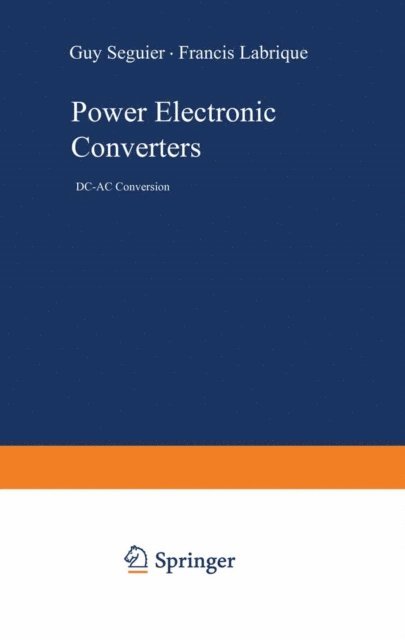
    Power Electronic Converters

    DC-AC Conversion

    AvGuy Seguier,Francis Labrique

    Häftad, Engelska, 2012

    Del i serien Electric Energy Systems and Engineering Series

    1 086 kr

    Beställningsvara. Skickas inom 10-15 vardagar. Fri frakt över 249 kr.

    Fler format och utgåvor

    E-bok

    1 416 kr

    Beskrivning

    This is the final volume in a four-volume series concerning POWER ELEC­ TRONIC CONVERTERS. The first volume studies AC/DC conversion, the second studies AC/ AC conversion, and the third DC/DC conversion. This final volume deals with DC/AC conversion, i.e. with inverters. At the output of an inverter fed by a DC voltage supply, this voltage is alternatively found with one polarity and then with the other; in other words, an AC voltage made up of square pulses is obtained. Filtering must be carried out if, as is normally the case, a virtually sinusoidal voltage is required: this problem of filtering underlies the entire study of inverters. In some applications, the load itself provides the filtering. In others, a filter is installed between the inverter and the load; however, as it will be shown in Chap. 2, in cases where the filtered voltage is at industrial network frequency and comprises only a single square-wave pulse per half-cycle, the filter becomes bulky and costly, and the results obtained are poor. Filtering problems explain the considerable development of inverters during the last years: - Firstly there is increasing use of pulse width modulation: each half-cycle is cut up into several pulses of suitable widths; this greatly simplifies filtering. The use of a chopping frequency which is much greater than the frequency of the fundamental components of the inverter output voltage and current has only been made possible by progress in the field of semiconductor devices.

    Produktinformation

    • Utgivningsdatum:2012-05-31
    • Mått:210 x 279 x 26 mm
    • Vikt:1 131 g
    • Format:Häftad
    • Språk:Engelska
    • Serie:Electric Energy Systems and Engineering Series
    • Antal sidor:444
    • Upplaga:1993
    • Förlag:Springer-Verlag Berlin and Heidelberg GmbH & Co. KG
    • ISBN:9783642503245

    Utforska kategorier

    • Elektronik och kommunikationer inom Naturvetenskap och teknik

    Innehållsförteckning

    • 1 Introduction and Presentation.- 1.1 Types of Inverters: Principles.- 1.2 Types of Semiconductor Devices. Supply and Load Imperfections. Filters.- 1.3 Principal Applications. Consequences on the Study.- 2 Voltage-Source Inverters with One Square-Pulse per Half-Cycle.- 2.1 Single-Phase Inverter with Centre-Tapped Transformer.- 2.2 Single-Phase Half-Bridge Inverter.- 2.3 Single-Phase Full-Bridge Inverter.- 2.4 Three-Phase Full-Bridge Inverter.- 2.5 Input Filter.- 2.6 Output Filter.- 3 Pulse-Width-Modulated Voltage-Source Inverters.- 3.1 Single-Phase Half-Bridge Inverter.- 3.2 Three-Phase Full-Bridge Inverter.- 3.3 Single-Phase Full-Bridge Inverter.- 3.4 Computed Modulation.- 4 Commutations in Voltage-Source Inverters.- 4.1 Commutation of the Bipolar Transistor in Full-Wave Inverters.- 4.2 Commutations of the Bipolar Transistor in PWM Inverters.- 4.3 GTO Thyristor Commutations.- 4.4 Field Effect Transistor Commutations.- 5 Current-Source Inverters.- 5.1 Single-Phase Inverters.- 5.2 Full-Bridge Three-Phase Inverter.- 5.3 Feeding an Inductive Load.- 5.4 Notes on the Configurations with a Pulse Number Greater than 6.- 5.5 Notes on the Computation of the Current-Source Inverter Input Filter.- 6 Resonant Inverters.- 6.1 Series Resonant Inverter.- 6.2 Parallel Resonant Inverter.- 6.3 Resonant Supplies.- Appendices.- Appendix A: Input Filter in Voltage-Source Inverters.- A.1 Inverters with Two “Switches” per Phase.- A.2 Full-Bridge Single-Phase Inverter.- Appendix B: “Sinusoidal” Voltage-Source Inverters.- B.1 Voltage Waveform.- B.2 Production of Optimized Waveforms.- B.3 Variation in the Output Voltage.- B.4 The most Usual Type of Configuration.- Appendix C: Forced Turn-Off of Thyristors in Voltage-Source Inverters.- C.1 Parallel Commutation by Oscillating Circuit.- C.2Parallel Commutation by Capacitor.- C.3 Series Commutation.- Appendix D: PWM Rectifier.- D.1 The Structure.- D.2 The Converter Alone.- D.3 The Converter and its Input Filter.- D.4 The Converter with its Input and Output Filters.- Appendix E: Use of the Four-Quadrant Chopper as a PWM Rectifier.- E.1 “Switch” Control.- E.2 Current Harmonics Taken from the Supply.