• Fri frakt över 249 kr
  • •
  • Snabba leveranser
  • •
  • Billiga böcker
Kundservice

Du är på sajten för privatpersoner.

Företag, bibliotek eller offentlig verksamhet?

Du handlar på classic.bokus.com, där alla dina funktioner finns intakta.
Till classic.bokus.com
Bokus logotyp. Gå till startsidan.
  • Erbjudanden
  • Nyheter
  • Student
  • Topplistor
  • Barn & ungdom
  • Bokus Play
  • E-böcker
  • Pocketböcker
  • Spel & pussel

10% rabatt på allt med kod NYSTART10 →

Sidfot

Mina sidor

    Hjälp

    • Kundservice
    • Vanliga frågor och svar
    • Frakt och leverans
    • Retur vid ångerrätt
    • Reklamera vara
    • Betalning
    • Köpvillkor
    • Allmänna villkor
    • Information om webbplatsens tillgänglighet

    Om Bokus

    • Om oss
    • Pressrum
    • För studenter
    • För företag
    • För bibliotek och offentlig verksamhet
    • För leverantörer
    • Hållbarhet

    Populärt

    • Aktuella erbjudanden
    • Presentkort
    • Studentlitteratur
    • Nya böcker
    • Topplistor
    • Signerade böcker
    • Engelska böcker

    Inspiration

    • Boktips
    • BookTok
    • Populära bokserier
    • Barnbokskaraktärer
    • Populära författare
    Logotyp för Bokus
    Följ oss på Facebook (extern länk)Följ oss på Instagram (extern länk)Följ oss på YouTube (extern länk)Följ oss på TikTok (extern länk)
    bokus @ CookiesAnpassa cookiesIntegritetspolicyKöpvillkor
    Till Citymail hemsida (extern länk)Till Budbee hemsida (extern länk)Till Postnord hemsida (extern länk)Till Schenker hemsida (extern länk)Till Early Bird hemsida (extern länk)Till Walleys hemsida (extern länk)
    1. Naturvetenskap och teknik
    2. Matematik och naturvetenskap
    3. Fysik

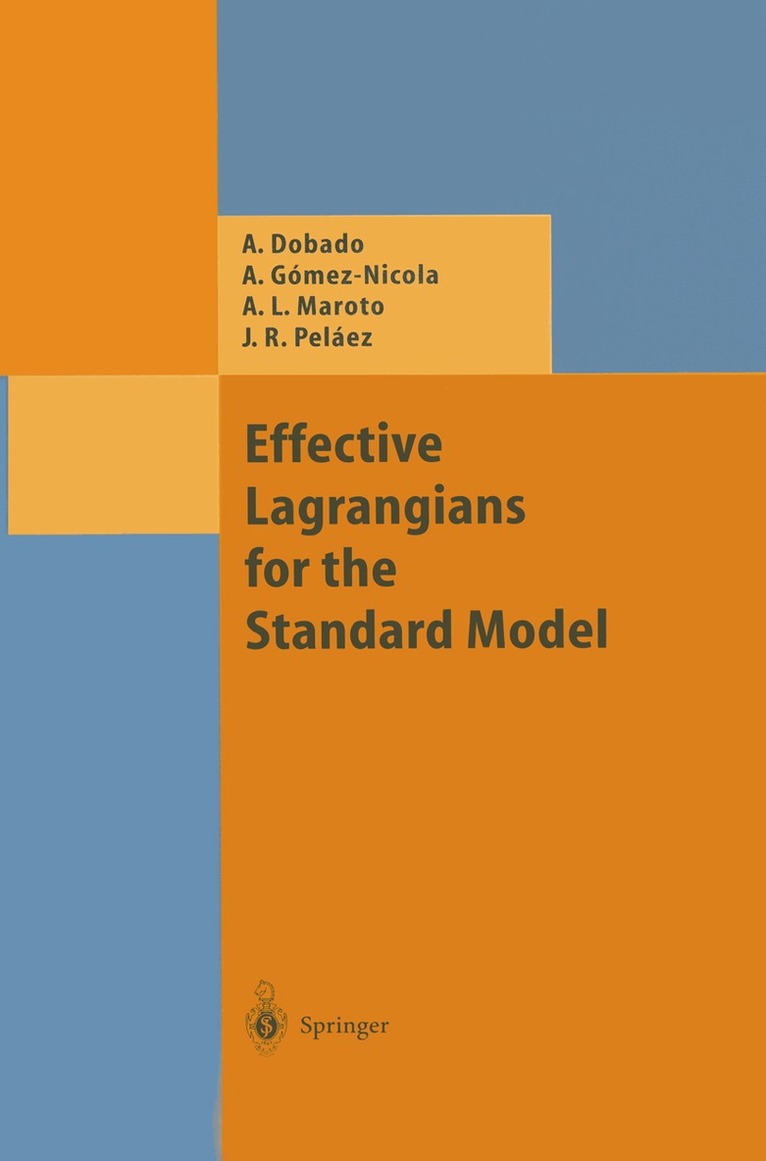
    Effective Lagrangians for the Standard Model

    AvAntonio Dobado,Angel Gomez-Nicola

    Häftad, Engelska, 2013

    Del i serien Theoretical and Mathematical Physics

    761 kr

    Beställningsvara. Skickas inom 10-15 vardagar. Fri frakt över 249 kr.

    Fler format och utgåvor

    Inbunden

    869 kr

    Beskrivning

    This book is devoted to some recently developed techniques in quantum field theory (QFT), as well as to their main applications to different areas of parti­ cle physics. All together they are known as the effective or phenomenological Lagrangian formalism. Motivated by the enormous amount of work carried out in this field during the last years, our purpose when writing this book has been to give a modern and pedagogical exposition of the most relevant as­ pects of the topic. We hope that our efforts will be useful, both for graduated students in the search for a solid theoretical background in modern phe­ nomenology and for more experimented particle physicists willing to learn about this field or to start working on it. Even though we have tried to keep the book as self-contained as possible, it has been written assuming that the reader is familiar, at least, with the most basic concepts and techniques of QFT, gauge theories, the standard model (SM) and differential geometry, at the level of graduate studies. It is therefore possible that senior high-energy physicists may find the book too detailed and so they could probably omit several sections. The book is divided into two main parts and the appendices. In the first part we introduce the fundamentals of the effective Lagrangian formalism and other basic topics such as Ward identities, non-linear sigma models (NLSM), spontaneous symmetry breaking (SSB), anomalies, the SM symmetries, etc.

    Produktinformation

    • Utgivningsdatum:2013-10-03
    • Mått:155 x 235 x 19 mm
    • Vikt:505 g
    • Format:Häftad
    • Språk:Engelska
    • Serie:Theoretical and Mathematical Physics
    • Antal sidor:316
    • Förlag:Springer-Verlag Berlin and Heidelberg GmbH & Co. KG
    • ISBN:9783642638893

    Utforska kategorier

    • Fysik inom Naturvetenskap och teknik
    • Matematisk fysik inom Naturvetenskap och teknik

    Innehållsförteckning

    • 1. The Notion of Effective Lagrangian.- 1.1 Introduction.- 1.2 Integration of the Heavy Modes.- 1.3 The Decoupling Theorem.- 1.4 The Euler-Heisenberg Lagrangian.- 1.5 Theories with Spontaneous Symmetry Breaking.- 1.6 Decoupling of Chiral Fermions.- 1.7 References.- 2. Global Symmetries in Quantum Field Theory.- 2.1 Classical Symmetries.- 2.2 Green Functions and the Reduction Formula.- 2.3 Quantum Symmetries and Ward Identities.- 2.4 Spontaneous Symmetry Breaking and the Goldstone Theorem.- 2.5 Explicit Symmetry Breaking and the Dashen Conditions.- 2.6 References.- 3. The Non-linear ? Model.- 3.1 Introduction.- 3.2 The Geometry and the Dynamics of the Non-linear ? Model.- 3.3 The Quantum Non-linear ? Model.- 3.4 Reparametrization Invariance of the S-Matrix Elements.- 3.5 Local Symmetries and the Higgs Mechanism.- 3.6 Topologically Non-trivial Configurations.- 3.7 References.- 4. Anomalies.- 4.1 Introduction.- 4.2 The Axial Anomaly, Triangle Diagrams and the ?0 Decay.- 4.3 The Axial Anomaly and the Index Theorem.- 4.4 Gauge Anomalies.- 4.5 Regularization Methods.- 4.6 Ambiguities and Counterterms.- 4.7 Topological Interpretation of Non-Abelian Anomalies.- 4.8 Non-perturbative Anomalies.- 4.9 Non-linear ? Model Anomalies.- 4.10 The Wess-Zumino-Witten Term.- 4.11 The Trace Anomaly.- 4.12 References.- 5. The Symmetries of the Standard Model.- 5.1 The Elements of the Standard Model.- 5.2 The Cabibbo-Kobayashi-Maskawa Matrix and Weak CP Violation.- 5.3 The Cancellation of Gauge Anomalies in the Standard Model.- 5.4 Baryon and Lepton Number Anomalies in the Standard Model.- 5.5 The Evolution of the Coupling Constants.- 5.6 The Strong CP Problem.- 5.7 The Symmetries of the Standard Model.- 5.8 References.- 6. The Effective Lagrangian for QCD.- 6.1 The QCD Lagrangian.- 6.2QCD at Low Energies.- 6.3 The Chiral Lagrangian at Leading Order.- 6.4 The Chiral Lagrangian to Next to Leading Order.- 6.5 The Low-Energy Constants.- 6.6 The Problem of Unitarity in ChPT.- 6.7 References.- 7. The Standard Model Symmetry Breaking Sector.- 7.1 The Mass Problem.- 7.2 The Effective Lagrangian for the SM Symmetry Breaking Sector.- 7.3 The O(p4) Lagrangian and One-Loop Renormalization.- 7.4 The Heavy Higgs and QCD-Like Models.- 7.5 Phenomenological Determination of the Chiral Parameters.- 7.6 The Equivalence Theorem.- 7.7 The Applicability of the Equivalence Theorem.- 7.8 Gauge Boson Scattering at High Energies.- 7.9 References.- 8. Gravity and the Standard Model.- 8.1 Introduction.- 8.2 The Standard Model in Curved Space-Time.- 8.3 Anomalies in the Standard Model.- 8.4 The Effect of Matter Fields on Gravitation.- 8.5 The Effective Action for Gravity.- 8.6 References.- A. Useful Formulae and Notation.- B. Notes on Differential Geometry.- C. Aspects of Quantum Field Theory.- D. Unitarity and Partial Waves.