• Fri frakt över 249 kr
  • •
  • Snabba leveranser
  • •
  • Billiga böcker
Kundservice

Du är på sajten för privatpersoner.

Företag, bibliotek eller offentlig verksamhet?

Du handlar på classic.bokus.com, där alla dina funktioner finns intakta.
Till classic.bokus.com
Bokus logotyp. Gå till startsidan.
  • Erbjudanden
  • Nyheter
  • Student
  • Topplistor
  • Barn & ungdom
  • Bokus Play
  • E-böcker
  • Pocketböcker
  • Spel & pussel

10% rabatt på allt med kod: NYSTART10 →

Sidfot

Mina sidor

    Hjälp

    • Kundservice
    • Vanliga frågor och svar
    • Frakt och leverans
    • Retur vid ångerrätt
    • Reklamera vara
    • Betalning
    • Köpvillkor
    • Allmänna villkor
    • Information om webbplatsens tillgänglighet

    Om Bokus

    • Om oss
    • Pressrum
    • För studenter
    • För företag
    • För bibliotek och offentlig verksamhet
    • För leverantörer
    • Hållbarhet

    Populärt

    • Aktuella erbjudanden
    • Presentkort
    • Studentlitteratur
    • Nya böcker
    • Topplistor
    • Signerade böcker
    • Engelska böcker

    Inspiration

    • Boktips
    • BookTok
    • Populära bokserier
    • Barnbokskaraktärer
    • Populära författare
    Logotyp för Bokus
    Följ oss på Facebook (extern länk)Följ oss på Instagram (extern länk)Följ oss på YouTube (extern länk)Följ oss på TikTok (extern länk)
    bokus @ CookiesAnpassa cookiesIntegritetspolicyKöpvillkor
    Till Citymail hemsida (extern länk)Till Budbee hemsida (extern länk)Till Postnord hemsida (extern länk)Till Schenker hemsida (extern länk)Till Early Bird hemsida (extern länk)Till Walleys hemsida (extern länk)
    1. Ekonomi och Ledarskap
    2. Nationalekonomi
    3. Makroekonomi

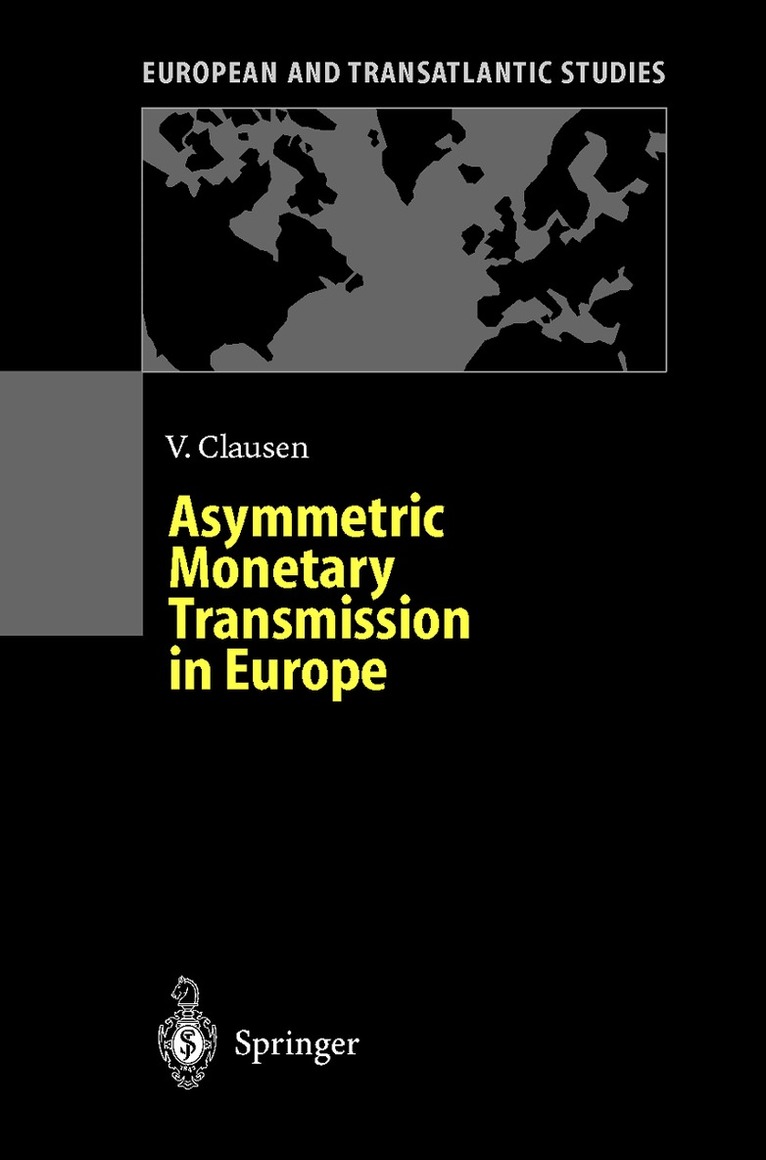
    Asymmetric Monetary Transmission in Europe

    AvVolker Clausen

    Häftad, Engelska, 2011

    Del i serien European and Transatlantic Studies

    1 119 kr

    Beställningsvara. Skickas inom 10-15 vardagar. Fri frakt över 249 kr.

    Fler format och utgåvor

    E-bok

    1 455 kr

    Beskrivning

    The euro and the ESCB have started in January 1999 and there is naturally a wide-ranging interest in academia and among policymakers in OECD coun­ tries, how successful European Monetary Union will and can be. EMU has started with 11 countries and experienced a rapid depreciation of the cur­ rency. With so many EU countries joining for a historical monetary union in a period of economic globalization, international financial market changes and ongoing EU enlargement the problem of monetary policy efficiency becomes crucial; especially as so many countries in the EU still have high unemploy­ ment rates and the euro has just started at the beginning of a cyclical upswing in the euro zone. Monetary policy is also quite crucial, because the Maastricht convergence criteria severely restrict the scope of national fiscal policy. With a very limited stock of valuable European monetary experience which could be usefully exploited by the ECB and the ESCB respectively, one naturally will appreciate advanced economic modeling of the main issues. This book takes an analytical look at the problem of asymmetric monetary transmission in Euroland. Facing the ECB's monetary policy, individual mem­ ber countries are likely to experience different policy effects. Countries differ in their financial structure -a well-known argument in the literature -but also in the characteristics of goods and labor markets. The latter fields have been somewhat neglected in the literature but receive broad analytical attention here.

    Produktinformation

    • Utgivningsdatum:2011-09-18
    • Mått:155 x 235 x 13 mm
    • Vikt:341 g
    • Format:Häftad
    • Språk:Engelska
    • Serie:European and Transatlantic Studies
    • Antal sidor:207
    • Förlag:Springer-Verlag Berlin and Heidelberg GmbH & Co. KG
    • ISBN:9783642640292

    Utforska kategorier

    • Makroekonomi inom Ekonomi och Ledarskap

    Innehållsförteckning

    • 1 Introduction.- 2 Sources of Asymmetric Monetary Transmission in Europe.- 2.1 Classification of Asymmetries.- 2.2 Asymmetries in the Structure of Output.- 2.3 Asymmetries in Financial Structure.- 2.4 Asymmetries in Openness.- 2.5 Asymmetries in Wage-Price Mechanisms.- 2.6 Implications of Partial Asymmetries.- 3 Financial Structure and Asymmetric Monetary Transmission: Implications of a Differential Role of Asset Markets.- 3.1 Introduction.- 3.2 The Model.- 3.3 Effects of Monetary Policy.- 3.4 Implications for the ECB.- 3.5 Appendix: Analytical Solution.- 4 Financial Structure and Asymmetric Monetary Transmission: Implications of a Differential Interest Elasticity of Aggregate Demand.- 4.1 Introduction.- 4.2 The Model.- 4.3 Effects of Monetary Policy.- 4.4 Implications for the ECB.- 4.5 Appendix: Analytical Solution.- 5 Financial Structure, Asymmetric National Money Demand Functions and the Stability of European Money Demand.- 5.1 Introduction.- 5.2 Alternative Concepts of Money Demand Stability.- 5.3 Empirical Evidence.- 5.4 Implications for the ECB.- 5.5 Appendix.- 6 Asymmetric Degrees of Openness and Monetary Transmission in Europe.- 6.1 Introduction.- 6.2 The Model.- 6.3 Effects of Monetary Policy.- 6.4 Effects of Disturbances in the Rest of the World.- 6.5 Implications for the ECB.- 7 Asymmetric Wage-Price Mechanisms and Monetary Transmission in Europe.- 7.1 Introduction.- 7.2 The Model.- 7.3 Effects of Monetary Policy.- 7.4 Implications for the ECB.- 8 Empirical Evidence on Asymmetric Monetary Transmission in Europe.- 8.1 Large National Central Bank Models.- 8.2 Structural Multi-Country Models.- 8.3 Small Vector Autoregressive Models.- 8.4 Small Structural Models.- 8.5 Implications for the ECB.- 9 Monetary Policy in an Era of Structural Change.- 9.1 Structural Changes in Financial Markets.- 9.2 Structural Changes in Goods Markets.- 9.3 Structural Changes in Labor Markets.- 9.4 Implications for the ECB.- List of Figures.- List of Tables.