• Fri frakt över 249 kr
  • •
  • Snabba leveranser
  • •
  • Billiga böcker
Kundservice

Du är på sajten för privatpersoner.

Företag, bibliotek eller offentlig verksamhet?

Du handlar på classic.bokus.com, där alla dina funktioner finns intakta.
Till classic.bokus.com
Bokus logotyp. Gå till startsidan.
  • Erbjudanden
  • Nyheter
  • Student
  • Topplistor
  • Barn & ungdom
  • Bokus Play
  • E-böcker
  • Pocketböcker
  • Spel & pussel

10% rabatt på allt med kod: NYSTART10 →

Sidfot

Mina sidor

    Hjälp

    • Kundservice
    • Vanliga frågor och svar
    • Frakt och leverans
    • Retur vid ångerrätt
    • Reklamera vara
    • Betalning
    • Köpvillkor
    • Allmänna villkor
    • Information om webbplatsens tillgänglighet

    Om Bokus

    • Om oss
    • Pressrum
    • För studenter
    • För företag
    • För bibliotek och offentlig verksamhet
    • För leverantörer
    • Hållbarhet

    Populärt

    • Aktuella erbjudanden
    • Presentkort
    • Studentlitteratur
    • Nya böcker
    • Topplistor
    • Signerade böcker
    • Engelska böcker

    Inspiration

    • Boktips
    • BookTok
    • Populära bokserier
    • Barnbokskaraktärer
    • Populära författare
    Logotyp för Bokus
    Följ oss på Facebook (extern länk)Följ oss på Instagram (extern länk)Följ oss på YouTube (extern länk)Följ oss på TikTok (extern länk)
    bokus @ CookiesAnpassa cookiesIntegritetspolicyKöpvillkor
    Till Citymail hemsida (extern länk)Till Budbee hemsida (extern länk)Till Postnord hemsida (extern länk)Till Schenker hemsida (extern länk)Till Early Bird hemsida (extern länk)Till Walleys hemsida (extern länk)
    1. Naturvetenskap och teknik
    2. Matematik och naturvetenskap
    3. Fysik
    4. Tillämpad fysik

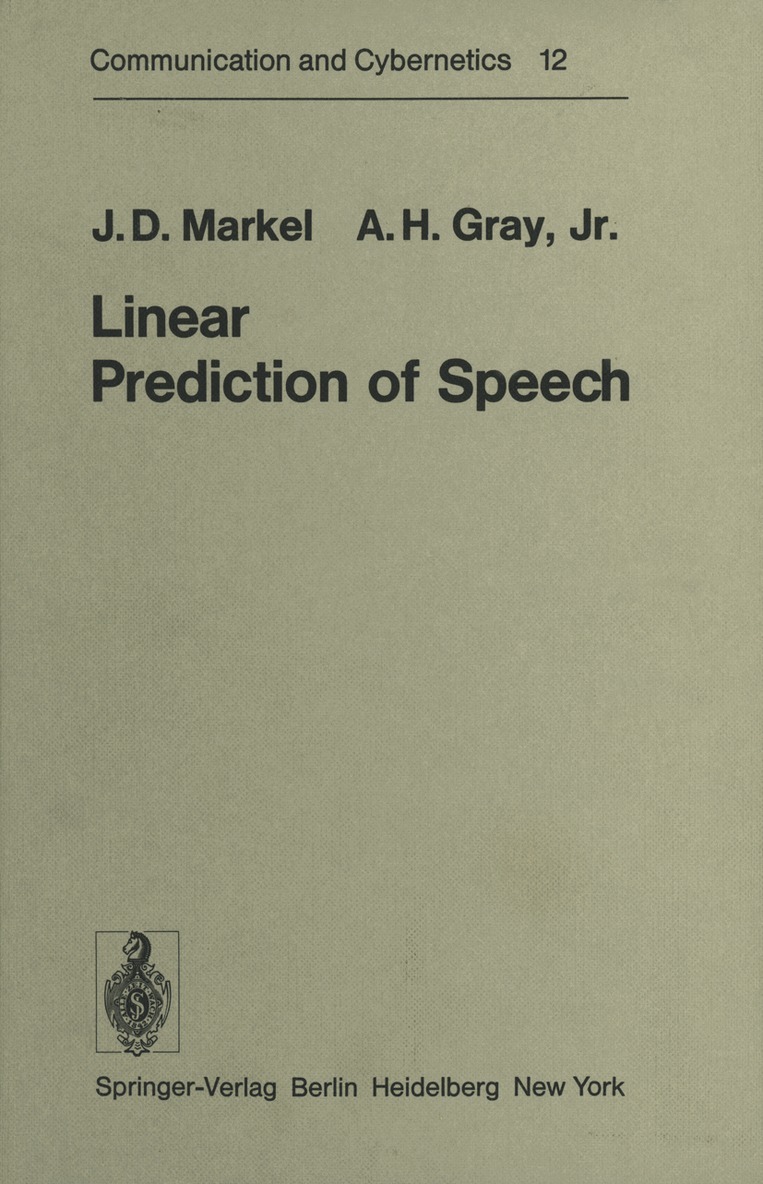
    Linear Prediction of Speech

    AvJ.D. Markel,A.H. Jr. Gray

    Häftad, Engelska, 2011

    Del 12 i serien Communication and Cybernetics

    1 086 kr

    Beställningsvara. Skickas inom 10-15 vardagar. Fri frakt över 249 kr.

    Beskrivning

    During the past ten years a new area in speech processing, generally referred to as linear prediction, has evolved. As with all scientific research, results did not always get published in a logical order and terminology was not always con­ sistent. In mid-1974, we decided to begin an extra hours and weekends project of organizing the literature in linear prediction of speech and developing it into a unified presentation in terms of content and terminology. This effort was completed in November, 1975, with the contents presented herein. If there are two words which describe our goals in this book, they are unifica­ tion and depth. Considerable effort has been spent on showing the interrelation­ ships among various linear prediction formulations and solutions, and in develop­ ing extensions such as acoustic tube models and synthesis filter structures in a unified manner with consistent terminology. Topics are presented in such a manner that derivations and theoretical details are covered, along with Fortran sub­ routines and practical considerations. Using this approach we hope to have made the material useful for a wide range of backgrounds and interests.

    Produktinformation

    • Utgivningsdatum:2011-11-15
    • Mått:170 x 244 x 17 mm
    • Vikt:528 g
    • Format:Häftad
    • Språk:Engelska
    • Serie:Communication and Cybernetics
    • Antal sidor:290
    • Förlag:Springer-Verlag Berlin and Heidelberg GmbH & Co. KG
    • ISBN:9783642662881

    Utforska kategorier

    • Tillämpad fysik inom Naturvetenskap och teknik

    Innehållsförteckning

    • 1. Introduction.- 1.1 Basic Physical Principles.- 1.2 Acoustical Waveform Examples.- 1.3 Speech Analysis and Synthesis Models.- 1.4 The Linear Prediction Model.- 1.5 Organization of Book.- 2. Formulations.- 2.1 Historical Perspective.- 2.2 Maximum Likelihood.- 2.3 Minimum Variance.- 2.4 Prony’s Method.- 2.5 Correlation Matching.- 2.6 PARCOR (Partial Correlation).- 3. Solutions and Properties.- 3.1 Introduction.- 3.2 Vector Spaces and Inner Products.- 3.3 Solution Algorithms.- 3.4 Matrix Forms.- 4. Acoustic Tube Modeling.- 4.1 Introduction.- 4.2 Acoustic Tube Derivation.- 4.3 Relationship between Acoustic Tube and Linear Prediction.- 4.4 An Algorithm, Examples, and Evaluation.- 4.5 Estimation of Lip Impedance.- 4.6 Further Topics.- 5. Speech Synthesis Structures.- 5.1 Introduction.- 5.2 Stability.- 5.3 Recursive Parameter Evaluation.- 5.4 A General Synthesis Structure.- 5.5 Specific Speech Synthesis Structures.- 6. Spectral Analysis.- 6.1 Introduction.- 6.2 Spectral Properties.- 6.3 A Spectral Flatness Model.- 6.4 Selective Linear Prediction.- 6.5 Considerations in Choice of Analysis Conditions.- 6.6 Spectral Evaluation Techniques.- 6.7 Pole Enhancement.- 7. Automatic Formant Trajectory Estimation.- 7.1 Introduction.- 7.2 Formant Trajectory Estimation Procedure.- 7.3 Comparison of Raw Data from Linear Prediction and Cepstral Smoothing.- 7.4 Algorithm 1.- 7.5 Algorithm 2.- 7.6 Formant Estimation Accuracy.- 8. Fundamental Frequency Estimation.- 8.1 Introduction.- 8.2 Preprocessing by Spectral Flattening.- 8.3 Correlation Techniques.- 9. Computational Considerations in Analysis.- 9.1 Introduction.- 9.2 Ill-Conditioning.- 9.3 Implementing Linear Prediction Analysis.- 9.4 Finite Word Length Considerations.- 10. Vocoders.- 10.1 Introduction.- 10.2 Techniques.- 10.3 Low BitRate Pitch Excited Vocoders.- 10.4 Base-Band Excited Vocoders.- 11. Further Topics.- 11.1 Speaker Identification and Verification.- 11.2 Isolated Word Recognition.- 11.3 Acoustical Detection of Laryngeal Pathology.- 11.4 Pole-Zero Estimation.- 11.5 Summary and Future Directions.- References.