• Fri frakt över 249 kr
  • •
  • Snabba leveranser
  • •
  • Billiga böcker
Kundservice

Du är på sajten för privatpersoner.

Företag, bibliotek eller offentlig verksamhet?

Du handlar på classic.bokus.com, där alla dina funktioner finns intakta.
Till classic.bokus.com
Bokus logotyp. Gå till startsidan.
  • Erbjudanden
  • Student
  • Topplistor
  • Barn & ungdom
  • Bokus Play
  • E-böcker
  • Ljudböcker
  • Pocketböcker
  • Spel och pussel

Pocketfynda! Hundratals böcker för 49 kr/st →

Sidfot

Mina sidor

    Hjälp

    • Kundservice
    • Vanliga frågor och svar
    • Frakt och leverans
    • Retur vid ångerrätt
    • Reklamera vara
    • Betalning
    • Köpvillkor
    • Allmänna villkor
    • Information om webbplatsens tillgänglighet

    Om Bokus

    • Om oss
    • Pressrum
    • För studenter
    • För företag
    • För bibliotek och offentlig verksamhet
    • För leverantörer
    • Hållbarhet

    Populärt

    • Aktuella erbjudanden
    • Presentkort
    • Studentlitteratur
    • Nya böcker
    • Topplistor
    • Signerade böcker
    • Engelska böcker

    Inspiration

    • Boktips
    • BookTok
    • Barnbokskaraktärer
    • Populära författare
    Logotyp för Bokus
    Följ oss på Facebook (extern länk)Följ oss på Instagram (extern länk)Följ oss på YouTube (extern länk)Följ oss på TikTok (extern länk)
    bokus @ CookiesAnpassa cookiesIntegritetspolicyKöpvillkor
    Till Citymail hemsida (extern länk)Till Budbee hemsida (extern länk)Till Postnord hemsida (extern länk)Till Schenker hemsida (extern länk)Till Early Bird hemsida (extern länk)Till Walleys hemsida (extern länk)
    1. Psykologi och pedagogik
    2. Psykologi

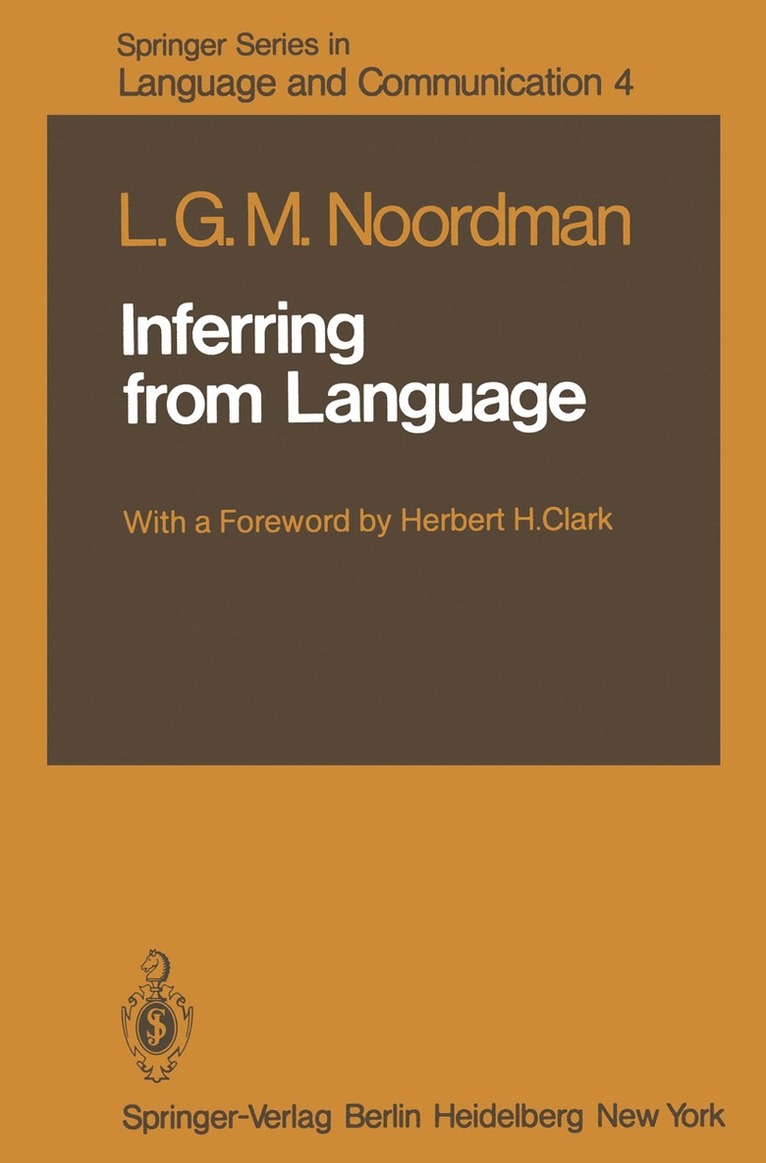
    Inferring from Language

    AvL.G.M. Noordman

    Häftad, Engelska, 2011

    Del 4 i serien Springer Series in Language and Communication

    1 048 kr

    Beställningsvara. Skickas inom 10-15 vardagar. Fri frakt över 249 kr.

    Fler format och utgåvor

    E-bok

    1 373 kr

    Beskrivning

    In the study of human thought there could hardly be a more fundamental con­ cern than language and reasoning. In the tradition of Western philosophy, humans are distinguished by their ability to speak and to think rationally. And language is often considered a prerequisite for rational thought. If psycholoQists, then, are ever to discover what is truly human about their species, they will have to discover how language is produced and understood, and how it plays a role in reasoning and other forms of rational thought. Within psychology there has been an imperative to study language and rea­ soning together. Since Wundt, psychologists have succeeded in building a the­ oretical foundation for both language and reasoning. What has become clear from these beginnings is that the two are inextricably bound to each other. Like the two players ina chess game, take away one of them and the game no longer exists. On the one hand, producing and understanding speech re­ quires an intricate process of reasoning. Speakers must rationally choose sentences that will affect their listeners in ways they intend, and listen­ ers must infer what speakers could conceivably have meant in selecting the sentences they did. Reasoning, inference, and rational thought lie at the very center of speaking and listening. On the other hand, logical reasoning begins with, and is influenced by, the language in which a problem is stated.

    Produktinformation

    • Utgivningsdatum:2011-10-18
    • Mått:155 x 235 x 11 mm
    • Vikt:295 g
    • Format:Häftad
    • Språk:Engelska
    • Serie:Springer Series in Language and Communication
    • Antal sidor:172
    • Förlag:Springer-Verlag Berlin and Heidelberg GmbH & Co. KG
    • Medarbetare:H.H. Clark
    • ISBN:9783642673092

    Utforska kategorier

    • Psykologi inom Psykologi och pedagogik

    Innehållsförteckning

    • 1 Introduction.- 1.1 Cognition and Language Behavior.- 1.2 Comprehension and Inferences.- 1.3 Types of Comprehension Research.- 1.4 Methodology of the Present Research.- 1.5 Overview of the Present Study.- I Processing Comparative Relations.- 2 Empirical Questions.- 3 A Model for Solving Verbal Problems.- 4 Storing the Information During a Time Interval.- 5 Solving Pictorial Problems.- Conclusion.- II Processing Conditional Relations.- 6 On the Interpretation of Conditional Conjunctions.- 7 Storing Conditional Relations.- 8 The Processing of Conditional Sentences.- III Foreground and Background Information in Inferential Processes.- 9 Presupposed or Background Information.- 10 Differences in Background Information.- 11 Dependency of Background Information on Context.- 12 Variability of Foreground and Background Information.- Conclusion.- 13 Summary and Conclusions.- References.- Author Index.