• Fri frakt över 249 kr
  • •
  • Snabba leveranser
  • •
  • Billiga böcker
Kundservice

Du är på sajten för privatpersoner.

Företag, bibliotek eller offentlig verksamhet?

Du handlar på classic.bokus.com, där alla dina funktioner finns intakta.
Till classic.bokus.com
Bokus logotyp. Gå till startsidan.
  • Erbjudanden
  • Student
  • Topplistor
  • Barn & ungdom
  • Bokus Play
  • E-böcker
  • Ljudböcker
  • Pocketböcker
  • Spel och pussel

5% studentrabatt – använd koden KURSBOK27 →

Sidfot

Mina sidor

    Hjälp

    • Kundservice
    • Vanliga frågor och svar
    • Frakt och leverans
    • Retur vid ångerrätt
    • Reklamera vara
    • Betalning
    • Köpvillkor
    • Allmänna villkor
    • Information om webbplatsens tillgänglighet

    Om Bokus

    • Om oss
    • Pressrum
    • För studenter
    • För företag
    • För bibliotek och offentlig verksamhet
    • För leverantörer
    • Hållbarhet

    Populärt

    • Aktuella erbjudanden
    • Presentkort
    • Studentlitteratur
    • Nya böcker
    • Topplistor
    • Signerade böcker
    • Engelska böcker

    Inspiration

    • Boktips
    • BookTok
    • Barnbokskaraktärer
    • Populära författare
    Logotyp för Bokus
    Följ oss på Facebook (extern länk)Följ oss på Instagram (extern länk)Följ oss på YouTube (extern länk)Följ oss på TikTok (extern länk)
    bokus @ CookiesAnpassa cookiesIntegritetspolicyKöpvillkor
    Till Citymail hemsida (extern länk)Till Budbee hemsida (extern länk)Till Postnord hemsida (extern länk)Till Schenker hemsida (extern länk)Till Early Bird hemsida (extern länk)Till Walleys hemsida (extern länk)
    1. Data och IT
    2. Systemvetenskap och AI

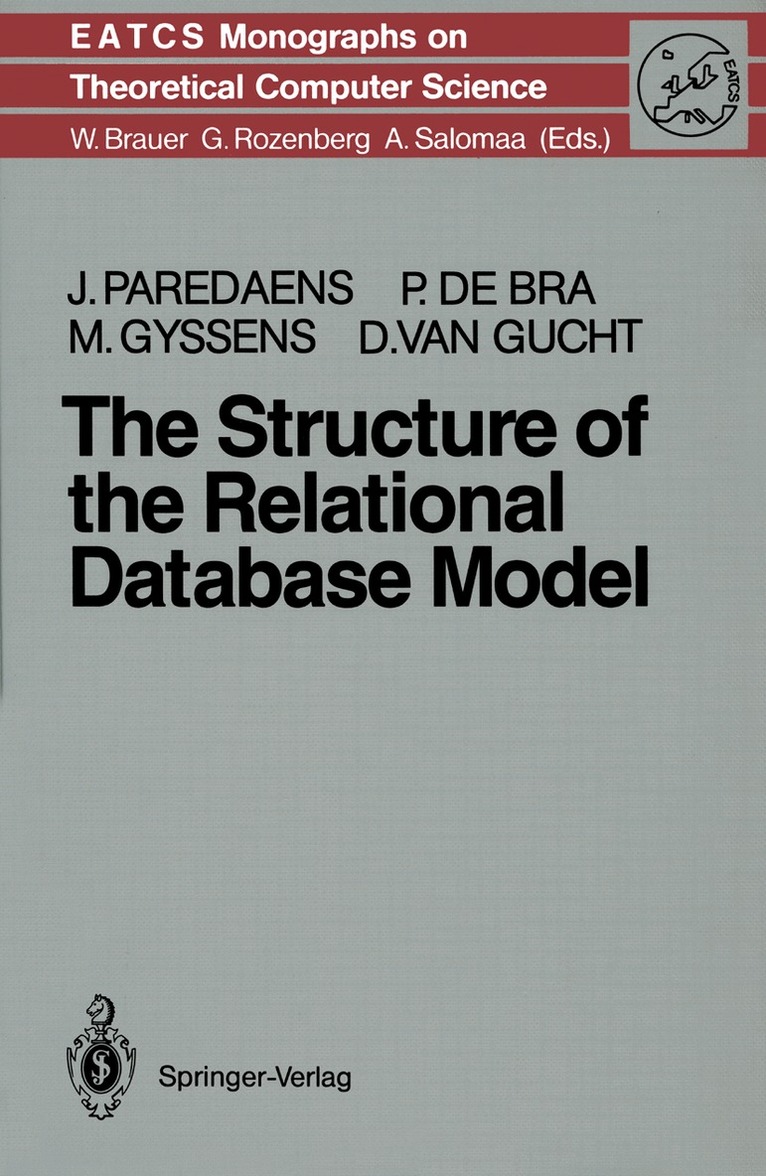
    Structure of the Relational Database Model

    AvJan Paredaens,Paul De Bra

    Häftad, Engelska, 2013

    Del i serien Monographs in Theoretical Computer Science. An EATCS Series

    559 kr

    Beställningsvara. Skickas inom 10-15 vardagar. Fri frakt över 249 kr.

    Beskrivning

    This book presents an overview of the most fundamental aspects of the theory that underlies the Relational Database Model. As such it is self-contained though experience with formal models and abstract data manipulating on the one hand and with the practical use of a relational system on the other hand can help the reader. Such experience will offer the reader a better understanding of and a motivation for the different concepts, theories and results mentioned in the book. We have focussed on the most basic concepts and aspects of the relational model, without trying to give a complete overview of the state of the art of database theory. Recently a lot of books on databases in general and on the relational model in particular have been published. Most of them describe the use of database systems. 'Some clarify how information has to be structured and organized before it can be used to build applications. Others help the user in writing down his applications or in finding tricky ways to optimize the running time or the necessary space. Another category of books treat more fundamental and more general aspects such as the description of the relational model, independent of any implementation, the decomposition in normal forms or the global design of distributed databases. Few, however, are the books that describe in a formal way some of the subjects mentioned above.

    Produktinformation

    • Utgivningsdatum:2013-10-03
    • Mått:170 x 244 x 14 mm
    • Vikt:435 g
    • Format:Häftad
    • Språk:Engelska
    • Serie:Monographs in Theoretical Computer Science. An EATCS Series
    • Antal sidor:233
    • Förlag:Springer-Verlag Berlin and Heidelberg GmbH & Co. KG
    • ISBN:9783642699580

    Utforska kategorier

    • Systemvetenskap och AI inom Data och IT
    • Databaser inom Data och IT

    Innehållsförteckning

    • 1 Relational Database Model.- 1.1 Relation Schemes.- 1.2 Relation Instances.- 1.3 Database Schemes and Database Instances.- 1.4 Dynamic Schemes and Evolutions.- 1.5 Classification of Constraints.- 1.6 Example.- 1.7 Exercises.- 2 Query Systems.- 2.1 The Relational Algebra.- 2.2 The Tuple Calculus.- 2.3 SQL: Structured Query Language.- 2.4 Reduction of the Tuple Calculus to the Algebra.- 2.5 Reduction of the Algebra to SQL.- 2.6 Reduction of SQL to the Tuple Calculus.- 2.7 Exercises.- 3 Constraints.- 3.1 Some Terminology.- 3.2 Functional Dependencies.- 3.3 Multivalued Dependencies.- 3.4 Join Dependencies.- 3.5 Inclusion Dependencies.- 3.6 Tuple and Equality Generating Dependencies.- 3.7 Exercises.- 4 Vertical Decompositions.- 4.1 First Normal Form.- 4.2 Second and Third Normal Form.- 4.3 Boyce-Codd Normal Form.- 4.4 Constraint Preserving Normalization.- 4.5 Fourth and Fifth Normal Form.- 4.6 Vertical Decomposition and Consistency Checking.- 4.7 Exercises.- 5 Horizontal Decompositions.- 5.1 Horizontal Decompositions.- 5.2 The Membership and Inference Problem for Fds and Ads.- 5.3 The Inheritance of Dependencies.- 5.4 Normal Forms for Horizontal Decompositions.- 5.5 Exercises.- 6 Incomplete Information.- 6.1 Representation Systems for Existing-but-Unknown Nulls.- 6.2 Updating Relations with Existing-but-Unknown Nulls.- 6.3 Constraints in Incomplete Databases.- 6.4 Relations with No-Information Nulls.- 6.5 The Weak Instance Model.- 6.6 Exercises.- 7 The Nested Relational Database Model.- 7.1 Nested Relation Schemes and Instances.- 7.2 The Nested Relational Algebra.- 7.3 Constraints.- 7.4 The Expressiveness of the Nested Relational Algebra.- 7.5 Hierarchical Instances.- 7.6 Exercises.- 8 Updates.- 8.1 Transactions.- 8.2 Equivalent Transactions.- 8.3 Dynamic Relation Constraints.- 8.4 Axiomatization of Equivalence of Transactions.- 8.5 Exercises.