• Fri frakt över 249 kr
  • •
  • Snabba leveranser
  • •
  • Billiga böcker
Kundservice

Du är på sajten för privatpersoner.

Företag, bibliotek eller offentlig verksamhet?

Du handlar på classic.bokus.com, där alla dina funktioner finns intakta.
Till classic.bokus.com
Bokus logotyp. Gå till startsidan.
  • Erbjudanden
  • Nyheter
  • Student
  • Topplistor
  • Barn & ungdom
  • Bokus Play
  • E-böcker
  • Pocketböcker
  • Spel & pussel

Må bättre, för mindre! Upp till 50% rabatt på hälsoböcker

Sidfot

Mina sidor

    Hjälp

    • Kundservice
    • Vanliga frågor och svar
    • Frakt och leverans
    • Retur vid ångerrätt
    • Reklamera vara
    • Betalning
    • Köpvillkor
    • Allmänna villkor
    • Information om webbplatsens tillgänglighet

    Om Bokus

    • Om oss
    • Pressrum
    • För studenter
    • För företag
    • För bibliotek och offentlig verksamhet
    • För leverantörer
    • Hållbarhet

    Populärt

    • Aktuella erbjudanden
    • Presentkort
    • Studentlitteratur
    • Nya böcker
    • Topplistor
    • Signerade böcker
    • Engelska böcker

    Inspiration

    • Boktips
    • BookTok
    • Populära bokserier
    • Barnbokskaraktärer
    • Populära författare
    Logotyp för Bokus
    Följ oss på Facebook (extern länk)Följ oss på Instagram (extern länk)Följ oss på YouTube (extern länk)Följ oss på TikTok (extern länk)
    bokus @ CookiesAnpassa cookiesIntegritetspolicyKöpvillkor
    Till Citymail hemsida (extern länk)Till Budbee hemsida (extern länk)Till Postnord hemsida (extern länk)Till Schenker hemsida (extern länk)Till Early Bird hemsida (extern länk)Till Walleys hemsida (extern länk)
    1. Data och IT
    2. Systemvetenskap och AI

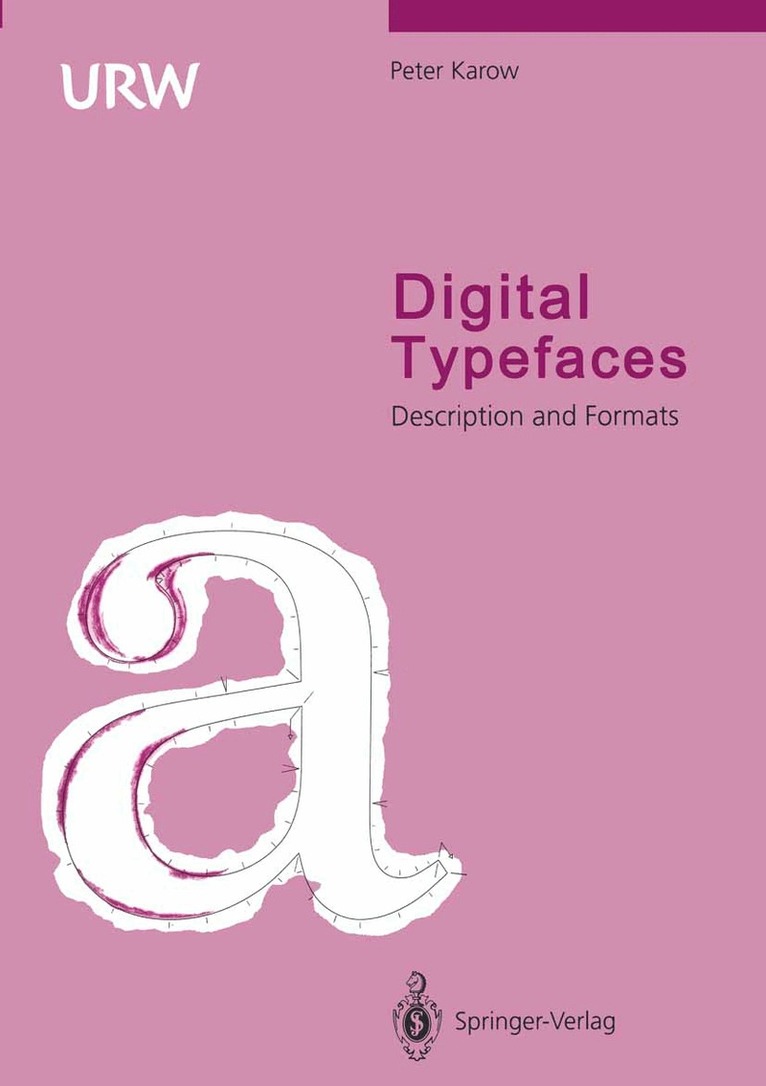
    Digital Typefaces

    Description and Formats

    AvPeter Karow

    Häftad, Engelska, 2012

    563 kr

    Beställningsvara. Skickas inom 10-15 vardagar. Fri frakt över 249 kr.

    Fler format och utgåvor

    E-bok

    734 kr

    Beskrivning

    Summary his book was written primarily for people who intend or wish to develop new machines for the output of typefaces. It is practical to categorize equipment into three groups for which digital alphabets are required - 1) display devices, 2) typesetting machines and 3) numerically controlled (NC) machines. Until now, development of typefaces has been overly dependent upon the design of the respective machine on which it was to be used. This need not be the case. Digitization of type should be undertaken in two steps: the preparation of a database using hand-digitization, and the subsequent automatic generation of machine formats by soft­ scanning, through the use of a computer-based program. Digital formats for typefaces are ideally suited to system­ atic ordering, as are coding techniques. In this volume, various formats are investigated, their properties discussed and rela­ tive production requirements analyzed. Appendices provide readers additional information, largely on digital formats for typeface storage introduced by the IKARUS system. This book was composed in Latino type, developed by Hermann Zapf from his Melior for URW in 1990. Compo­ sition was accomplished on a Linotronic 300, as well as on an Agfa 9400 typesetter using PostScript. v Preface Preface his book was brought out by URW Publishers in 1986 with the title «Digital Formats for Typefaces;). It was translated into English in 1987, Japanese in 1989 and French in 1991.

    Produktinformation

    • Utgivningsdatum:2012-01-19
    • Mått:170 x 242 x 26 mm
    • Vikt:794 g
    • Format:Häftad
    • Språk:Engelska
    • Antal sidor:448
    • Förlag:Springer-Verlag Berlin and Heidelberg GmbH & Co. KG
    • Medarbetare:H. Zapf
    • ISBN:9783642781070

    Utforska kategorier

    • Systemvetenskap och AI inom Data och IT

    Innehållsförteckning

    • 1. Introduction.- 2. Typeface terminology.- 3. Display of typefaces.- 3.1 Visual display devices.- 3.2 Typesetting machines.- 3.3 NC machines.- 4. Requirements of typesetting.- 4.1 Type structure.- 4.2 Form setting.- 4.3 Hierarchical format structure.- 5. Formats.- 5.1 Review of formats.- 5.2 Other concepts.- 5.3 Special coding techniques.- 5.4 Listing of a selection of type manufacturers.- 6. The URW concept.- 6.1 IKARUS.- 6.2 Format hierarchy at URW.- 6.3 IK interpolation.- 6.4 Nimbus.- 7. The preparation of rasters.- 7.1 Soft-scanning.- 7.2 Manual corrections.- 7.3 SC formats for laser printers.- 8. Industry Standards.- 8.1 Type 1 (by Jochen Lau).- 8.2 Intellifont (by Jochen Lau).- 8.3 TrueType Format (by Hartmut Schwarz).- 8.4 F3 Unix (by Jochen Lau).- 9. Conclusions.- 9.1 Properties of formats.- 9.2 Requirements to be met by formats.- 9.3 Recommendations for manufacturers.- 9.4 Time required for producing type.- Appendices.- A Type classification.- B Characters of a typeface.- C Accents for Latin type.- D Dingbats.- E Explanation of optical effects.- F Short dictionary of type terminology.- G Data structure for typefaces.- H Description of the IK format.- I Description of the BE, CN and QQ format.- J Description of the II format (by Jochen Lau).- K Description of the DI format.- L Description of the VC format.- M Description of the BS format.- N Description of the VE format.- O Description of the SC format.- P Description of the SN format.- Q Description of the BI format.- R Description of the GS format.- S Data structure for spacing.- T Width table.- U Kerning table.- V Touching and Overlapping table.- W Programs for converting IK ? DI.- X Marking and digitizing rules.- Y References, on typefaces in particular.- Z Index.