• Fri frakt över 249 kr
  • •
  • Snabba leveranser
  • •
  • Billiga böcker
Kundservice

Du är på sajten för privatpersoner.

Företag, bibliotek eller offentlig verksamhet?

Du handlar på classic.bokus.com, där alla dina funktioner finns intakta.
Till classic.bokus.com
Bokus logotyp. Gå till startsidan.
  • Erbjudanden
  • Nyheter
  • Student
  • Topplistor
  • Barn & ungdom
  • Bokus Play
  • E-böcker
  • Pocketböcker
  • Spel & pussel

Må bättre, för mindre! Upp till 50% rabatt på hälsoböcker

Sidfot

Mina sidor

    Hjälp

    • Kundservice
    • Vanliga frågor och svar
    • Frakt och leverans
    • Retur vid ångerrätt
    • Reklamera vara
    • Betalning
    • Köpvillkor
    • Allmänna villkor
    • Information om webbplatsens tillgänglighet

    Om Bokus

    • Om oss
    • Pressrum
    • För studenter
    • För företag
    • För bibliotek och offentlig verksamhet
    • För leverantörer
    • Hållbarhet

    Populärt

    • Aktuella erbjudanden
    • Presentkort
    • Studentlitteratur
    • Nya böcker
    • Topplistor
    • Signerade böcker
    • Engelska böcker

    Inspiration

    • Boktips
    • BookTok
    • Populära bokserier
    • Barnbokskaraktärer
    • Populära författare
    Logotyp för Bokus
    Följ oss på Facebook (extern länk)Följ oss på Instagram (extern länk)Följ oss på YouTube (extern länk)Följ oss på TikTok (extern länk)
    bokus @ CookiesAnpassa cookiesIntegritetspolicyKöpvillkor
    Till Citymail hemsida (extern länk)Till Budbee hemsida (extern länk)Till Postnord hemsida (extern länk)Till Schenker hemsida (extern länk)Till Early Bird hemsida (extern länk)Till Walleys hemsida (extern länk)
    1. Ekonomi och Ledarskap
    2. Ledarskapsböcker

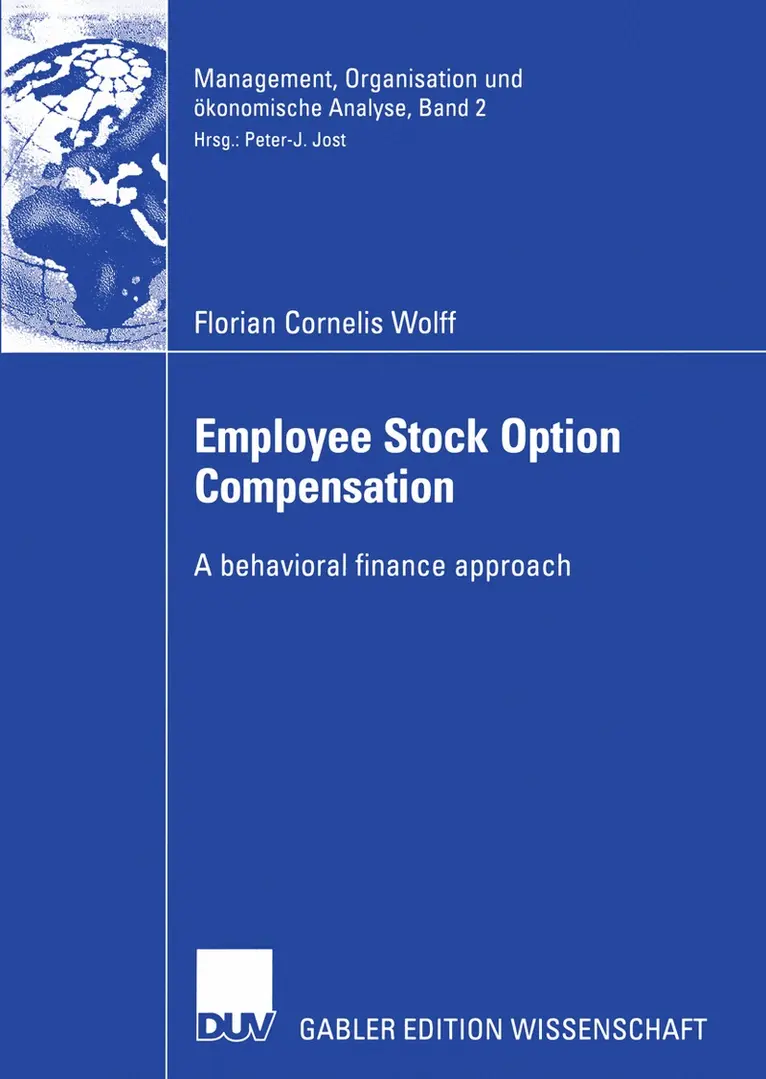
    Employee Stock Option Compensation

    A behavioral finance approach

    AvFlorian Wolff

    Häftad, Engelska, 2004

    Del 2 i serien Management, Organisation und ökonomische Analyse

    952 kr

    Beställningsvara. Skickas inom 10-15 vardagar. Fri frakt över 249 kr.

    Fler format och utgåvor

    E-bok

    1 211 kr

    Beskrivning

    Over the last years stock options have become an integral part of the compensation of senior managers in Germany: Originating in the USA in the 1950s, this form of compensation gained increasing popularity among German corporations during the 1990s, so that by today far over 100 German listed companies grant stock option plans to their employees. Based on recent research the average German CEO ("Vor­ standsvorsitzender") receives approximately 10% of his salary in form of stock op­ tions. The ongoing globalisations of business practises as well as the boom of the Neuer Markt have been key drivers of this development. Initially, from an economic perspective the increasing importance of stock option plans in the compensation of senior managers has to be welcomed: Assuming that senior managers through their actions have the ability to influence the stock price of their companies, stock options represent a performance based type of pay that im­ proves the incentives to senior managers to create additional shareholder value. However, this perspective often neglects the potential costs created by such an in­ centive instrument. Several research studies suggest that companies in some cases generate additional costs through the granting of stock options that can exceed the benefits created by their incentive effect.

    Produktinformation

    • Utgivningsdatum:2004-12-10
    • Mått:148 x 210 x 15 mm
    • Vikt:356 g
    • Format:Häftad
    • Språk:Engelska
    • Serie:Management, Organisation und ökonomische Analyse
    • Antal sidor:253
    • Förlag:Deutscher Universitats-Verlag
    • ISBN:9783824482139

    Utforska kategorier

    • Ledarskapsböcker inom Ekonomi och Ledarskap

    Mer om författaren

    Dr. Florian Wolff promovierte bei Prof. Dr. Peter-J. Jost am Lehrstuhl für Organisationstheorie der Wissenschaftlichen Hochschule für Unternehmensführung (WHU) in Vallendar. Er ist Unternehmensberater bei McKinsey & Company, Inc. in München.

    Innehållsförteckning

    • Tabel of contents.- 1. Introduction to the topic.- 1.1. Relevance of the topic.- 1.2. Questions posed.- 1.3. Summary conclusions.- 1.4. Outline of the structure of the book.- 2. Theoretical & empirical assessment.- 2.1. Definition of a stock option plan.- 2.2. Review of stock option plan use.- 2.3. Empirical analysis of the use of stock option plans.- 2.4. Conclusion.- 3. Review of risk-neutral valuation models.- 3.1. Importance of valuing stock options.- 3.2. Valuing stock options from the company perspective.- 3.3. Valuing stock options from the executive’s perspective.- 3.4. Conclusion.- 4. Utility-based stock-option valuation.- 4.1. General introduction to expected utility models.- 4.2. Hall-Murphy model.- 4.3. Modifications to the ‘traditional’ EU model.- 4.4. Implications for a new model of subjective valuation.- 5. A new model to value executive stock option.- 5.1. Model specification and implementation.- 5.2. Model outputs.- 5.3. Summary of model findings and first hypotheses.- 6. Experimental test of subjective valuations.- 6.1. Purpose of the experiment.- 6.2. Experimental design.- 6.3. Experimental results.- 6.4. Implications for the valuation model.- 7. Conclusion and outlook.- 7.1. Summary conclusions.- 7.2. Future research agenda.- Appendix I.- Appendix I.