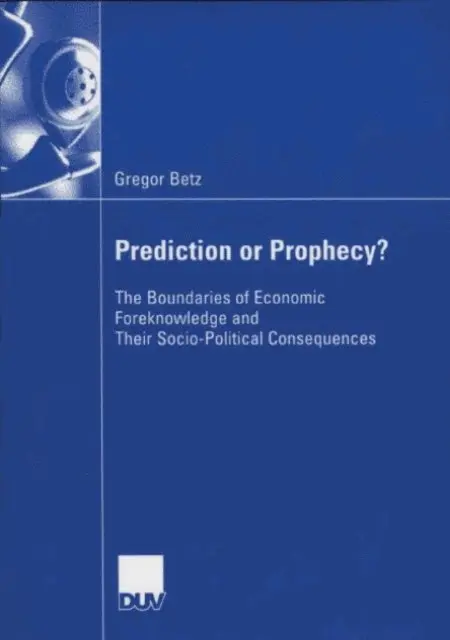
E-bok, Engelska, 2007
Prediction or Prophecy?
Av Gregor Betz
732 kr
Läs direkt i Bokus Reader – eller ladda ned till din enhet (PDF kräver ofta zoom och scroll på små skärmar).
Beskrivning
"Knowing, in order to predict". It was this leitmotiv alone that Auguste Comte, in the 19th century, considered suitable for the then rapidly developing empirical sciences. This view remains unchanged until today—not only in the empirical sciences themselves, but also in the philosophy of science. A scientific theory is and should be evaluated primarily on the grounds of its capacity to correctly predict observable phenomena. The aim of predicting takes precedence over the other important aim of science, namely to produce and purposefully manipulate phenomena by technical means in the laboratory, moreover, it even includes the latter. For if scientists successfully produce and manipulate certain phenomena in an experiment, they can ipso facto predict how that experiment will evolve under certain conditions. We live in a scientifically-dominated world: The more science progresses, the more important correct scientific predictions become. To a sometimes even fa tal extent we have made ourselves dependent on science and its results. Our scientifical-technological interventions into nature, yet also into social processes, cover ever larger spatial and temporal distances, and the consequences are ever more drastic given the increasing effort that would be required to reverse the effects—if that is possible at all. That is the reason why we ought to be very well informed about the consequences of our actions, in particular those based on science and technology.
Produktinformation
- Utgivningsdatum: 2007-10-06
- Språk: Engelska
- Filformat: PDF
- Kopieringsskydd: LCP
- ISBN: 9783835090538
- Förlag: Deutscher Universitatsverlag
- Medarbetare: Prof. Dr. Holm Tetens
Utforska kategorier
Betyg & recensioner
0 recensioner
Inga recensioner tillgängliga.