• Fri frakt över 249 kr
  • •
  • Snabba leveranser
  • •
  • Billiga böcker
Kundservice

Du är på sajten för privatpersoner.

Företag, bibliotek eller offentlig verksamhet?

Du handlar på classic.bokus.com, där alla dina funktioner finns intakta.
Till classic.bokus.com
Bokus logotyp. Gå till startsidan.
  • Erbjudanden
  • Student
  • Topplistor
  • Barn & ungdom
  • Bokus Play
  • E-böcker
  • Ljudböcker
  • Pocketböcker
  • Spel och pussel

5% studentrabatt – använd koden KURSBOK27 →

Sidfot

Mina sidor

    Hjälp

    • Kundservice
    • Vanliga frågor och svar
    • Frakt och leverans
    • Retur vid ångerrätt
    • Reklamera vara
    • Betalning
    • Köpvillkor
    • Allmänna villkor
    • Information om webbplatsens tillgänglighet

    Om Bokus

    • Om oss
    • Pressrum
    • För studenter
    • För företag
    • För bibliotek och offentlig verksamhet
    • För leverantörer
    • Hållbarhet

    Populärt

    • Aktuella erbjudanden
    • Presentkort
    • Studentlitteratur
    • Nya böcker
    • Topplistor
    • Signerade böcker
    • Engelska böcker

    Inspiration

    • Boktips
    • BookTok
    • Barnbokskaraktärer
    • Populära författare
    Logotyp för Bokus
    Följ oss på Facebook (extern länk)Följ oss på Instagram (extern länk)Följ oss på YouTube (extern länk)Följ oss på TikTok (extern länk)
    bokus @ CookiesAnpassa cookiesIntegritetspolicyKöpvillkor
    Till Citymail hemsida (extern länk)Till Budbee hemsida (extern länk)Till Postnord hemsida (extern länk)Till Schenker hemsida (extern länk)Till Early Bird hemsida (extern länk)Till Walleys hemsida (extern länk)
    1. Naturvetenskap och teknik
    2. Teknik och industri
    3. Elektronik och kommunikationer

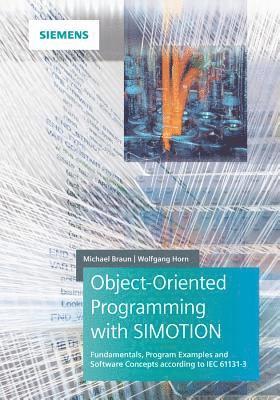
    Object-Oriented Programming with SIMOTION

    Fundamentals, Program Examples and Software Concepts According to IEC 61131-3

    AvMichael Braun,Wolfgang Horn

    Inbunden, Engelska, 2017

    456 kr

    Skickas . Fri frakt över 249 kr.

    Beskrivning

    In mechanical engineering the trend towards increasingly flexible solutions is leading to changes in control systems. The growth of mechatronic systems and modular functional units is placing high demands on software and its design. In the coming years, automation technology will experience the same transition that has already taken place in the PC world: a transition to more advanced and reproducible software design, simpler modification, and increasing modularity. This can only be achieved through object-oriented programming. This book is aimed at those who want to familiarize themselves with this development in automation technology. Whether mechanical engineers, technicians, or experienced automation engineers, it can help readers to understand and use object-oriented programming. From version 4.5, SIMOTION provides the option to use OOP in accordance with IEC 61131-3 ED3, the standard for programmable logic controllers. The book supports this way of thinking and programming and offers examples of various object-oriented techniques and their mechanisms. The examples are designed as a step-by-step process that produces a finished, ready-to-use machine module. Contents: Developments in the field of control engineering - General principles of object-oriented programming - Function blocks, methods, classes, interfaces - Modular software concepts - Object-oriented design, reusable and easy-to-maintain software, organizational and legal aspects, software tests - I/O references, namespaces, general references - Classes in SIMOTION, instantiation of classes and function blocks, compatible and efficient software - Introduction to SIMOTION and SIMOTION SCOUT.

    Produktinformation

    • Utgivningsdatum:2017-06-07
    • Mått:178 x 249 x 20 mm
    • Vikt:953 g
    • Format:Inbunden
    • Språk:Engelska
    • Antal sidor:297
    • Förlag:Publicis MCD Verlag,Germany
    • ISBN:9783895784569

    Utforska kategorier

    • Elektronik och kommunikationer inom Naturvetenskap och teknik
    • Programmeringsböcker inom Data och IT

    Mer om författaren

    MICHAEL BRAUN is product manager for motion control engineering at Siemens in Erlangen. He communicates customers? demands to the R&D department, pushes the implementation and introduces new software to the market.DR. WOLFGANG HORN is software manager and developer at the IST in Chemnitz. He is intimately familiar with the architecture and programming of SIMOTION.

    Innehållsförteckning

    • Information for readers 131 Developments in the Field of Control Engineering 1 181.1 The early days of programmable logic controllers (PLCs) 1.1 191.2 The PLC learns to communicate 1.2 221.3 Development of fieldbus systems 1.3 241.4 Integration of display systems in PLCs 1.4 251.5 Integration of motion control in PLCs 1.5 271.6 Drives become fully-fledged bus system nodes 1.6 301.7 PLC and PAC – what is the difference? 1.7 311.8 General conclusions about past developments 1.8 312 Basic Principles of Object-Oriented Programming 2 332.1 The basis of object-oriented programming 2.1 332.1.1 History 332.1.2 What’s different? 342.1.3 What does object orientation mean? 352.1.4 Objects and their interactions 362.2 General principles of OOP 2.2 372.2.1 Objects 372.2.2 Classes 392.2.3 Inheritance 392.2.4 Overriding 412.2.5 Interfaces for object interaction 422.2.6 Summary 442.2.7 Advantages of using OOP 452.2.8 Disadvantages of OOP 452.3 Tips about defining classes 2.3 463 Object-Oriented Programming 3 493.1 Implementation of OOP with SIMOTION 3.1 493.2 Function blocks with methods 3.2 503.2.1 Modularization without OOP extensions 513.2.2 Program and data are separate 533.2.3 Advances in the life cycle of software 553.2.4 Disadvantages of programming without OOP extensions 563.2.5 Extensions to FBs and their access specification 573.2.6 Use of methods to improve program structuring 593.2.6.1 Example of FB with methods 603.2.6.2 Example of a function block call 613.2.7 Function block with methods for placing commands 623.2.7.1 Example of the FB with command methods 633.2.7.2 Example of an FB call with command methods 653.3 Classes (CLASS) 3.3 663.3.1 Keywords supported for a class 673.3.1.1 Example of a CLASS declaration 693.3.2 Methods (METHOD) 693.3.3 Methods and their access specification 703.3.4 Declaration of instances of a class 713.3.5 Rules for identifiers in a class 723.3.6 Use of class methods 723.3.6.1 Example of a CLASS COUNTER 733.3.6.2 Use of the method of CLASS COUNTER 743.3.6.3 Extension of the CLASS COUNTER and use of THIS 753.3.6.4 Use of the methods UP and DOWN 763.3.7 Classes and inheritance 763.3.7.1 Example of derivation of a class 783.3.7.2 Example of how to use base and derived classes 793.3.7.3 Other aspects of the method call 803.3.7.4 Example of base and derived classes in a function 813.3.8 Abstract classes 823.4 Examples of valve applications with OOP 3.4 843.4.1 Example with 4/3-way valve 843.4.1.1 Example of a class for 4/3-way valves 853.4.1.2 Example of a valve call 873.4.1.3 Example with 4/3-way valve with fast/slow speed 883.4.1.4 Example of a derived class ValveControl43FS 893.4.1.5 Example of calls of base class and extended class 903.4.1.6 Example of call of extended class with basic function 913.5 Interfaces 3.5 923.5.1 Supported features 933.5.2 Principles of interfaces 943.5.2.1 Example of an interface declaration 953.5.3 Representation of interfaces in the PNV of SCOUT 973.5.4 Benefits of interfaces 993.5.5 Interfaces as a reference to classes 1003.5.6 Valve classes with interfaces 1033.5.7 Declaration of the valve interface 1053.5.7.1 Example of ValveControl43 with limit switch monitoring 1053.5.7.2 Example of ValveControl43 with error reporting 1083.5.7.3 Example of ValveControl43 with test error reporting 1123.5.7.4 Example of class HMIReporting 1133.5.7.5 Example of ValveControl43 with error reporting 1153.5.8 Interface for neutralizing I/O components 1163.5.8.1 Connection of cameras to the control system 1163.5.8.2 Interface definition for a camera connection 1223.5.9 Interface for neutral I/O connection (condensed example) 1233.5.9.1 Interface definition for neutral I/O connection 1253.5.9.2 Implementation in classes 1253.5.9.3 Interface definition and mapping table program 1263.5.9.4 Program for implementation and use of classes 1273.5.9.5 Interface for fast/slow speed switchover 1293.5.9.6 Implementation of classes for fast/slow speed 1303.6 Further optimization of the valve class 3.6 1313.6.1 Existing implementation of ValveControl 1313.6.2 Design of a state machine 1323.6.2.1 Example of ValveControl43ST – state machine using CASE 1343.6.2.2 Example of ValveControl43ST – state machine with classes 1403.7 Abstract class for different drives 3.7 1433.7.1 Functional differences between various drive solutions 1443.7.2 Class model for connecting different drives 1463.7.2.1 Example of abstract class “CDrive” 1473.7.2.2 Example of class for direct-on-line starting drives 1483.7.2.3 Example of class for drives with star-delta starters 1493.7.2.4 Example of class for speed-controlled drives 1513.7.2.5 Example program for controlling drives of different types 1553.8 Abstract class versus interface 3.8 1573.9 OOP opens up the world of design patterns 3.9 1594 OOP Supports Modular Software Concepts 4 1614.1 Assembling projects for real machines 4.1 1624.1.1 Module design 1634.1.2 The role of the software developer 1634.1.3 Modularizing software 1644.1.3.1 Creating equipment modules 1664.1.3.2 Software design of the equipment module 1674.1.3.3 Example of the class “CEMPusher” 1694.1.3.4 Example of an equipment module call 1744.1.4 Preparations for multiple reuse 1754.1.4.1 Example of the neutralized equipment module 1764.2 SIMOTION easyProject project generator 4.2 1774.2.1 Adding your own modules to the project generator 1814.2.2 Creating a user interface for the project generator 1824.2.3 XML description of the equipment module 1845 Guide to Designing and Developing Software 5 1885.1 Establishing requirements 5.1 1885.1.1 Starting point – user interfaces 1895.1.2 Starting point – process operations 1895.1.3 Starting point – mechanical engineering elements 1905.1.4 Existing solutions 1915.2 Object-oriented design 5.2 1925.2.1 Encapsulation 1925.2.2 Responsibility of a class 1935.2.3 Commonalities and differences between objects 1945.2.4 Principle of replaceability with derived classes 1945.2.5 Determining relationships 1955.2.6 SOLID principles 1975.3 Reusable and easy-to-maintain software 5.3 1975.3.1 How can software be made reusable? 1975.3.2 Libraries are helpful 1985.3.3 What is the best way to develop modules? 1985.4 Organizational and legal aspects 5.4 2015.4.1 Transition to OOP must be planned 2015.4.2 Software needs to be planned 2025.4.2.1 Analysis of existing programs 2025.4.2.2 Reuse of software 2035.4.3 Reuse and ownership of software 2055.4.3.1 Distribution of software 2065.4.3.2 Acquisition of software 2075.4.4 “Good software” and object-oriented design 2085.5 Software tests are a must! 5.5 2115.5.1 Module test 2135.5.2 Integration test 2145.5.3 System test 2145.5.4 Acceptance test 2166 Additional Topics Relating to Software Structuring 6 2176.1 I/O references 6.1 2176.1.1 Declaration 2186.1.2 Linking references to I/O variables 2186.2 Namespaces 6.2 2206.3 General references 6.3 2226.3.1 Declaration and initialization 2236.3.2 Working with references 2247 Description of the Extended Functionality in SIMOTION 7 2287.1 General extensions to the programming model 7.1 2287.2 Classes in SIMOTION 7.2 2297.2.1 Constants and user-defined data types in classes 2297.2.2 Naming of variables in classes and methods 2307.2.3 Method calls 2317.2.4 FINAL for methods and classes 2327.2.5 Declaration of abstract classes and methods 2327.2.6 Interface implementation and class derivations 2337.2.7 Type conversions for classes and interfaces 2347.3 Instantiation of classes and function blocks 7.3 2367.3.1 User-defined initialization of instances 2367.3.2 Initialization of interface variables 2377.3.3 Creating class and function block instances 2387.3.4 RETAIN data in classes and function blocks 2397.3.5 Arrays of variable length 2397.4 Tips for creating compatible and efficient software 7.4 2407.4.1 Methods and function calls 2407.4.2 Use of enum values and constants 2407.4.3 Use of predefined namespaces 2417.4.4 Declaration of data types, variables and methods 2427.4.5 Preparing structured data for transmission 2438 Introduction to SIMOTION 8 2468.1 Classic development of control systems 8.1 2468.2 New control concepts required 8.2 2478.3 Technology Objects in SIMOTION 8.3 2488.4 Three hardware platforms 8.4 2498.5 Connecting drives and I/O devices to SIMOTION 8.5 2518.6 Handling kinematics in SIMOTION 8.6 2518.7 SIMOTION’s programming model 8.7 2528.7.1 The units of SIMOTION 2538.7.2 The variable model in SIMOTION 2548.7.3 Libraries in SIMOTION 2588.8 The SIMOTION SCOUT engineering system 8.8 2598.9 Components of SCOUT 8.9 2608.9.1 The SCOUT project navigator 2618.9.2 Creating a new project 2628.9.3 Creating a new device 2638.9.4 Hardware configuration 2668.9.5 The SIMOTION address list 2688.9.6 Creating axes 2698.9.7 Creating drives 2748.9.8 Creating path objects 2768.9.9 Language editors in SCOUT 2788.9.10 Support for programming languages 2798.9.11 Inserting program sources (units) 2808.9.12 Entering programs 2828.9.13 Assigning programs to the execution system 2848.9.14 Integrated test functions 2858.9.15 Testing with “program status” 286Note about using the example programs 293Index 294