• Fri frakt över 249 kr
  • •
  • Snabba leveranser
  • •
  • Billiga böcker
Kundservice

Du är på sajten för privatpersoner.

Företag, bibliotek eller offentlig verksamhet?

Du handlar på classic.bokus.com, där alla dina funktioner finns intakta.
Till classic.bokus.com
Bokus logotyp. Gå till startsidan.
  • Erbjudanden
  • Student
  • Topplistor
  • Barn & ungdom
  • Bokus Play
  • E-böcker
  • Ljudböcker
  • Pocketböcker
  • Spel och pussel

5% studentrabatt – använd koden KURSBOK27 →

Sidfot

Mina sidor

    Hjälp

    • Kundservice
    • Vanliga frågor och svar
    • Frakt och leverans
    • Retur vid ångerrätt
    • Reklamera vara
    • Betalning
    • Köpvillkor
    • Allmänna villkor
    • Information om webbplatsens tillgänglighet

    Om Bokus

    • Om oss
    • Pressrum
    • För studenter
    • För företag
    • För bibliotek och offentlig verksamhet
    • För leverantörer
    • Hållbarhet

    Populärt

    • Aktuella erbjudanden
    • Presentkort
    • Studentlitteratur
    • Nya böcker
    • Topplistor
    • Signerade böcker
    • Engelska böcker

    Inspiration

    • Boktips
    • BookTok
    • Barnbokskaraktärer
    • Populära författare
    Logotyp för Bokus
    Följ oss på Facebook (extern länk)Följ oss på Instagram (extern länk)Följ oss på YouTube (extern länk)Följ oss på TikTok (extern länk)
    bokus @ CookiesAnpassa cookiesIntegritetspolicyKöpvillkor
    Till Citymail hemsida (extern länk)Till Budbee hemsida (extern länk)Till Postnord hemsida (extern länk)Till Schenker hemsida (extern länk)Till Early Bird hemsida (extern länk)Till Walleys hemsida (extern länk)
    1. Data och IT
    2. Systemvetenskap och AI

    Elementary Cluster Analysis

    Four Basic Methods that (Usually) Work

    AvJames C. Bezdek

    Inbunden, Engelska, 2022

    1 683 kr

    Beställningsvara. Skickas inom 10-15 vardagar. Fri frakt över 249 kr.

    Fler format och utgåvor

    E-bok

    864 kr

    E-bok

    864 kr

    Beskrivning

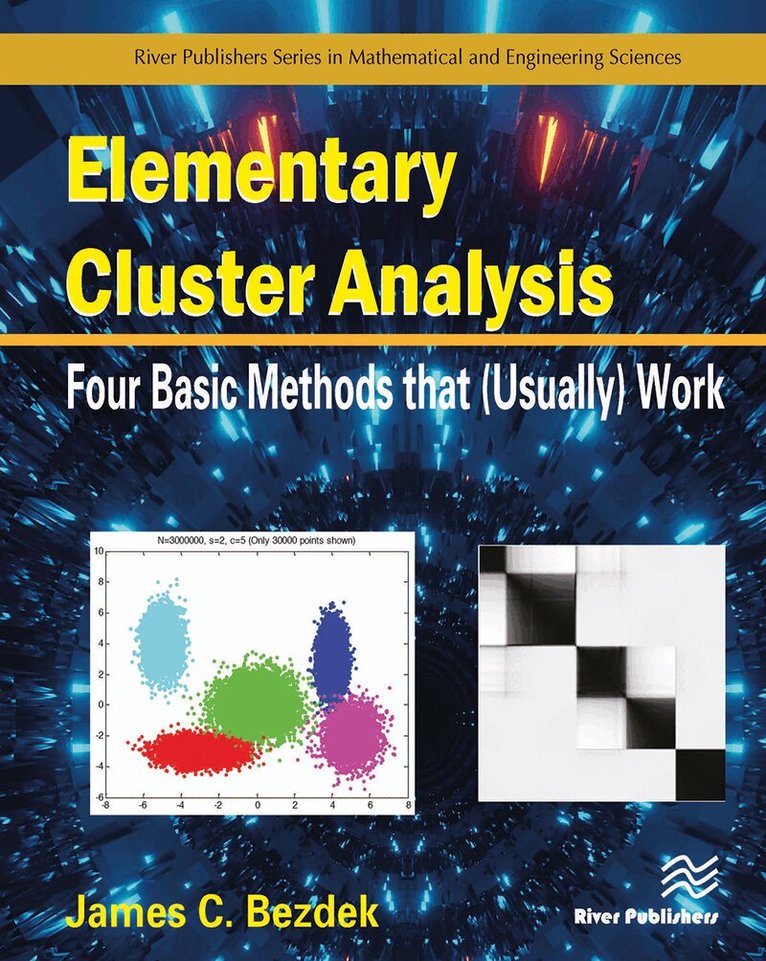
    The availability of packaged clustering programs means that anyone with data can easily do cluster analysis on it. But many users of this technology don't fully appreciate its many hidden dangers. In today's world of "grab and go algorithms," part of my motivation for writing this book is to provide users with a set of cautionary tales about cluster analysis, for it is very much an art as well as a science, and it is easy to stumble if you don't understand its pitfalls. Indeed, it is easy to trip over them even if you do! The parenthetical word usually in the title is very important, because all clustering algorithms can and do fail from time to time.Modern cluster analysis has become so technically intricate that it is often hard for the beginner or the non-specialist to appreciate and understand its many hidden dangers. Here's how Yogi Berra put it, and he was right:In theory there's no difference between theory and practice. In practice, there is ~Yogi BerraThis book is a step backwards, to four classical methods for clustering in small, static data sets that have all withstood the tests of time. The youngest of the four methods is now almost 50 years old:Gaussian Mixture Decomposition (GMD, 1898)SAHN Clustering (principally single linkage (SL, 1909))Hard c-means (HCM, 1956, also widely known as (aka) "k-means")Fuzzy c-means (FCM, 1973, reduces to HCM in a certain limit)The dates are the first known writing (to me, anyway) about these four models. I am (with apologies to Marvel Comics) very comfortable in calling HCM, FCM, GMD and SL the Fantastic Four.Cluster analysis is a vast topic. The overall picture in clustering is quite overwhelming, so any attempt to swim at the deep end of the pool in even a very specialized subfield requires a lot of training. But we all start out at the shallow end (or at least that's where we should start!), and this book is aimed squarely at teaching toddlers not to be afraid of the water. There is no section of this book that, if explored in real depth, cannot be expanded into its own volume. So, if your needs are for an in-depth treatment of all the latest developments in any topic in this volume, the best I can do - what I will try to do anyway - is lead you to the pool, and show you where to jump in.

    Produktinformation

    • Utgivningsdatum:2022-03-31
    • Mått:203 x 254 x 33 mm
    • Vikt:1 110 g
    • Format:Inbunden
    • Språk:Engelska
    • Antal sidor:516
    • Förlag:River Publishers
    • ISBN:9788770224253

    Utforska kategorier

    • Systemvetenskap och AI inom Data och IT
    • Byggnadsteknik inom Naturvetenskap och teknik

    Mer om författaren

    Jim received the BS in Civil Engineering from the University of Nevada (Reno) in 1969; and the PhD in Applied Mathematics from Cornell University in 1973. Jim is past president of NAFIPS (North American Fuzzy Information Processing Society), IFSA (International Fuzzy Systems Association) and the IEEE CIS (Computational Intelligence Society when it was the Neural Networks Council): founding editor the Int'l. Jo. Approximate Reasoning and the IEEE Transactions on Fuzzy Systems: Life fellow of the IEEE and IFSA; recipient of the IEEE 3rd Millennium, IEEE CIS Fuzzy Systems Pioneer, and IEEE technical field award Rosenblatt medals; and the IPMU Kempe de Feret award.

    Innehållsförteckning

    • Preface, 1. Clusters: The Human Point of View (HPOV); 2. Uncertainty: Fuzzy sets and models; 3. Clusters: the Computer Point of View (CPOV); 4. The Three Canonical Problems; 5. Feature Analysis; 6. The c-means (aka k-means) Models; 7. Probabilistic Clustering - GMD/EM; 8. Relational Clustering - The SAHN Models; 9. Properties of the Fantastic Four: External Cluster Validity; 10. Alternating Optimization; 11. Clustering in Big Static Data; 12. Structural Assessment in Streaming Data; Lists of Acronyms, Abbreviations, Algorithms, Definitions, Examples, Figures, Tables, Theorems, Video Links; Subject Index.