• Fri frakt över 249 kr
  • •
  • Snabba leveranser
  • •
  • Billiga böcker
Kundservice

Du är på sajten för privatpersoner.

Företag, bibliotek eller offentlig verksamhet?

Du handlar på classic.bokus.com, där alla dina funktioner finns intakta.
Till classic.bokus.com
Bokus logotyp. Gå till startsidan.
  • Erbjudanden
  • Student
  • Topplistor
  • Barn & ungdom
  • Bokus Play
  • E-böcker
  • Ljudböcker
  • Pocketböcker
  • Spel och pussel

Pocketfynda! Hundratals böcker för 49 kr/st →

Sidfot

Mina sidor

    Hjälp

    • Kundservice
    • Vanliga frågor och svar
    • Frakt och leverans
    • Retur vid ångerrätt
    • Reklamera vara
    • Betalning
    • Köpvillkor
    • Allmänna villkor
    • Information om webbplatsens tillgänglighet

    Om Bokus

    • Om oss
    • Pressrum
    • För studenter
    • För företag
    • För bibliotek och offentlig verksamhet
    • För leverantörer
    • Hållbarhet

    Populärt

    • Aktuella erbjudanden
    • Presentkort
    • Studentlitteratur
    • Nya böcker
    • Topplistor
    • Signerade böcker
    • Engelska böcker

    Inspiration

    • Boktips
    • BookTok
    • Barnbokskaraktärer
    • Populära författare
    Logotyp för Bokus
    Följ oss på Facebook (extern länk)Följ oss på Instagram (extern länk)Följ oss på YouTube (extern länk)Följ oss på TikTok (extern länk)
    bokus @ CookiesAnpassa cookiesIntegritetspolicyKöpvillkor
    Till Citymail hemsida (extern länk)Till Budbee hemsida (extern länk)Till Postnord hemsida (extern länk)Till Schenker hemsida (extern länk)Till Early Bird hemsida (extern länk)Till Walleys hemsida (extern länk)
    1. Ekonomi och Ledarskap
    2. Nationalekonomi
    3. Makroekonomi

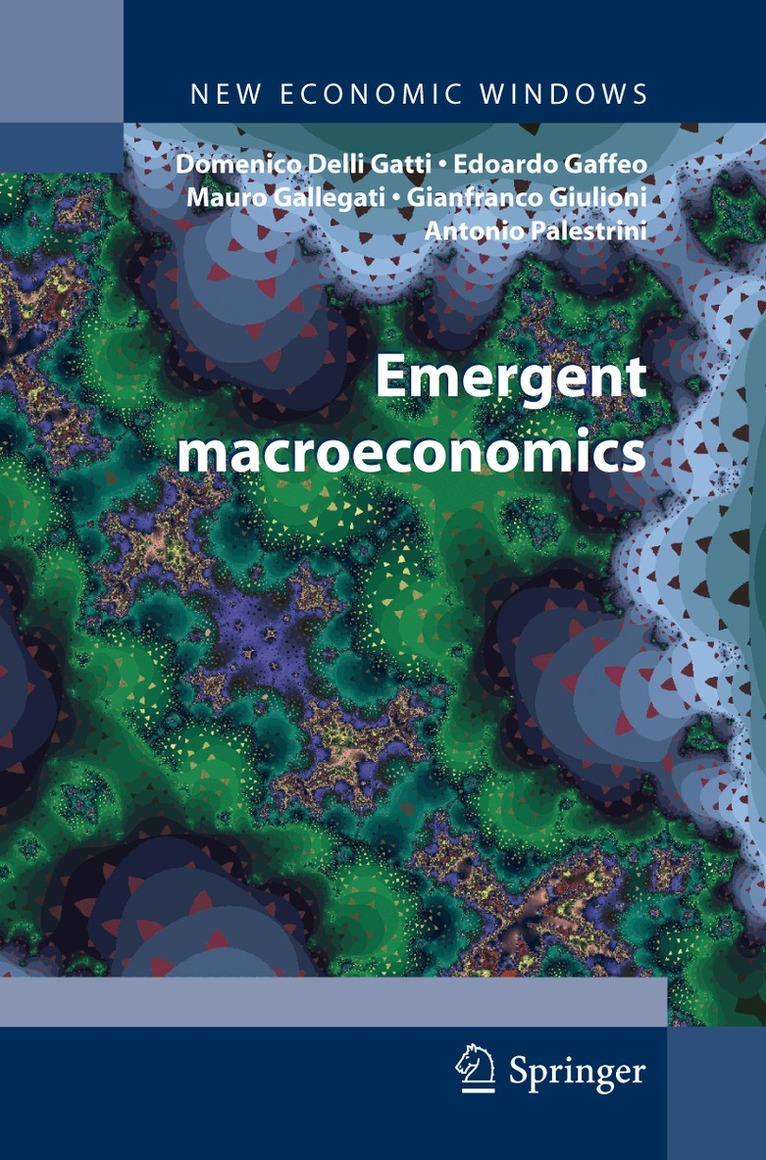
    Emergent Macroeconomics

    An Agent-Based Approach to Business Fluctuations

    AvDomenico Gatti,Edoardo Gaffeo

    Inbunden, Engelska, 2008

    Del i serien New Economic Windows

    559 kr

    Beställningsvara. Skickas inom 10-15 vardagar. Fri frakt över 249 kr.

    Fler format och utgåvor

    Häftad

    559 kr

    Beskrivning

    by exploiting the disequilibrium and non linear relationships among economic aggregates. Prom an empirical point of view, this approach resemblaces the old NBER view, according to which: "the business cycle [. . . ] consists of - pansions occurring at about the same time in many economic activities, f- lowed by similairly general recessions, contractions, and revivals which merge into the expansion phase of the next cyxle" (Burns and Mitchell, 1946). They add that the movement, although recurrent, is not periodic, lasting from 1 to 12 years, and it is not divisible into shorter cycles. Of course, both approaches are not free from limits and inconsistencies. In spite of the equilibrium approach having nowadays became the workhorse of modern macroeconomics, for example, their users still find enormous d- ficulties in explaining why small shocks produce large fluctuations. A well known argument in multi sector real business cycle models (see e. g. Long and Plosser, 1983) is that as the number of sectors or industries considered in the analysis becomes large, aggregate volatility must tend to zero very quickly. This result, which follows directly from the Law of Large Numbers (LLN), rests on the hypothesis that each sector is periodically buffeted with idiosyncratic, identically and independently distributed shocks to Total F- tor Productivity (TFP).

    Produktinformation

    • Utgivningsdatum:2008-04-14
    • Mått:155 x 235 x 13 mm
    • Vikt:366 g
    • Format:Inbunden
    • Språk:Engelska
    • Serie:New Economic Windows
    • Antal sidor:114
    • Upplaga:2008
    • Förlag:Springer Verlag
    • ISBN:9788847007246

    Utforska kategorier

    • Makroekonomi inom Ekonomi och Ledarskap

    Innehållsförteckning

    • Crucial Issues.- Stylized Facts of Industrial Dynamics: The Distribution of Firms’ Size.- Stylized Facts in Industrial Dynamics: Exit, Productivity, Income.- An Agent-based Model.- Where Do We Go from Here?.