• Fri frakt över 249 kr
  • •
  • Snabba leveranser
  • •
  • Billiga böcker
Kundservice

Du är på sajten för privatpersoner.

Företag, bibliotek eller offentlig verksamhet?

Du handlar på classic.bokus.com, där alla dina funktioner finns intakta.
Till classic.bokus.com
Bokus logotyp. Gå till startsidan.
  • Erbjudanden
  • Nyheter
  • Student
  • Topplistor
  • Barn & ungdom
  • Bokus Play
  • E-böcker
  • Pocketböcker
  • Spel & pussel

10% rabatt på allt med kod NYSTART10 →

Sidfot

Mina sidor

    Hjälp

    • Kundservice
    • Vanliga frågor och svar
    • Frakt och leverans
    • Retur vid ångerrätt
    • Reklamera vara
    • Betalning
    • Köpvillkor
    • Allmänna villkor
    • Information om webbplatsens tillgänglighet

    Om Bokus

    • Om oss
    • Pressrum
    • För studenter
    • För företag
    • För bibliotek och offentlig verksamhet
    • För leverantörer
    • Hållbarhet

    Populärt

    • Aktuella erbjudanden
    • Presentkort
    • Studentlitteratur
    • Nya böcker
    • Topplistor
    • Signerade böcker
    • Engelska böcker

    Inspiration

    • Boktips
    • BookTok
    • Populära bokserier
    • Barnbokskaraktärer
    • Populära författare
    Logotyp för Bokus
    Följ oss på Facebook (extern länk)Följ oss på Instagram (extern länk)Följ oss på YouTube (extern länk)Följ oss på TikTok (extern länk)
    bokus @ CookiesAnpassa cookiesIntegritetspolicyKöpvillkor
    Till Citymail hemsida (extern länk)Till Budbee hemsida (extern länk)Till Postnord hemsida (extern länk)Till Schenker hemsida (extern länk)Till Early Bird hemsida (extern länk)Till Walleys hemsida (extern länk)
    1. Skönlitteratur
    2. Litteraturvetenskap
    3. Litteraturvetenskap

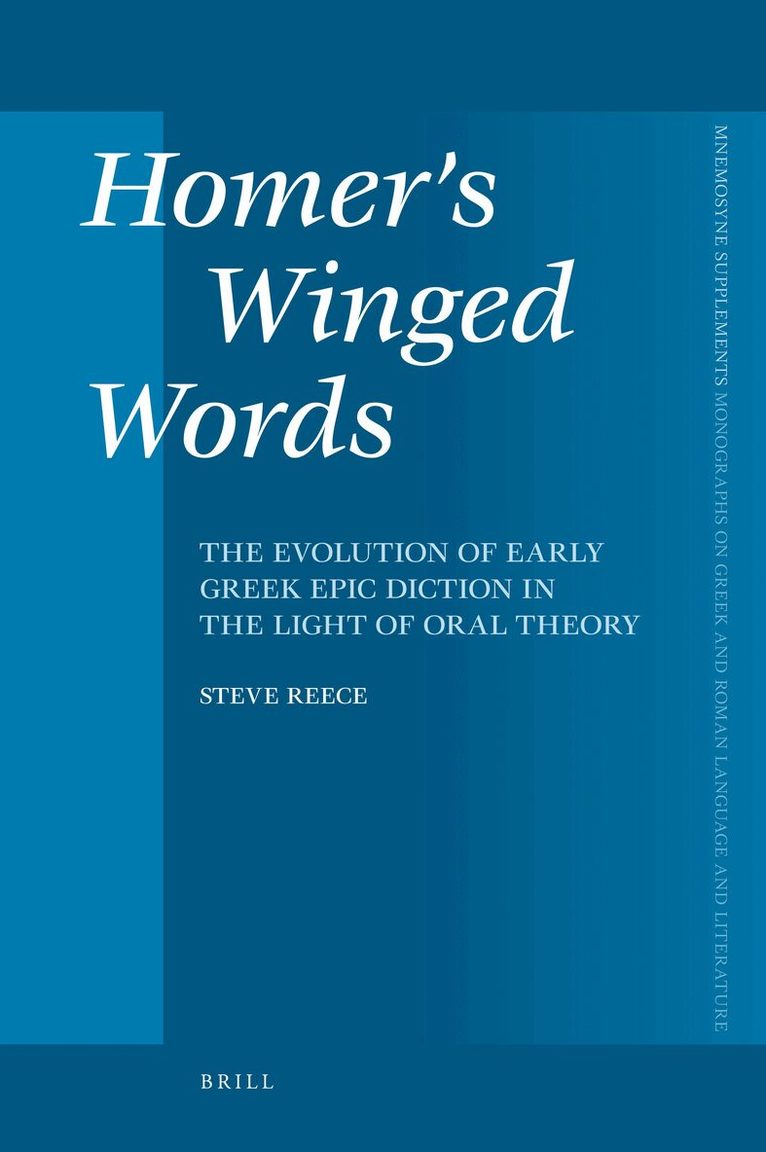
    Homer's Winged Words

    The Evolution of Early Greek Epic Diction in the Light of Oral Theory

    AvSteve Reece

    Inbunden, Engelska, 2009

    Del 313 i serien Mnemosyne, Supplements

    4 452 kr

    Beställningsvara. Skickas inom 5-8 vardagar. Fri frakt över 249 kr.

    Beskrivning

    For over 2500 years many of the most learned scholars of the Greek language have concerned themselves with the topic of etymology. The most productive source of difficult, even inexplicable, words was Homer’s 28,000 verses of epic poetry. Steve Reece proposes an approach to elucidating the meanings of some of these difficult words that finds its inspiration primarily in Milman Parry’s oral-formulaic theory. He proposes that during the long period of oral transmission acoustic uncertainties, especially regarding word boundaries, were continually occurring: a bard uttered one collocation of words, but his audience thought it heard another. The consequent resegmentation of words and phrases is the probable cause of some of the etymologically inexplicable words in our Homeric texts.

    Produktinformation

    • Utgivningsdatum:2009-05-20
    • Mått:160 x 240 x 28 mm
    • Vikt:883 g
    • Format:Inbunden
    • Språk:Engelska
    • Serie:Mnemosyne, Supplements
    • Antal sidor:413
    • Förlag:Brill
    • ISBN:9789004174412

    Utforska kategorier

    • Litteraturvetenskap inom Skönlitteratur
    • Forntidens historia inom Historia och arkeologi

    Mer om författaren

    Steve Reece, Ph.D. (1990) in Classics, University of California, Los Angeles, is Professor of Classics at Saint Olaf College in Northfield, Minnesota. He has published widely on Homeric studies, New Testament studies, comparative oral traditions, historical linguistics, and pedagogy.

    Recensioner i media

    "There is indeed no comparable work. Reece's book will be of interest to those interested in linguistic change and the history of Greek, prosody (in the broader sense encompassing e.g. rhythm, intonation, and syllabification, and not just metrics), and of course the Homeric Kunstsprache and the oral-formulaic theory of performance and composition. We are indebted to Reece for undertaking such a comprehensive investigation of the topic (the book is just over four-hundred pages)." - D.M. Goldstein, in: BMCR 2010.03.03"While the book can be read piecemeal, Reece builds a solid and cumulative case for his thesis that poetry composed and experienced within an oral tradition is especially liable to certain kinds of verbal innovation, which in turn explains the origins of some of the most notoriously obscure Homeric expressions." - Jenny Strauss Clay, University of Virginia, in: Religious Studies Review, Vol. 37 Nr. 2 (2011)