• Fri frakt över 249 kr
  • •
  • Snabba leveranser
  • •
  • Billiga böcker
Kundservice

Du är på sajten för privatpersoner.

Företag, bibliotek eller offentlig verksamhet?

Du handlar på classic.bokus.com, där alla dina funktioner finns intakta.
Till classic.bokus.com
Bokus logotyp. Gå till startsidan.
  • Erbjudanden
  • Nyheter
  • Student
  • Topplistor
  • Barn & ungdom
  • Bokus Play
  • E-böcker
  • Pocketböcker
  • Spel & pussel

10% rabatt på allt med kod: NYSTART10 →

Sidfot

Mina sidor

    Hjälp

    • Kundservice
    • Vanliga frågor och svar
    • Frakt och leverans
    • Retur vid ångerrätt
    • Reklamera vara
    • Betalning
    • Köpvillkor
    • Allmänna villkor
    • Information om webbplatsens tillgänglighet

    Om Bokus

    • Om oss
    • Pressrum
    • För studenter
    • För företag
    • För bibliotek och offentlig verksamhet
    • För leverantörer
    • Hållbarhet

    Populärt

    • Aktuella erbjudanden
    • Presentkort
    • Studentlitteratur
    • Nya böcker
    • Topplistor
    • Signerade böcker
    • Engelska böcker

    Inspiration

    • Boktips
    • BookTok
    • Populära bokserier
    • Barnbokskaraktärer
    • Populära författare
    Logotyp för Bokus
    Följ oss på Facebook (extern länk)Följ oss på Instagram (extern länk)Följ oss på YouTube (extern länk)Följ oss på TikTok (extern länk)
    bokus @ CookiesAnpassa cookiesIntegritetspolicyKöpvillkor
    Till Citymail hemsida (extern länk)Till Budbee hemsida (extern länk)Till Postnord hemsida (extern länk)Till Schenker hemsida (extern länk)Till Early Bird hemsida (extern länk)Till Walleys hemsida (extern länk)
    1. Filosofi och religion
    2. Religion och tro
    3. Kristendom

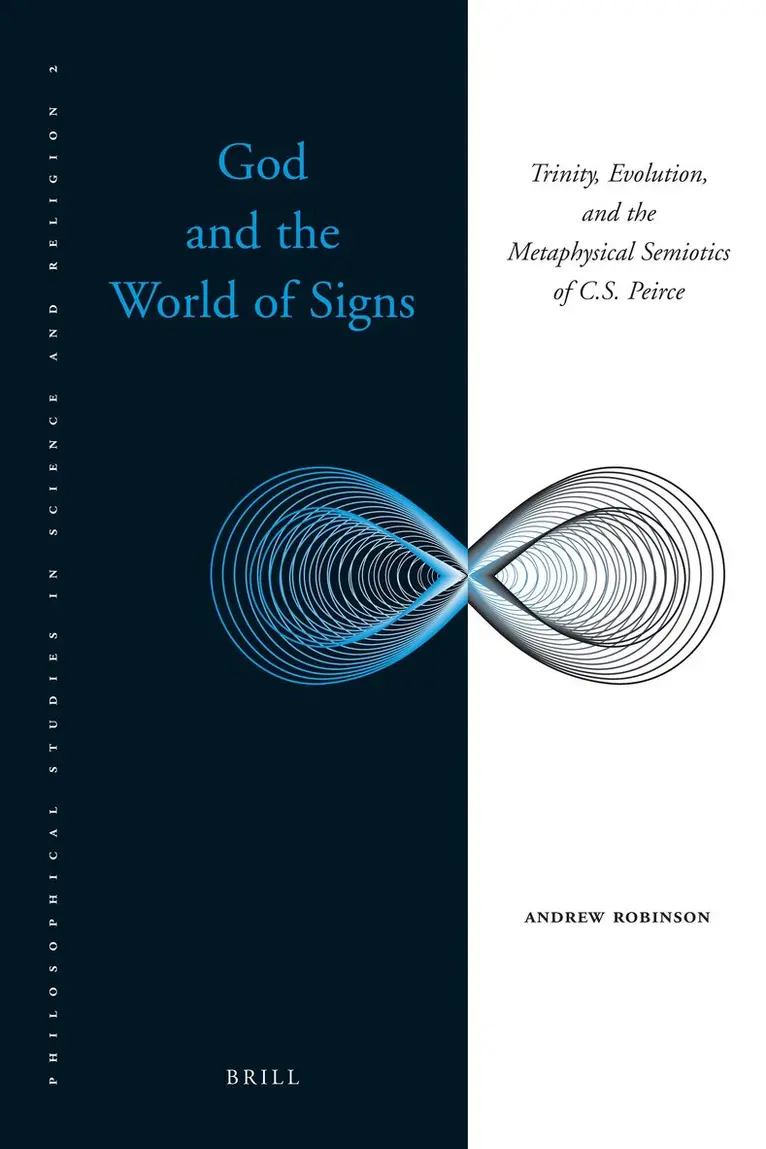
    God and the World of Signs

    Trinity, Evolution, and the Metaphysical Semiotics of C. S. Peirce

    AvAndrew Robinson

    Inbunden, Engelska, 2010

    Del 2 i serien Philosophical Studies in Science and Religion

    2 817 kr

    Beställningsvara. Skickas inom 5-8 vardagar. Fri frakt över 249 kr.

    Beskrivning

    Christianity has been described as “a religion seeking a metaphysic”. Drawing on the philosophy of C. S. Peirce, Robinson develops a metaphysical framework centred around a ‘semiotic model’ of the Trinity. The model invites a fresh approach to the claim that Jesus was the incarnate Word of God and suggests a new way of understanding how nature may bear the imprint of the Triune Creator in the form of ‘vestiges of the Trinity in creation’. Scientific spin-offs include a new perspective on the problem of the origin of life and a novel hypothesis about the evolution of human distinctiveness. The result is an original contribution to Trinitarian theology and a bold new way of integrating philosophy, science and religion.

    Produktinformation

    • Utgivningsdatum:2010-09-24
    • Mått:155 x 235 x 28 mm
    • Vikt:1 640 g
    • Format:Inbunden
    • Språk:Engelska
    • Serie:Philosophical Studies in Science and Religion
    • Antal sidor:382
    • Förlag:Brill
    • ISBN:9789004187993

    Utforska kategorier

    • Kristendom inom Filosofi och religion
    • Medicin: allmänt inom Medicin

    Mer om författaren

    Andrew Robinson is Honorary University Fellow in Theology at the University of Exeter. He took a degree in Physiology (BSc, Bristol, 1985) before qualifying in Medicine (MB ChB 1988) and subsequently undertaking doctoral research in Theology (PhD, Exeter, 2003).

    Recensioner i media

    "In conclusion, God and the World of Signs is remarkably well written, clear in structure and thought, and impressive in scope. The reader can follow the ambitious argument from page one and is helped all the way through by careful introductions and summaries at the beginning and end of each chapter. (...) This is a unique contribution, especially in regard to the relationship between the theology of the Trinity and Peircean semiotics." Johanne Stubbe Teglbjærg Kristensen, University of Copenhagen, in: Philosophy, Theology, and the Sciences Vol. 3.1 (2016)."As systematically ambitious as the great systematic theologies of the past, resonating with the spirit of an Augustine or a Thomas Aquinas. ... Philosophers in the great traditions, East and West, will be pleased; systematic religious thinkers will discern one of their own; and even skeptics may be intrigued, even if in the end they can only shake their heads at the sheer chutzpah of it all!" Philip Clayton, Claremont School of Theology."This is the first comprehensively Trinitarian reading of Peirce as well as the most thorough exploration yet published of Peircian semiotics for science-and-religion research." Gary Slater, Oxford University, in: American Journal of Theology and Philosophy

    Innehållsförteckning

    • Acknowledgements ... xiAbbreviations ... xiiiIntroduction ... 11. Peirce’s Metaphysical Semiotics ... 151.1 A World Perfused With Signs ... 151.2 Peirce’s Categories: Firstness, Secondness and Thirdness ... 201.2.1 Peirce’s Gift to the World ... 201.2.2 A Priori and Phenomenological Derivation of the Categories ... 231.2.3 Further Features of Firstness ... 281.3 Peirce’s Semiotics ... 311.3.1 The Development of Peirce’s Theory of Signs ... 311.3.2 Semiotics and the Categories ... 371.3.3 More Kinds of Sign and Further Iterations of the Categories ... 391.4 Peirce’s Theory of Inquiry ... 431.4.1 Fallibilism and Inference ... 431.4.2 Pragmatism and Realism ... 491.4.3 Faith, Hope and Charity: Virtues of the Community of Inquirers ... 562. A Semiotic Model of the Trinity ... 612.1 The Son / Word and Secondness ... 632.1.1 In the Beginning Was the Word ... 632.1.2 Logos As Secondness: Points of Disagreement? ... 682.2 The Father and Firstness ... 722.2.1 The Transcendence of the Father and the Homoousion of the Son ... 722.2.2 Firstness and Ingenerateness ... 772.2.3 Essence and Energies: On Not Knowing God by a Definition ... 812.3 The Spirit and Thirdness ... 842.3.1 The Lord the Giver of Life ... 842.3.2 The Procession of the Spirit ... 902.4 Persons, Relations, and Perichoresis ... 972.4.1 The Problem with Relations ... 972.4.2 A Semiotic Model of the Trinity ... 1012.5 Peirce and the Trinity ... 1083. Semiotics, Incarnation and Anthropology ... 1133.1 Incarnation and Peirce’s Taxonomy of Signs ... 1153.1.1 Jesus and the Enacted Return of YHWH ... 1153.1.2 Jesus’ Signs and Peirce’s Taxonomy ... 1183.1.3 Incarnation As Qualisign ... 1233.2 Semiotics and Christology ... 1283.2.1 Three Dimensions of Christology ... 1283.2.2 Qualisign or Real-Symbol?: Peirce vs. Rahner ... 1333.2.3 Fused Substances and Broken Symbols: Response to TwoObjections ... 1403.3 Semiotics and Palaeo-Anthropology ... 1433.3.1 Human Distinctiveness and Hierarchical Semiotics ... 1433.3.2 Human Evolution and the Semiotic Matrix ... 1503.4 Semiotics and Theological Anthropology ... 1613.4.1 Self-Transcendence and the Gift of Abduction ... 1613.4.2 Discipleship as Interpretative Transformation ... 1664. Evolution, Theology and Biosemiotics ... 1794.1 Darwinism and Theology ... 1814.1.1 Three Phases of Darwinism ... 1814.1.2 Biosemiotics: Resource for a Theology of Nature? ... 1864.2 Interpretation, Teleology, and the Origin of Life ... 1964.2.1 Defining Purpose and Interpretation ... 1964.2.2 Interpretation and the Emergence of Life ... 2074.2.3 Biosemiotics vs. Teleosemantics ... 2135. Vestiges of the Trinity in Creation ... 2215.1 Peirce’s Evolutionary Cosmology ... 2245.1.1 Biographical Context: Vocation and Destitution ... 2245.1.2 Three Modes of Evolution: Chance, Necessity and Love ... 2275.2 Braiding the Strands: Towards a Trinitarian Theology of Nature ... 2355.2.1 Continuity, Semiosis and Thirdness ... 2355.2.2 Contingency, Emergent Novelty, and Firstness ... 2405.2.3 Naturalism, Secondness and the Trinitarian Mediation of Creation ... 2485.3 Vestiges of the Trinity in Creation ... 2565.3.1 Analogy, Likeness, or Vestige? ... 2565.3.2 The Two Hands of God ... 2625.3.3 The Immanent and Economic Trinity ... 2696. Metaphysics and the Architecture of Knowledge ... 2796.1 Metaphysics and the Architecture of Theories ... 2816.1.1 Do Not Block the Way of Inquiry ... 2816.1.2 Cenoscopy and Synthetic Philosophy ... 2856.2 Natural Theology and Revelation ... 2906.3 A ‘Cosmological Argument’ From the Universes of Experience ... 3036.3.1 Peirce’s ‘Neglected Argument’ ... 3036.3.2 A Petite Bouchée with the Categories: Intimations of the Trinity ... 3057. Guesses At Some Riddles ... 3137.1 Trinitarian Selfhood: Psyche, Society or Semiosis? ... 3147.1.1 Psychological and Social Analogies for the Trinity ... 3147.1.2 The Psychological Analogies Re-visited ... 3187.1.3 The Semiotic Model and Peirce’s Approach to the Self ... 3207.2 Two Guesses about Firstness ... 3297.2.1 The Freedom of the Father and the Goodness of Creation ... 3297.2.2 Firstness and the Quest For the Maternal ... 3338. Epilogue: If the Fathers Had Known Peirce ... 3378.1 Nicaea to Constantinople: Standard View ... 3378.2 Nicaea to Constantinople: Lateral View ... 3428.3 Credo ... 348Bibliography ... 355Index of Names ... 369Index of Subjects ... 373