• Fri frakt över 249 kr
  • •
  • Snabba leveranser
  • •
  • Billiga böcker
Kundservice

Du är på sajten för privatpersoner.

Företag, bibliotek eller offentlig verksamhet?

Du handlar på classic.bokus.com, där alla dina funktioner finns intakta.
Till classic.bokus.com
Bokus logotyp. Gå till startsidan.
  • Erbjudanden
  • Nyheter
  • Student
  • Topplistor
  • Barn & ungdom
  • Bokus Play
  • E-böcker
  • Pocketböcker
  • Spel & pussel

10% rabatt på allt med kod NYSTART10 →

Sidfot

Mina sidor

    Hjälp

    • Kundservice
    • Vanliga frågor och svar
    • Frakt och leverans
    • Retur vid ångerrätt
    • Reklamera vara
    • Betalning
    • Köpvillkor
    • Allmänna villkor
    • Information om webbplatsens tillgänglighet

    Om Bokus

    • Om oss
    • Pressrum
    • För studenter
    • För företag
    • För bibliotek och offentlig verksamhet
    • För leverantörer
    • Hållbarhet

    Populärt

    • Aktuella erbjudanden
    • Presentkort
    • Studentlitteratur
    • Nya böcker
    • Topplistor
    • Signerade böcker
    • Engelska böcker

    Inspiration

    • Boktips
    • BookTok
    • Populära bokserier
    • Barnbokskaraktärer
    • Populära författare
    Logotyp för Bokus
    Följ oss på Facebook (extern länk)Följ oss på Instagram (extern länk)Följ oss på YouTube (extern länk)Följ oss på TikTok (extern länk)
    bokus @ CookiesAnpassa cookiesIntegritetspolicyKöpvillkor
    Till Citymail hemsida (extern länk)Till Budbee hemsida (extern länk)Till Postnord hemsida (extern länk)Till Schenker hemsida (extern länk)Till Early Bird hemsida (extern länk)Till Walleys hemsida (extern länk)
    1. Skönlitteratur
    2. Litteraturvetenskap
    3. Litteraturvetenskap

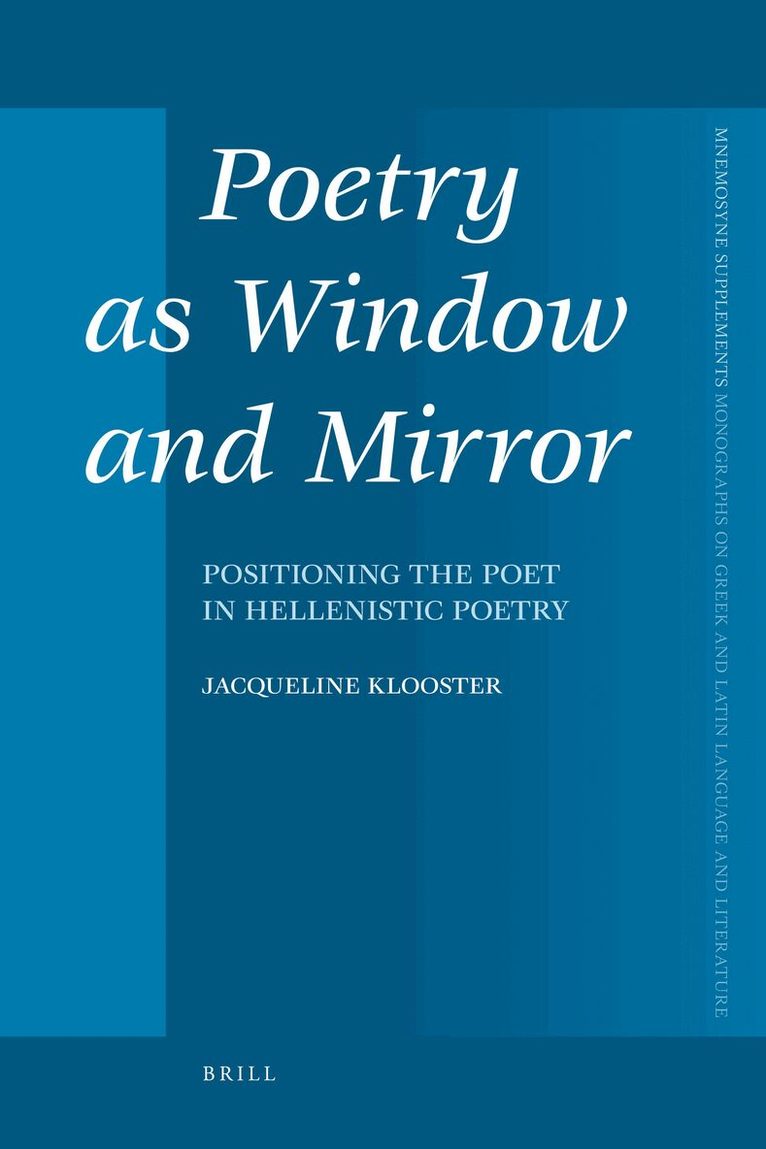
    Poetry as Window and Mirror

    Positioning the Poet in Hellenistic Poetry

    AvJacqueline Klooster

    Inbunden, Engelska, 2011

    Del 330 i serien Mnemosyne, Supplements

    2 733 kr

    Beställningsvara. Skickas inom 5-8 vardagar. Fri frakt över 249 kr.

    Beskrivning

    Hellenistic Poetry has enjoyed a notable re-appreciation in recent years and received ample scholarly discussion, especially focusing on its reception and innovation of Greek poetic tradition. This book wishes to add to our picture of how Hellenistic poetry works by looking at it from a slightly different angle. Concentrating on the interaction between contemporary poets, it attempts to view the dynamics of imitation and reception in the light of poetical self-positioning. In the courtly Alexandrian surroundings, choosing a poetic model and affiliation determines one's position in the cultural field. This book sets out to chart, not only the well-known complexities of handling the poetic past, but especially their relation to the poetic interaction of the Hellenistic, in particular Alexandrian poets.

    Produktinformation

    • Utgivningsdatum:2011-03-21
    • Mått:155 x 235 x 24 mm
    • Vikt:620 g
    • Format:Inbunden
    • Språk:Engelska
    • Serie:Mnemosyne, Supplements
    • Antal sidor:282
    • Förlag:Brill
    • ISBN:9789004202290

    Utforska kategorier

    • Litteraturvetenskap inom Skönlitteratur

    Mer om författaren

    Jacqueline Klooster, Ph. D. (2009) in Classics, University of Amsterdam, is researcher and lecturer at the University of Amsterdam. She has published various articles on Hellenistic Poetry including narratological analyses of time and space in Apollonius and Theocritus (Brill, 2007).

    Innehållsförteckning

    • CHAPTER 1: POETIC PREDECESSORS IN EPIGRAM1.1From Greece to Alexandria1.2Greek Poets and their Predecessors1.3Royal Patronage and Cultural Memory1.4Which Poets and what Past?1.5Poetical Predecessors Represented in Epigram1.5.1The Text as Monument1.5.2Biographical Readings1.6ConclusionCHAPTER 2: COMING TO TERMS WITH POETIC MODELS2.1Tradition and Originality2.2Meeting Ancient Poets2.2.1Timon, Xenophanes and Pyrrho in Homer’s Hades2.2.2Hipponax in Callimachus’ Iambi and Herondas’ Mimiambi2.3Paradigmatic Poets: Theocritus 16:2.4Biased Readings: Hermesianax' Leontion2.5Poets to Avoid2.5.1Imitating Homer2.5.2Liking Antimachus2.6ConclusionCHAPTER 3: APPROPRIATING MYTHICAL POETS 3.1Inventing Traditions3.2Mythical Poets3.3Orpheus in Greek Tradition3.4Orpheus in the Argonautica3.5Orpheus and the Hymnic Argonautica3.6Theocritus and the Invention of Bucolic Poetry3.7Ancient Theories on the Origins of Bucolic Poetry3.8Daphnis in Idyll 13.9Allusive Narrative3.10Daphnis in the other Idylls3.11Daphnis and Comatas3.12A World of Song3.13ConclusionCHAPTER 4: CRITICIZING CONTEMPORARIES4.1The Muses' Birdcage4.2Poetic Competition and Strife4.3Bourdieu’s Field of Cultural Production4.4Callimachus and Apollonius4.5The Aetia-Prologue4.6The Telchines and the Lyde4.7Callimachus’ Iambi4.8Epigrams4.9ConclusionCHAPTER 5: PRAISING CONTEMPORARIES5.1Praised Poetics and Poetics of Praise5.2Praising the Old and the New5.3Reading the Signs in Aratus’ Phaenomena5.4The Mirror of Immortality5.5Inviting Comparison5.6Eliciting Praise5.7ConclusionCHAPTER 6: PERSONA, ALIAS AND ALTER EGO IN SPHRAGIS-POETRY6.1Sphragides6.2The Seal or Testament of Posidippus6.3Role-Playing versus Self-Portrayal6.4Allusive Names, Elusive Poets6.5Punning and Wordplay6.6Theocritus, Simichidas and Lycidas6.7ConclusionCHAPTER 7: AUTHORITY AND INSPIRATION IN THE AGE OF THE MUSEUM7.1Questioning the Muse7.2Homeric Scholarship and Hellenistic Poetry7.3Overview of Passages featuring ὑποφήτης7.4The Μοῦσαι ὑποφήτορες of Apollonius7.5Apollonius on Poetic Inspiration7.6Parallel Representations of the Muses7.7Theocritus7.7.1Idyll 16: Κλέος and Prophecy7.7.2Idyll 17: Immortal Fame for an Immortal King7.7.3Idyll 22: Rewriting the Poetic Past7.8Conclusion