• Fri frakt över 249 kr
  • •
  • Snabba leveranser
  • •
  • Billiga böcker
Kundservice

Du är på sajten för privatpersoner.

Företag, bibliotek eller offentlig verksamhet?

Du handlar på classic.bokus.com, där alla dina funktioner finns intakta.
Till classic.bokus.com
Bokus logotyp. Gå till startsidan.
  • Erbjudanden
  • Nyheter
  • Student
  • Topplistor
  • Barn & ungdom
  • Bokus Play
  • E-böcker
  • Pocketböcker
  • Spel & pussel

10% rabatt på allt med kod: NYSTART10 →

Sidfot

Mina sidor

    Hjälp

    • Kundservice
    • Vanliga frågor och svar
    • Frakt och leverans
    • Retur vid ångerrätt
    • Reklamera vara
    • Betalning
    • Köpvillkor
    • Allmänna villkor
    • Information om webbplatsens tillgänglighet

    Om Bokus

    • Om oss
    • Pressrum
    • För studenter
    • För företag
    • För bibliotek och offentlig verksamhet
    • För leverantörer
    • Hållbarhet

    Populärt

    • Aktuella erbjudanden
    • Presentkort
    • Studentlitteratur
    • Nya böcker
    • Topplistor
    • Signerade böcker
    • Engelska böcker

    Inspiration

    • Boktips
    • BookTok
    • Populära bokserier
    • Barnbokskaraktärer
    • Populära författare
    Logotyp för Bokus
    Följ oss på Facebook (extern länk)Följ oss på Instagram (extern länk)Följ oss på YouTube (extern länk)Följ oss på TikTok (extern länk)
    bokus @ CookiesAnpassa cookiesIntegritetspolicyKöpvillkor
    Till Citymail hemsida (extern länk)Till Budbee hemsida (extern länk)Till Postnord hemsida (extern länk)Till Schenker hemsida (extern länk)Till Early Bird hemsida (extern länk)Till Walleys hemsida (extern länk)
    1. Juridik
    2. Rättsvetenskap
    3. Komparativ rätt

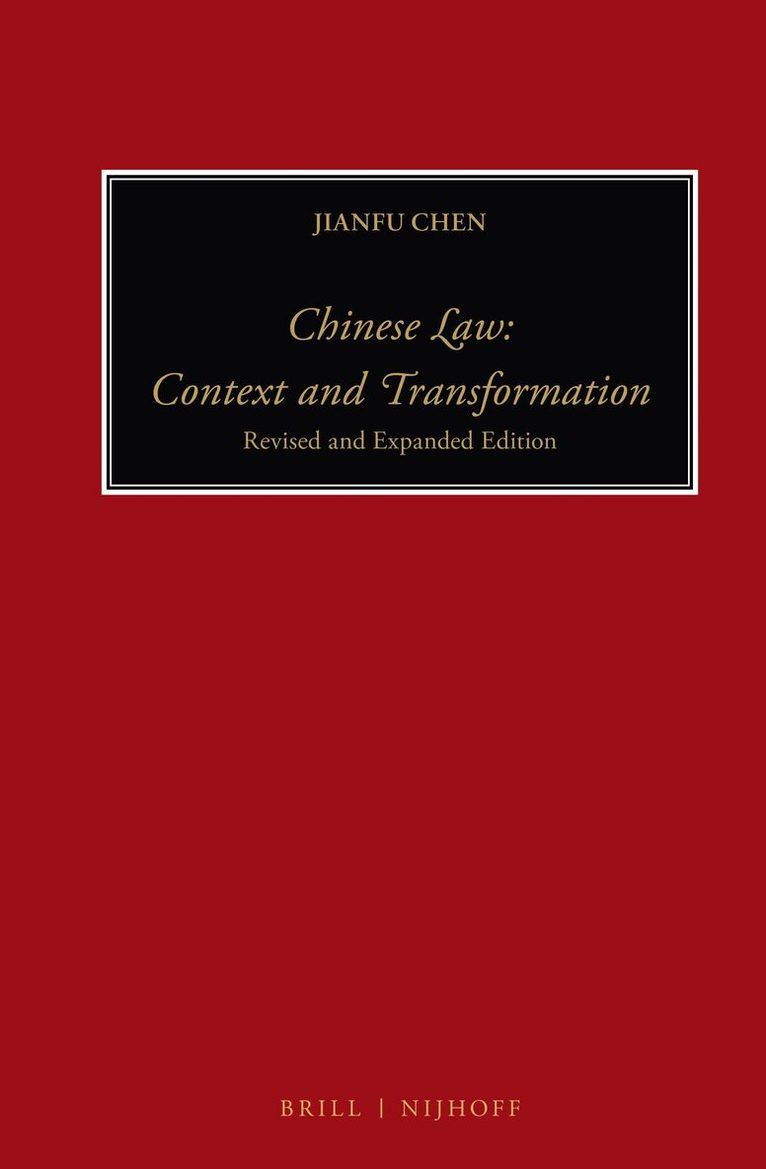
    Chinese Law: Context and Transformation

    Revised and Expanded Edition

    AvJianfu Chen

    Häftad, Engelska, 2015

    2 325 kr

    Beställningsvara. Skickas inom 5-8 vardagar. Fri frakt över 249 kr.

    Beskrivning

    China has changed and the continuing changes have not just been about economic development. Among the many transformations there has been another quiet, peaceful, and largely successful (but far from perfect) ‘revolution’ in the area of law, whose deficiencies have been more often mercilessly examined and documented than have its historical achievements and significance. This legal ‘revolution’ is the subject matter of the present book. Like the previous edition in 2008, it examines the historical and politico-economic context in which Chinese law has developed and transformed, focusing on the underlying factors and justifications for the changes. It attempts to sketch the main trends in legal modernisation in China, offering an outline of the principal features of contemporary Chinese law and a clearer understanding of its nature from a developmental perspective. It provides comprehensive coverage of topics: ‘legal culture’ and modern law reform, constitutional law, legal institutions, law-making, administrative law, criminal law, criminal procedure law, civil law, property, family law, contracts, torts, law on business entities, securities, bankruptcy, intellectual property, law on foreign investment and trade, Chinese investment overseas, dispute settlement and implementation of law. Fully revised, updated and considerably expanded, this edition of Chinese Law: Context and Transformation is a valuable and important resource for researchers, policy-makers and teachers alike.

    Produktinformation

    • Utgivningsdatum:2015-11-27
    • Mått:155 x 235 x 47 mm
    • Vikt:1 566 g
    • Format:Häftad
    • Språk:Engelska
    • Antal sidor:1 122
    • Upplaga:2
    • Förlag:Brill
    • ISBN:9789004228887

    Utforska kategorier

    • Komparativ rätt inom Juridik

    Mer om författaren

    Jianfu Chen, LLM (Hon I), PhD (Law, 1994), the University of Sydney, is Professor of Law at La Trobe University School of Law. He has published extensively on Chinese law, international trade law, and legal globalisation.

    Innehållsförteckning

    • Excerpt of table of contents:Preface, Acknowledgements, Abbreviations; Introduction1. The Transformation of Chinese Law and the Legal System in Context2. Structure of the Present Study Chapter One: Legal Culture, State Orthodoxy and the Modernisation of Law 1. Introduction; 2. Legal Culture and Heritage; 3. The Beginning of Modernisation - The Wholesale Westernisation of Chinese Law; 4. The Continuing Reform under the KMT - The Modernisation of Chinese Law; 5. Concluding RemarksChapter Two: Experience of Law in the PRC1. Introduction; 2. The Pre-PRC Communist Experience of Law; 3. The Triumph of Ideology; 4. Legal Experience under Mao’s Leadership; 5. Legal Experience in Post-Mao China; 6. After Ideology - Between Westernisation and Modernisation of Chinese Law; 7. Concluding RemarksChapter Three: Constitutional Law1. Introduction; 2. A Brief Historical Review; 3. The Search for Socialist Solutions with Chinese Characteristics; 4. Constitutional Law in Present-day China; 5. Concluding RemarksChapter Four: Legal Institutions and the Administration of Justice and Law1. Introduction; 2. Legal Institutions in Context; 3. The People’s Courts; 4. The People’s Procuratorates; 5. The Legal Profession; 6. The Administration of Justice and Law; 7. Legal Education; 8. Concluding RemarksChapter Five: Sources of Law and Law-Making1. Introduction; 2. A Changing Constitutional Framework for Law-Making; 3. The Law on Law-Making; 4. Substantive Issues; 5. Procedural Issues; 6. Concluding RemarksChapter Six: Administrative Law1. Introduction; 2. Historical Development of Administrative Law in China; 3. Changing Conceptions of Administrative Law in Contemporary China; 4. Administrative Decision Making and Procedural Requirements; 5. Internal Review of Administrative Decisions; 6. Administrative Supervision; 7. Administrative Litigation; 8. Administrative Liability; 9. Concluding RemarksChapter Seven:Criminal Law1. Introduction; 2. The 1979 Criminal Law and Its Development; 3. General Principles; 4. Crime and Punishment; 5. Administrative Sanctions v. Criminal Punishments; 6. The Death Penalty; 7. Concluding RemarksChapter Eight: Criminal Procedure Law1. Introduction; 2. An Overview of the Major Deficiencies of the CPL; 3. Major Reforms in 1996 and 2012; 4. Other Developments; 5. Concluding RemarksChapter Nine: Civil Law: Development and General Principles1. Introduction; 2. Historical Heritage of Civil Law in China; 3. The Emergence of Modern Civil Law in the PRC; 4. An Abstract Conceptual Framework on Civil Matters; 5. Civil and Commercial Law Institutions; 6. Concluding RemarksChapter Ten: Civil Law: Property1. Introduction; 2. Property Rights in Traditional China and Modern Property Law under the KMT; 3. Socialist Concepts and Conceptions of Property Rights in the PRC; 4. The New Rights in rem; 5. Concluding RemarksChapter Eleven: Civil Law: Family 1. Introduction; 2. An Overview of the Traditional Family and Society; 3. Historical Development of Family Law in Modern China; 4. The Contemporary Legal Framework on Family Matters; 5. The Law as an Instrument for and in Response to Social Change; 6. Concluding RemarksChapter Twelve: Civil Law: Contracts1. Introduction; 2. The Development of Contract Law in the PRC; 3. Present Legal Framework on Contracts; 4. General Principles of the Contract Law; 5. Concluding RemarksChapter Thirteen: Civil Law: Torts1. Introduction; 2. The Emergence of the 2009 Tort Liability Law ; 3. The Present Legal Framework on Tort Liability; 4. Tort Liability: Principles and Remedies; 5. The Missing Link and the Unresolved Issues; 6. Concluding RemarksChapter Fourteen: Law on Business Entities1. Introduction; 2. Business Entities in Transition; 3. Individual Sole Investment Enterprises (Sole Proprietorship) (Geren Duzi Qiye); 4. The Partnership Law; 5. Company Law; 6. Concluding Remarks Chapter Fifteen: Securities and Futures Law1. Introduction; 2. Early Experiments and Their Politico-Economic Functions; 3. The Coming of Age of the Securities Market and Its Regulation; 4. Legal Framework; 5. Institutional Setting; 6. Issuing of Securities; 7. Trading of Securities; 8. Globalisation of the Chinese Securities Industry; 9. Futures; 10. Legal Liabilities for Violation Law; 11. Concluding RemarksChapter Sixteen: Enterprise Bankruptcy Law1. Introduction; 2. A Historical Review of Bankruptcy Law in China; 3. Current Legal Framework on Bankruptcy; 4. Breakthrough, Compromise & Limitations; 5. Concluding RemarksChapter Seventeen: Intellectual Property Law 1. Introduction; 2. Rapid Development of the IP Market and Legal Framework on Protection; 3. Trademarks; 4. Patents; 5. Copyright; 6. Competition Law & Commercial Secrets; 7. Implementation and Enforcement Mechanisms; 8. Concluding Remarks Chapter Eighteen: Foreign Trade and Investment Law1. Introduction; 2. A Process of Gradual Transformation; 3. Law on Foreign Trade; 4. Direct Foreign Investment; 5. Concluding RemarksChapter Nineteen: China’s Outbound Direct Investment1. Introduction; 2. China’s ODI from a Developmental Perspective: The Macro Economic Context; 3. China’s ODI Strategy in Context - The Evolving Policy and Regulatory Framework; 4. Between Macro Economic Control and Micro Economic Management; 5. Concluding RemarksChapter Twenty: Dispute Settlement1. Introduction; 2. Negotiation/Consultation; 3. Mediation/Conciliation (Tiaojie); 4. Arbitration; 5. Petition (Xinfang – letters and visits): Alternative to formal institutions?; 6. Civil Litigation; 7. Concluding RemarksChapter Twenty One: Implementation and Enforcement of Law1. Introduction; 2. Implementation of Law – Its Nature and Complexity; 3. Implementation of Law – the Impact of Law: the Case of IP Protection; 4. Enforcement of Law – the Case of ‘Zhixing Nan’ ; 5. Enemies Within and Without, Systemic and Institutional; 6. Politico-Legal Manoeuvres in the Battlefield; 7. Contradictions in Judicial Reforms and the Missed Target; 8. Concluding Remarks Conclusion1. Chinese Law Transformed; 2. Towards a Rule of Law?; 3. What’s Next?Select Bibliography, Index.