• Fri frakt över 249 kr
  • •
  • Snabba leveranser
  • •
  • Billiga böcker
Kundservice

Du är på sajten för privatpersoner.

Företag, bibliotek eller offentlig verksamhet?

Du handlar på classic.bokus.com, där alla dina funktioner finns intakta.
Till classic.bokus.com
Bokus logotyp. Gå till startsidan.
  • Erbjudanden
  • Nyheter
  • Student
  • Topplistor
  • Barn & ungdom
  • Bokus Play
  • E-böcker
  • Pocketböcker
  • Spel & pussel

10% rabatt på allt med kod: NYSTART10 →

Sidfot

Mina sidor

    Hjälp

    • Kundservice
    • Vanliga frågor och svar
    • Frakt och leverans
    • Retur vid ångerrätt
    • Reklamera vara
    • Betalning
    • Köpvillkor
    • Allmänna villkor
    • Information om webbplatsens tillgänglighet

    Om Bokus

    • Om oss
    • Pressrum
    • För studenter
    • För företag
    • För bibliotek och offentlig verksamhet
    • För leverantörer
    • Hållbarhet

    Populärt

    • Aktuella erbjudanden
    • Presentkort
    • Studentlitteratur
    • Nya böcker
    • Topplistor
    • Signerade böcker
    • Engelska böcker

    Inspiration

    • Boktips
    • BookTok
    • Populära bokserier
    • Barnbokskaraktärer
    • Populära författare
    Logotyp för Bokus
    Följ oss på Facebook (extern länk)Följ oss på Instagram (extern länk)Följ oss på YouTube (extern länk)Följ oss på TikTok (extern länk)
    bokus @ CookiesAnpassa cookiesIntegritetspolicyKöpvillkor
    Till Citymail hemsida (extern länk)Till Budbee hemsida (extern länk)Till Postnord hemsida (extern länk)Till Schenker hemsida (extern länk)Till Early Bird hemsida (extern länk)Till Walleys hemsida (extern länk)
    1. Skönlitteratur
    2. Litteraturvetenskap

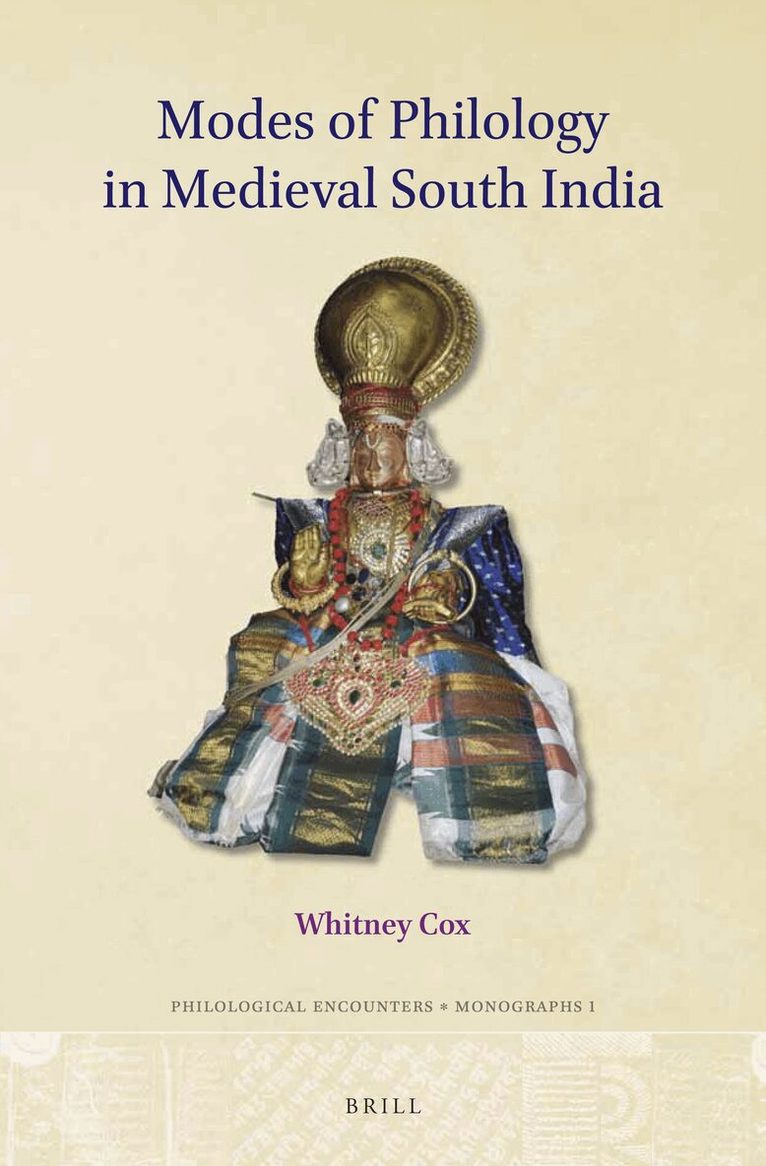
    Modes of Philology in Medieval South India

    AvWhitney Cox

    Inbunden, Engelska, 2016

    Del 1 i serien Philological Encounters Monographs

    2 007 kr

    Beställningsvara. Skickas inom 5-8 vardagar. Fri frakt över 249 kr.

    Fler format och utgåvor

    Inbunden

    611 kr

    Beskrivning

    Philology was everywhere and nowhere in classical South Asia. While its civilizations possessed remarkably sophisticated tools and methods of textual analysis, interpretation, and transmission, they lacked any sense of a common disciplinary or intellectual project uniting these; indeed they lacked a word for ‘philology’ altogether.Arguing that such pseudepigraphical genres as the Sanskrit purāṇas and tantras incorporated modes of philological reading and writing, Cox demonstrates the ways in which the production of these works in turn motivated the invention of new kinds of śāstric scholarship. Combining close textual analysis with wider theoretical concerns, Cox traces this philological transformation in the works of the dramaturgist Śāradātanaya, the celebrated Vaiṣṇava poet-theologian Veṅkaṭanātha, and the maverick Śaiva mystic Maheśvarānanda.

    Produktinformation

    • Utgivningsdatum:2016-10-13
    • Mått:155 x 235 x 17 mm
    • Vikt:451 g
    • Format:Inbunden
    • Språk:Engelska
    • Serie:Philological Encounters Monographs
    • Antal sidor:196
    • Förlag:Brill
    • ISBN:9789004331679

    Utforska kategorier

    • Litteraturvetenskap inom Skönlitteratur

    Mer om författaren

    Whitney Cox, University of Chicago, is Associate Professor in the Department of South Asian Languages and Civilizations at that university and a member of the Collegium of the Zukunftsphilologie research project, Forum Transregionale Studien, Berlin. He is the author of Politics, Kingship and Poetry in Medieval South India: Moonset on Sunrise Mountain (Cambridge, 2016)

    Innehållsförteckning

    • Table of ContentsAcknowledgmentsA note on the transliteration, presentation, and citationof primary textsI. Introduction: towards a history of Indic philologyPhilology?Indian philology?Existing studiesParametersII. Textual Pasts and FuturesThe southern pseudepigrapha: an overviewA case study: the SūtasaṃhitāMethods of the anonymous philology: the ‘toolkit’Appropriation and adaptation: Cekkiḻār’s PĕriyapurāṇamConclusions: looking aheadIII. Bearing the Nāṭyaveda: Śāradātanaya’s BhāvaprakāśanaIntroduction: nāṭya as a form of knowledgeAt Śāradā’s side: the author and his workBharatavṛddha, Śiva, Padmabhū, Vāsuki‘Following the Kalpavallī’“Lost or as good as lost”IV. Veṅkaṭanātha and the limits of philological argumentSnakes versus EaglesRite and ContaminationEarlier canons of Vaiṣṇava textual criticismOn the shores of the milk ocean: Veṅkaṭanātha’s poetry as philologyV. Flowers of language: Maheśvarānanda’s MahārthamañjarīThe dreamThe pleasures of the textAmbiguity and auto-philologyWriting, reading, and the hermeneutical yoginMaheśvarānanda’s GītāVI. Conclusions: philology as politics, philology as scienceContext one: philology in and as temple-state politicsContext two: Indic philology and the history of science1. Non-reductive historicism2. The refusal of teleology3. The agency of the non-humanProblems and prospectsBibliography