• Fri frakt över 249 kr
  • •
  • Snabba leveranser
  • •
  • Billiga böcker
Kundservice

Du är på sajten för privatpersoner.

Företag, bibliotek eller offentlig verksamhet?

Du handlar på classic.bokus.com, där alla dina funktioner finns intakta.
Till classic.bokus.com
Bokus logotyp. Gå till startsidan.
  • Erbjudanden
  • Nyheter
  • Student
  • Topplistor
  • Barn & ungdom
  • Bokus Play
  • E-böcker
  • Pocketböcker
  • Spel & pussel

10% rabatt på allt med kod: NYSTART10 →

Sidfot

Mina sidor

    Hjälp

    • Kundservice
    • Vanliga frågor och svar
    • Frakt och leverans
    • Retur vid ångerrätt
    • Reklamera vara
    • Betalning
    • Köpvillkor
    • Allmänna villkor
    • Information om webbplatsens tillgänglighet

    Om Bokus

    • Om oss
    • Pressrum
    • För studenter
    • För företag
    • För bibliotek och offentlig verksamhet
    • För leverantörer
    • Hållbarhet

    Populärt

    • Aktuella erbjudanden
    • Presentkort
    • Studentlitteratur
    • Nya böcker
    • Topplistor
    • Signerade böcker
    • Engelska böcker

    Inspiration

    • Boktips
    • BookTok
    • Populära bokserier
    • Barnbokskaraktärer
    • Populära författare
    Logotyp för Bokus
    Följ oss på Facebook (extern länk)Följ oss på Instagram (extern länk)Följ oss på YouTube (extern länk)Följ oss på TikTok (extern länk)
    bokus @ CookiesAnpassa cookiesIntegritetspolicyKöpvillkor
    Till Citymail hemsida (extern länk)Till Budbee hemsida (extern länk)Till Postnord hemsida (extern länk)Till Schenker hemsida (extern länk)Till Early Bird hemsida (extern länk)Till Walleys hemsida (extern länk)
    1. Filosofi och religion
    2. Filosofi
    3. Filosofiska discipliner

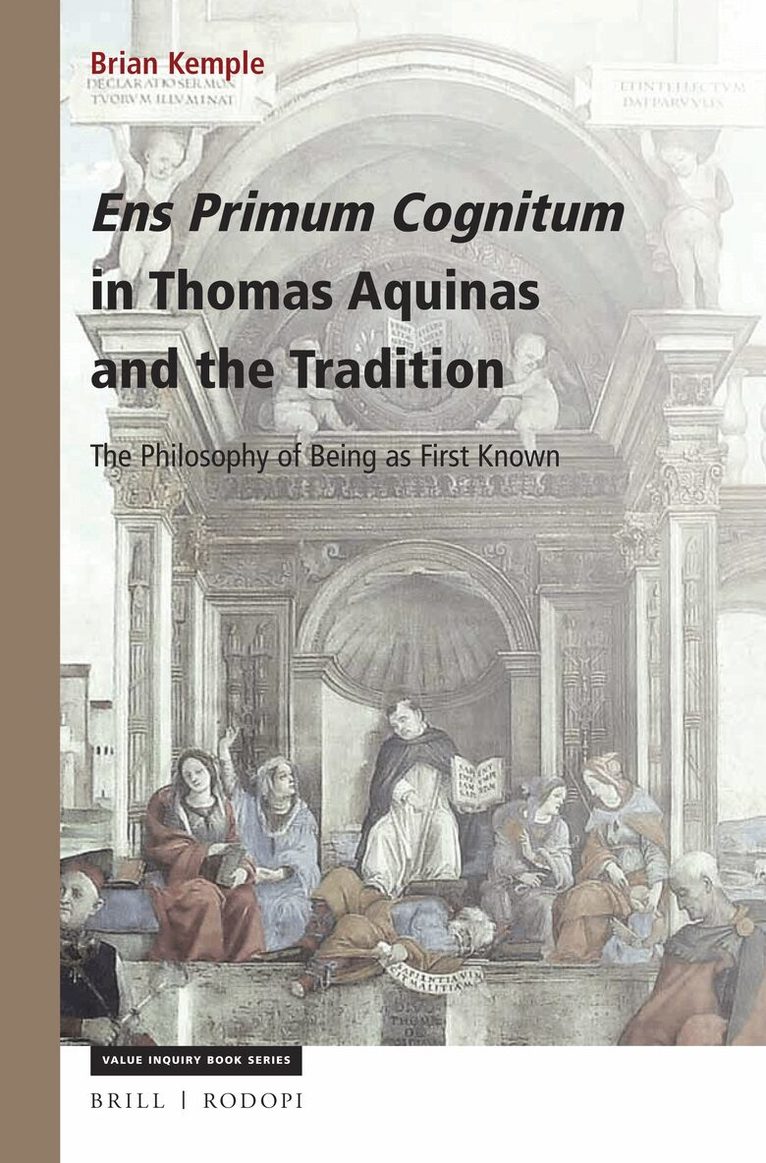
    Ens Primum Cognitum in Thomas Aquinas and the Tradition

    The Philosophy of Being as First Known

    AvBrian Kemple

    Häftad, Engelska, 2017

    Del 309 i serien Gilson Studies

    1 521 kr

    Beställningsvara. Skickas inom 5-8 vardagar. Fri frakt över 249 kr.

    Beskrivning

    Ens Primum Cognitum in Thomas Aquinas and the Tradition presents a reading of Thomas Aquinas’ claim that “being” is the first object of the human intellect. Blending the insights of both the early Thomistic tradition (c.1380—1637AD) and the Leonine Thomistic revival (1879—present), Brian Kemple examines how this claim of Aquinas has been traditionally understood, and what is lacking in that understanding. While the recent tradition has emphasized the primacy of the real (so-called ens reale) in human recognition of the primum cognitum, Kemple argues that this misinterprets Aquinas, thereby closing off Thomistic philosophy to the broader perspective needed to face the philosophical challenges of today, and proposes an alternative interpretation with dramatic epistemological and metaphysical consequences.

    Produktinformation

    • Utgivningsdatum:2017-09-21
    • Mått:155 x 235 x 21 mm
    • Vikt:614 g
    • Format:Häftad
    • Språk:Engelska
    • Serie:Gilson Studies
    • Antal sidor:376
    • Förlag:Brill
    • ISBN:9789004352391

    Utforska kategorier

    • Filosofiska discipliner inom Filosofi och religion

    Mer om författaren

    Brian Kemple, Ph.D. (2016), is a recent graduate of the Center for Thomistic Studies at the University of St. Thomas (Texas, USA). He writes on metaphysics, epistemology, phenomenology, and semiotics and is author of Peirce and Heidegger: The Intersection of Phenomenology and Semiotics (Mouton de Gruyter, 2017).

    Innehållsförteckning

    • AcknowledgementsIntroduction: Escaping the Framework of ModernityPrefatory Notes on Terminology Subject and Object, ens naturae and ens rationisIdeoscopic and Cenoscopic Concept, verbum mentis, species expressaEns ut primum cognitum and ens primum cognitumInfluential Approaches to Ens Primum CognitumObjectively and Socially-Constituted RealityThomas Aquinas: Intellectus Agens, Verbum Mentis, Relatio1 The Latin Thomists and Ens Primum Cognitum 1.1 The Early Dispute: Setting the Stage1.1.1 The Scotistic Foil1.2 Thomas Cajetan and the Doctrine of Being1.2.1 Cajetan’s Four Cognitions and Three Abstractions1.2.2 The Doctrine of Analogy1.2.3 Conclusion1.3 John Poinsot, the Nature of Concepts and Ens ut Primum Cognitum1.3.1 Objectivity and Conceptualization1.3.2 De Primo Cognito1.3.3 Objectivity and the Concept of Ens Primum Cognitum2 Recent Thomistic Interpretations of Ens Primum Cognitum2.1 Étienne Gilson’s “Metaphysical Realism”2.1.1 Overcoming Critique2.1.2 Abstraction and the Nature of the Concept2.1.3 Realism vs. Idealism and the Question of Ens ut Primum Cognitum2.2 Jacques Maritain2.2.1 Maritain on Abstraction2.2.2 Concept Formation2.2.3 Maritain on Ens Primum Cognitum2.3 Conclusion3 The Intellectus Agens and Concept Formation3.1 St. Thomas and the Obiectum Intellectus3.1.1 Ens, ens ut verum, and ens intelligibile3.1.2 Quod quid est, quid est, and quod quid erat esse3.1.3 Quidditas rei and quidditas rei materialis3.2 Intellectus Agens3.2.1 Illuminare3.2.2 Digression on Nature: Matter, Form, and Understanding3.2.3 Abstrahere4 The Discursion of Concept Formation4.1 The Discursion of Intellectual Discovery4.1.1 From Pre-Philosophical Cognition to Philosophical Science4.1.2 Intellectual Discovery and the Philosophical Sciences4.2 Formation of the Verbum Mentis4.2.1 The Derivation of Primary Concepts4.2.2 Terminus of Intellectual Operation and Intentional Fundamentum4.2.3 Necessity of Composition4.2.4 Definition and Quiddity4.3 A Recursive Analysis of the Species Expressa4.3.1 True and False Concepts4.3.2 Species Expressae and Cognition-Dependent Objects4.3.3 What is Inessential to Things is Essential to Our Concepts5 Relation and Ens Primum Cognitum5.1 What is Relation?5.1.1 Relativa Secundum Esse5.1.2 Relativa Secundum Dici5.1.3 The Constitution of Cognition-Dependent Relative Being5.2 Relations and Objectivity5.2.1 Intellectual Apprehension of Relations5.2.2 Interpretation and the Constitution of Objective Realities5.2.3 “Reality”, “The Real”, and Objective Constitution6 The Nature of Ens Primum Cognitum6.1 Summary of Argument6.2 The Nature of Ens Primum Cognitum6.2.1 St. Thomas and the Resolutio ad Ens Primum Cognitum6.3 ConclusionReferences Historically Layered