• Fri frakt över 249 kr
  • •
  • Snabba leveranser
  • •
  • Billiga böcker
Kundservice

Du är på sajten för privatpersoner.

Företag, bibliotek eller offentlig verksamhet?

Du handlar på classic.bokus.com, där alla dina funktioner finns intakta.
Till classic.bokus.com
Bokus logotyp. Gå till startsidan.
  • Erbjudanden
  • Nyheter
  • Student
  • Topplistor
  • Barn & ungdom
  • Bokus Play
  • E-böcker
  • Pocketböcker
  • Spel & pussel

Må bättre, för mindre! Upp till 50% rabatt på hälsoböcker

Sidfot

Mina sidor

    Hjälp

    • Kundservice
    • Vanliga frågor och svar
    • Frakt och leverans
    • Retur vid ångerrätt
    • Reklamera vara
    • Betalning
    • Köpvillkor
    • Allmänna villkor
    • Information om webbplatsens tillgänglighet

    Om Bokus

    • Om oss
    • Pressrum
    • För studenter
    • För företag
    • För bibliotek och offentlig verksamhet
    • För leverantörer
    • Hållbarhet

    Populärt

    • Aktuella erbjudanden
    • Presentkort
    • Studentlitteratur
    • Nya böcker
    • Topplistor
    • Signerade böcker
    • Engelska böcker

    Inspiration

    • Boktips
    • BookTok
    • Populära bokserier
    • Barnbokskaraktärer
    • Populära författare
    Logotyp för Bokus
    Följ oss på Facebook (extern länk)Följ oss på Instagram (extern länk)Följ oss på YouTube (extern länk)Följ oss på TikTok (extern länk)
    bokus @ CookiesAnpassa cookiesIntegritetspolicyKöpvillkor
    Till Citymail hemsida (extern länk)Till Budbee hemsida (extern länk)Till Postnord hemsida (extern länk)Till Schenker hemsida (extern länk)Till Early Bird hemsida (extern länk)Till Walleys hemsida (extern länk)
    1. Historia och arkeologi
    2. Historia
    3. Forntidens historia

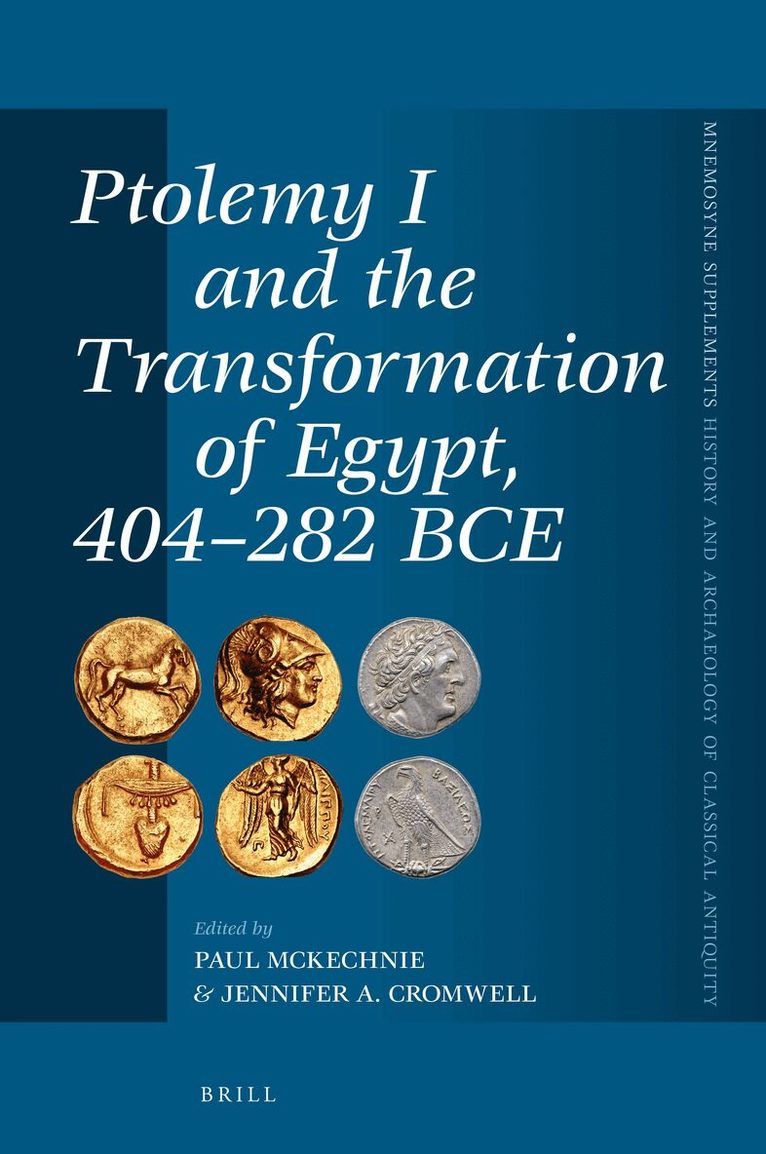
    Ptolemy I and the Transformation of Egypt, 404-282 BCE

    AvPaul McKechnie,Jennifer A. Cromwell

    Inbunden, Engelska, 2018

    Del 415 i serien Mnemosyne, Supplements, History and Archaeology of Classical Antiquity

    2 082 kr

    Beställningsvara. Skickas inom 5-8 vardagar. Fri frakt över 249 kr.

    Beskrivning

    Amyrtaeus, only pharaoh of the Twenty-eighth Dynasty, shook off the shackles of Persian rule in 404 BCE; a little over seventy years later, Ptolemy son of Lagus started the ‘Greek millennium’ (J.G. Manning’s phrase) in Egypt―living long enough to leave a powerful kingdom to his youngest son, Ptolemy II, in 282.In this book, expert studies document the transformation of Egypt through the dynamic fourth century, and the inauguration of the Ptolemaic state. Ptolemy built up his position as ruler subtly and steadily. Continuity and change marked the Egyptian-Greek encounter. The calendar, the economy and coinage, the temples, all took on new directions. In the great new city of Alexandria, the settlers’ burial customs had their own story to tell.

    Produktinformation

    • Utgivningsdatum:2018-06-07
    • Mått:155 x 235 x 20 mm
    • Vikt:535 g
    • Format:Inbunden
    • Språk:Engelska
    • Serie:Mnemosyne, Supplements, History and Archaeology of Classical Antiquity
    • Antal sidor:248
    • Förlag:Brill
    • ISBN:9789004366961

    Utforska kategorier

    • Forntidens historia inom Historia och arkeologi

    Mer om författaren

    Paul McKechnie, D.Phil. (1985), University College, Oxford, is Associate Professor (CoRE) in Ancient Cultures at Macquarie University, Sydney, Australia. He has published on Greek and Roman history, and (with Philippe Guillaume) edited Ptolemy II Philadelphus and his World (Brill, 2008).Jennifer A. Cromwell, PhD (2008), University of Liverpool, is a Marie Curie Research Fellow at the University of Copenhagen. Her work focuses on Late Antique Egypt and she is the author of Recording Village Life: A Coptic Scribe in Early Islamic Egypt (2017).Contributors are: †Chris Bennett, Henry P. Colburn, Thomas Landvatter, Paul McKechnie, Martina Minas-Nerpel, Boyo G. Ockinga, Dorothy J. Thompson.

    Recensioner i media

    "... a useful and important piece of scholarship. (...) this book should be considered a useful resource for scholars studying the early Hellenistic period, especially those seeking more specified information on early Ptolemaic calendars, coinage, temples, burial practices, and the Satrap Stele. In fact, the availability of a work that brings together such varied research and different viewpoints on transition is a boon to any Ptolemaic scholar." - Tara Sewell-Lasater, in: BMCR 2018.12.34"The admirable volume under review, the fourth in the informal series, Mnemosyne Supplements, consists of a short introduction and seven papers presented at a conference held at Macquarie University in Sydney, Australia during September of 2011. (...) Chapter [3, "Soter and the Calendars"] is well researched and thoughtfully written. (...) The present collection of essays will remain a valuable source for the study of the satrapy and reign of Ptolemy I (...) The titles of the essays, all well grounded in the primary evidence and scholarship of the time period, draw attention to the range of sources. (...) Those coming to the topics for the first time as well as specialists in the field will be stimulated and challenged to further study and thought." - Carol Shaw, in: Classical Journal online, 2019.06.01"Dorothy J. Thompson (p. 6-26) presents a very readable, reliable, and succinct overview of the period of Ptolemy I Soter’s possession of Egypt, placed into the context, when appropriate, of prior events dating to the Late Period. (...) Paul McKechnie (p. 27-45) presents an interesting, persuasive theory about the bellicose intricacies among Persia, the Greek city states, and Egypt during the fourth century B.C., namely, that the Persians “wanted [Greece] for the sake of Egypt.” (p. 29-30). (...) In a reasoned, well-argued manner Colburn explains how the initial introduction of Athenian tetradrachms, the first coins ever minted in Egypt,14) served as “a bridge between the Egyptian systems of wealth finance… and typically Greek approaches to money” which laid the foundations on which the monetized policies of the Ptolemies were to be built." - Robert Steven Bianchi, in: BIBLIOTHECA ORIENTALIS LXXV N° 5-6 (2018)