• Fri frakt över 249 kr
  • •
  • Snabba leveranser
  • •
  • Billiga böcker
Kundservice

Du är på sajten för privatpersoner.

Företag, bibliotek eller offentlig verksamhet?

Du handlar på classic.bokus.com, där alla dina funktioner finns intakta.
Till classic.bokus.com
Bokus logotyp. Gå till startsidan.
  • Erbjudanden
  • Nyheter
  • Student
  • Topplistor
  • Barn & ungdom
  • Bokus Play
  • E-böcker
  • Pocketböcker
  • Spel & pussel

10% rabatt på allt med kod: NYSTART10 →

Sidfot

Mina sidor

    Hjälp

    • Kundservice
    • Vanliga frågor och svar
    • Frakt och leverans
    • Retur vid ångerrätt
    • Reklamera vara
    • Betalning
    • Köpvillkor
    • Allmänna villkor
    • Information om webbplatsens tillgänglighet

    Om Bokus

    • Om oss
    • Pressrum
    • För studenter
    • För företag
    • För bibliotek och offentlig verksamhet
    • För leverantörer
    • Hållbarhet

    Populärt

    • Aktuella erbjudanden
    • Presentkort
    • Studentlitteratur
    • Nya böcker
    • Topplistor
    • Signerade böcker
    • Engelska böcker

    Inspiration

    • Boktips
    • BookTok
    • Populära bokserier
    • Barnbokskaraktärer
    • Populära författare
    Logotyp för Bokus
    Följ oss på Facebook (extern länk)Följ oss på Instagram (extern länk)Följ oss på YouTube (extern länk)Följ oss på TikTok (extern länk)
    bokus @ CookiesAnpassa cookiesIntegritetspolicyKöpvillkor
    Till Citymail hemsida (extern länk)Till Budbee hemsida (extern länk)Till Postnord hemsida (extern länk)Till Schenker hemsida (extern länk)Till Early Bird hemsida (extern länk)Till Walleys hemsida (extern länk)
    1. Juridik
    2. Internationell rätt
    3. Folkrätt

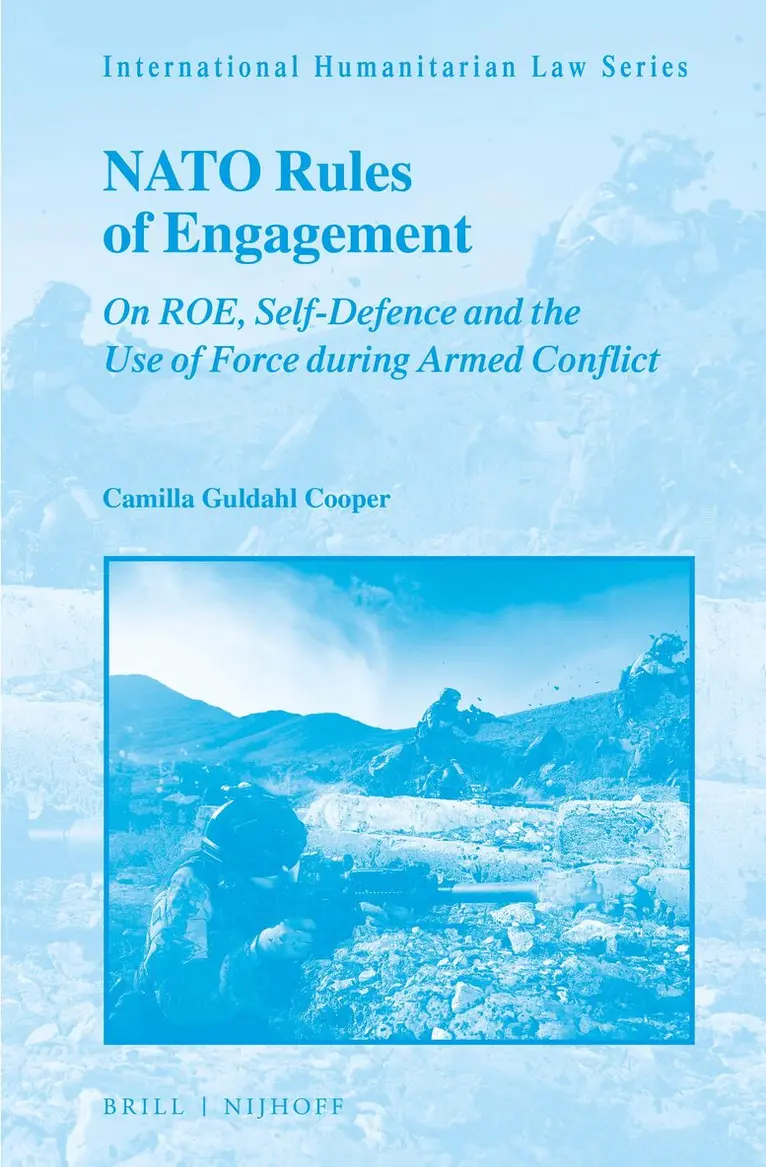
    NATO Rules of Engagement

    On ROE, Self-Defence and the Use of Force during Armed Conflict

    AvCamilla Guldahl Cooper

    Inbunden, Engelska, 2019

    Del 57 i serien International Humanitarian Law Series

    3 021 kr

    Beställningsvara. Skickas inom 5-8 vardagar. Fri frakt över 249 kr.

    Beskrivning

    In NATO Rules of Engagement, Camilla Guldahl Cooper offers clarity on a topic prone to confusion and misunderstanding. NATO rules of engagement (ROE) are of considerable political, strategic and operational importance, yet many of its concepts lack clarity. The resulting ambiguity may be detrimental for people involved and for mission accomplishment.Through a thorough analysis of the concept, purpose, development and use of NATO ROE, Cooper contributes to improved understanding and implementation of NATO ROE. The book covers all use of force categories and relevant law relating to the use of force during armed conflicts, including the complex concepts of hostile act and hostile intent, direct participation in hostilities, and the increasing reliance on self-defence during armed conflict.

    Produktinformation

    • Utgivningsdatum:2019-12-19
    • Mått:155 x 235 x 35 mm
    • Vikt:882 g
    • Format:Inbunden
    • Språk:Engelska
    • Serie:International Humanitarian Law Series
    • Antal sidor:488
    • Förlag:Brill
    • ISBN:9789004401679

    Utforska kategorier

    • Folkrätt inom Juridik

    Mer om författaren

    Camilla Guldahl Cooper, Ph.D. (Oslo, 2018), Norwegian Defence University College, is an Associate Professor of operational law. She has co-authored the Norwegian Manual of the Law of Armed Conflict, and published articles and chapters on operational law.

    Innehållsförteckning

    • Acknowledgements List of Abbreviations 1 Introduction 1.1 Background and Purpose 1.2 nato<\sc> Rules of Engagement 1.3 Scope 1.4 Sources and Methodology 1.5 The Structure of the Book Part 1The Point of Departure: nato<\sc> Rules of Engagement2 Rules of Engagement: Introduction, Development and Use 2.1 Introduction 2.2 Analysing roe<\sc>: Definition, Scope and Form, and Legal Status 2.3 The History of Mission-Specific Rules of Engagement 2.4 roe<\sc> Development 2.5 roe<\sc> as a Tool for Command and Control 2.6 Conclusions 3 ‘Use of force’ Categories in nato roe Doctrine 3.1 Introduction 3.2 The Use of Force in Self-Defence 3.3 The Use of Force in Response to an Attack or Imminent Attack by Opposing Forces 3.4 The Use of Force to Accomplish Designated Tasks 3.5 Attack in Response to Hostile Act and Hostile Intent as Defined by Nato<\sc> 3.6 Attack on Forces ‘declared hostile’ Part 2“Otherwise Lawful Use of Force”: the Law Regulating the Use of Force during Armed Conflict4 Introduction: the Search for a Legal Basis4.1 The Lotus Principle, Human Rights, and the Relevance of the Relationship between the jus ad bellum and jus in bello<\i> 4.2 The Right to Life and Prohibition on Arbitrary Deprivation of Life4.3 The Relationship between the jus ad bellum and the jus in bello: Related in Fact, but Not in Law 4.4 When Does What Apply? On lex specialis<\i>4.5 Conclusion: Two Main Legal Bases for the Use of Force 5 The Law of Armed Conflict 5.1 Introduction 5.2 Who Is a Lawful Target 5.3 What Does It Entail to Be a Lawful Target 5.4 Identification of Lawful Targets: Precautions in Attack and the Issue of Doubt 5.5 Carrying Out Attacks 6 Self-Defence 6.1 Introduction 6.2 State Self-Defence 6.3 Personal Self-Defence 6.4 Conclusion Part 3Operational ‘use of force’ Categories and their Corresponding Legal Bases: What May Legally Be Authorised?7 Introduction to Part 3 8 The Use of Force in Self-Defence during Armed Conflict: a Legal Analysis of the Various Concepts of Self-Defence 8.1 Overview 8.2 The Use of Force in Personal Self-Defence by Military Forces during Armed Conflict 8.3 Operational Concepts of Self-Defence8.4 Conclusions on the Relevance of Self-Defence as a Legal Basis for Use of Force during Armed Conflict Operations9 The Use of Force by nato<\sc> Forces in Response to Attacks or Imminent Attacks by Opposing Forces 10 When May Force be Used to Accomplish Designated Tasks? 11 nato<\sc> Hostile Intent and Hostile Act roe: Applicable Law and Its Consequences11.1 ‘hostile act’ and ‘hostile intent’ as Operationalisation of dph<\sc> 11.2 nato<\sc> Hostile Act and Hostile Intent roe and Customary Law 11.3 Conclusions on the Relationship between the nato<\sc> Hostile Act and Hostile Intent roe<\sc> and dph<\sc> 11.4 ‘Attack’ 12 The Use of Force in an Attack on Forces ‘declared hostile’ and Applicable Law12.1 Forces ‘declared hostile’12.2 ‘attack’ and The Role of Targeting Procedures Part 4Conclusions and Proposals13 Conclusions and Proposals 13.1 nato roe<\sc> and the Legal Basis for the Use of Force 13.2 The Need for a Holistic and Uniform Approach to roe<\sc> 13.3 The Relationship between Self-Defence, loac<\sc> and roe<\sc> Bibliography Index