• Fri frakt över 249 kr
  • •
  • Snabba leveranser
  • •
  • Billiga böcker
Kundservice

Du är på sajten för privatpersoner.

Företag, bibliotek eller offentlig verksamhet?

Du handlar på classic.bokus.com, där alla dina funktioner finns intakta.
Till classic.bokus.com
Bokus logotyp. Gå till startsidan.
  • Erbjudanden
  • Nyheter
  • Student
  • Topplistor
  • Barn & ungdom
  • Bokus Play
  • E-böcker
  • Pocketböcker
  • Spel & pussel

Må bättre, för mindre! Upp till 50% rabatt på hälsoböcker

Sidfot

Mina sidor

    Hjälp

    • Kundservice
    • Vanliga frågor och svar
    • Frakt och leverans
    • Retur vid ångerrätt
    • Reklamera vara
    • Betalning
    • Köpvillkor
    • Allmänna villkor
    • Information om webbplatsens tillgänglighet

    Om Bokus

    • Om oss
    • Pressrum
    • För studenter
    • För företag
    • För bibliotek och offentlig verksamhet
    • För leverantörer
    • Hållbarhet

    Populärt

    • Aktuella erbjudanden
    • Presentkort
    • Studentlitteratur
    • Nya böcker
    • Topplistor
    • Signerade böcker
    • Engelska böcker

    Inspiration

    • Boktips
    • BookTok
    • Populära bokserier
    • Barnbokskaraktärer
    • Populära författare
    Logotyp för Bokus
    Följ oss på Facebook (extern länk)Följ oss på Instagram (extern länk)Följ oss på YouTube (extern länk)Följ oss på TikTok (extern länk)
    bokus @ CookiesAnpassa cookiesIntegritetspolicyKöpvillkor
    Till Citymail hemsida (extern länk)Till Budbee hemsida (extern länk)Till Postnord hemsida (extern länk)Till Schenker hemsida (extern länk)Till Early Bird hemsida (extern länk)Till Walleys hemsida (extern länk)
    1. Språk och ordböcker
    2. Språk: referensverk och allmänt
    3. Språk: historia och allmänt

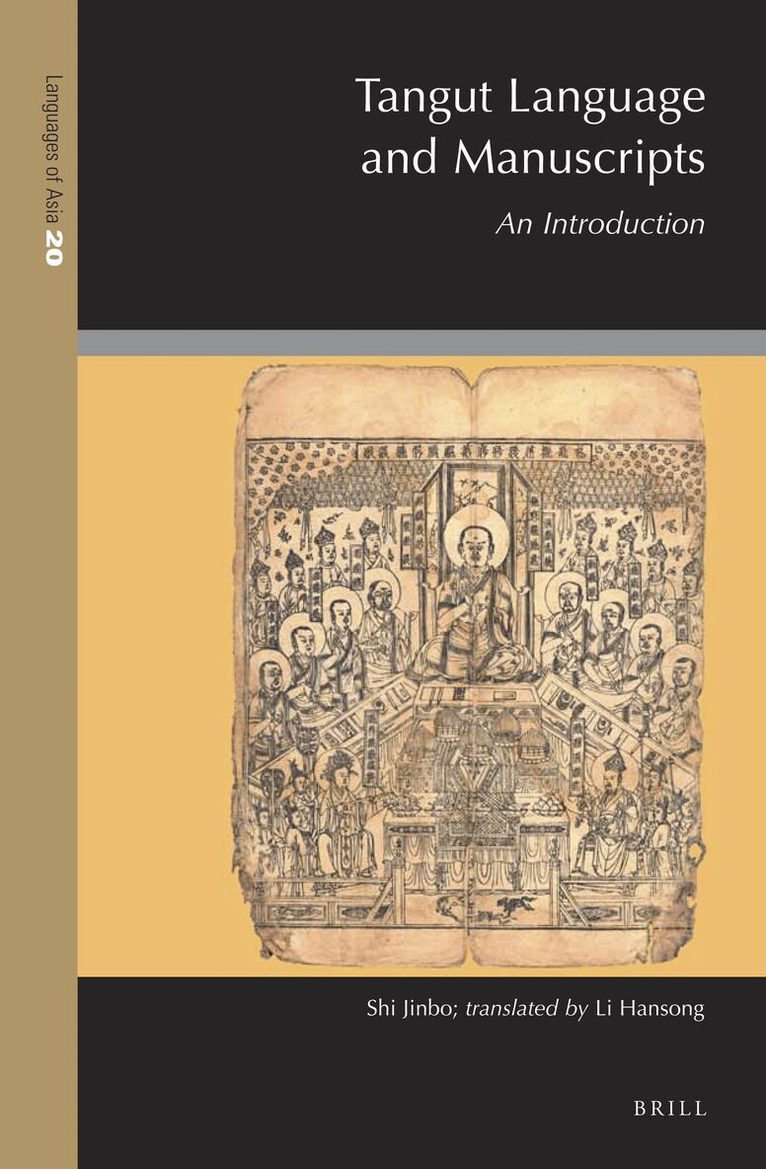
    Tangut Language and Manuscripts: An Introduction

    AvJinbo Shi

    Inbunden, Engelska, 2020

    Del 20 i serien Languages of Asia

    3 756 kr

    Beställningsvara. Skickas inom 5-8 vardagar. Fri frakt över 249 kr.

    Beskrivning

    This book is the first comprehensive introduction to the Tangut language and culture. Five of the fiſteen chapters survey the history of Western Xia and the evolution of Tangut Studies, including new advancements in the field, such as research on the recently decoded Tangut cursive writings found in Khara-Khoto documents. The other ten chapters provide an introduction to the Tangut language: its origins, script, characters, grammars, translations, textual and contextual readings. In this synthesis of historical narratives and linguistic analysis, the renowned Tangutologist Shi Jinbo offers a guided access to the mysterious civilisation of the ‘Great State White and High’ to both a specialized and a general audience.

    Produktinformation

    • Utgivningsdatum:2020-06-04
    • Mått:155 x 235 x 38 mm
    • Vikt:958 g
    • Format:Inbunden
    • Språk:Engelska
    • Serie:Languages of Asia
    • Antal sidor:548
    • Förlag:Brill
    • ISBN:9789004414532
    • Originaltitel:西夏文教程
    • Översättare:Hansong Li

    Utforska kategorier

    • Språk: historia och allmänt inom Språk och ordböcker
    • Språkvetenskap och lingvistik inom Språk och ordböcker

    Mer om författaren

    Shi, Jinbo is a Fellow at the Chinese Academy of Social Sciences. Shi has published widely on Tangutology, including Study of the Sea of Characters (1983), Western Xia Publishing (2004), and Economic Records of Western Xia (2017).Li, Hansong, B.A. University of Chicago, M.Phil. University of Cambridge, is a scholar of intellectual and international history at Harvard University.

    Innehållsförteckning

    • Translator’s PrefaceList of IllustrationsIntroduction1 The Purpose of Studying Tangut2 Some Notes on Learning Tangut1 History and Society of Western Xia1 History of Western Xia2 Tangut Society3 Religions in Western Xia4 Tangut CultureTangut Vocabulary (1)2 Tangut Manuscripts1 Discovery of the Corpus of Tangut Manuscripts2 Types and Quantities of Tangut Texts3 Introduction to Tangut Manuscripts4 Compilation and Publication of Tangut ManuscriptsTangut Vocabulary (2)3 Tangut Bibliology and Bibliography1 Types and Versions2 Binding of Books3 Structure and Design4 Illustrations, Letter Code, and Attachments5 PapersTangut Vocabulary (3)4 Structure and Features of Tangut Characters1 The Structure of Tangut Characters2 Pictograms and Simple Ideograms (Simple Indicatives) Comparisons with Chinese Characters3 Tangut Radicals4 Write and Search Tangut Words in a DictionaryTangut Vocabulary (4)5 Phonetics and Vocabulary1 The Tangut Language2 Tangut Phonetics3 Tangut WordsTangut Vocabulary (5)6 Parts of Speech1 Nouns2 Pronouns3 Numerals and Classifiers4 Verbs5 Adjectives6 Adverbs7 Particles8 Prepositions9 Conjunctions10 Interjections, Mood Particles, and OnomatopoeiaTangut Vocabulary (6)7 Phrases and Word Order1 Phrases2 SyntaxTextual Interpretation (1)8 Sentences1 Judgments, Descriptions, Statements and Interrogations2 Indicatives, Imperatives and Exclamations3 Simple and Compound Sentences4 Active and Passive5 Autonomous and CausativeTextual Interpretation (2)9 Cases and Case-Markers1 Nominative2 Genitive3 Accusative4 Presentative5 Subject of the PerformativeTextual Interpretation (3)10 Existential Verbs1 Categories and Usages2 Definitions and Applications of Existential Verbs in the Sea of Characters3 Features of UsageTextual Interpretation (4)11 Prepositional Particles1 Types and Usage2 Features3 Tactics in Translating Tangut TextsTextual Interpretation (5)12 Rime Transformation and Person Agreement in Tangut Verbs1 Categories of Person Agreements2 Rime Transformation in Person Agreement3 Explanations Found in the Sea of Characters and the Homophones4 In Textual TranslationsTextual Interpretation (6)13 Proper Nouns and Kinship Terms1 Names of States and Ethnicities2 Imperial Titles and Era Names3 Titles of Civil Servants4 Family Names and Given Names5 Addressing Families and RelativesTextual Interpretation (7)14 Interpretation of Tangut Social Documents and the Cursive Script1 Tangut Social Documents2 Tangut Cursive Script and Social DocumentsTextual Interpretation (8)15 Translation and Punctuation1 Some Notes on Translation2 How to Pause Properly When Reading a Tangut TextTextual Interpretation (9)AfterwordBibliographyIndex