• Fri frakt över 249 kr
  • •
  • Snabba leveranser
  • •
  • Billiga böcker
Kundservice

Du är på sajten för privatpersoner.

Företag, bibliotek eller offentlig verksamhet?

Du handlar på classic.bokus.com, där alla dina funktioner finns intakta.
Till classic.bokus.com
Bokus logotyp. Gå till startsidan.
  • Erbjudanden
  • Nyheter
  • Student
  • Topplistor
  • Barn & ungdom
  • Bokus Play
  • E-böcker
  • Pocketböcker
  • Spel & pussel

10% studentrabatt med kod TERM26

Sidfot

Mina sidor

    Hjälp

    • Kundservice
    • Vanliga frågor och svar
    • Frakt och leverans
    • Retur vid ångerrätt
    • Reklamera vara
    • Betalning
    • Köpvillkor
    • Allmänna villkor
    • Information om webbplatsens tillgänglighet

    Om Bokus

    • Om oss
    • Pressrum
    • För studenter
    • För företag
    • För bibliotek och offentlig verksamhet
    • För leverantörer
    • Hållbarhet

    Populärt

    • Aktuella erbjudanden
    • Presentkort
    • Studentlitteratur
    • Nya böcker
    • Topplistor
    • Signerade böcker
    • Engelska böcker

    Inspiration

    • Boktips
    • BookTok
    • Populära bokserier
    • Barnbokskaraktärer
    • Populära författare
    Logotyp för Bokus
    Följ oss på Facebook (extern länk)Följ oss på Instagram (extern länk)Följ oss på YouTube (extern länk)Följ oss på TikTok (extern länk)
    bokus @ CookiesAnpassa cookiesIntegritetspolicyKöpvillkor
    Till Citymail hemsida (extern länk)Till Budbee hemsida (extern länk)Till Postnord hemsida (extern länk)Till Schenker hemsida (extern länk)Till Early Bird hemsida (extern länk)Till Walleys hemsida (extern länk)
    1. Samhälle och politik
    2. Sociologi och antropologi
    3. Sociologi

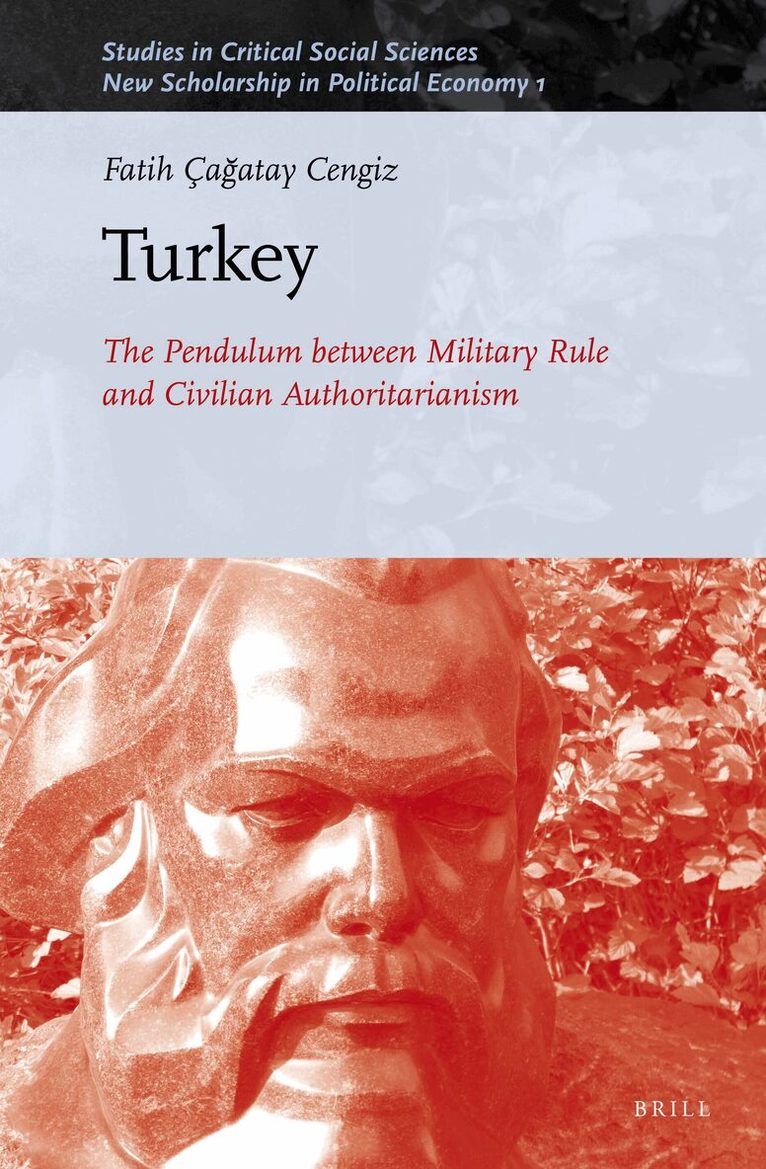
    Turkey: The Pendulum between Military Rule and Civilian Authoritarianism

    AvFatih Çağatay Cengiz

    Inbunden, Engelska, 2020

    Del i serien New Scholarship in Political Economy

    3 284 kr

    Beställningsvara. Skickas inom 5-8 vardagar. Fri frakt över 249 kr.

    Fler format och utgåvor

    Häftad

    363 kr

    Beskrivning

    Winner of the 2021 Choice Outstanding Academic Title AwardIn Turkey: The Pendulum between Military Rule and Civilian Authoritarianism, Fatih Çağatay Cengiz explains Turkey’s trajectory of military and civilian authoritarianism while offering an alternative framework for understanding the Kemalist state and state-society relations. This book clearly captures the zeitgeist of the moment Turkey has passed/has been passing through: democratisation, authoritarianism, and the coup cycle. Moreover, the book not only focuses on Turkish domestic politics with regards to procedural democratisation and waves of authoritarianism under the Justice and Development Party (Adalet ve Kalkınma Partisi, AKP), it also engages with Turkey’s recent foreign policy; policy that pushes Turkey to take an active role in the Syrian conflict through the concept of ‘Neo-Ottomanism’.

    Produktinformation

    • Utgivningsdatum:2020-09-03
    • Mått:155 x 235 x 21 mm
    • Vikt:542 g
    • Format:Inbunden
    • Språk:Engelska
    • Serie:New Scholarship in Political Economy
    • Antal sidor:268
    • Förlag:Brill
    • ISBN:9789004435551

    Utforska kategorier

    • Sociologi inom Samhälle och politik

    Mer om författaren

    Fatih Çağatay Cengiz,, Ph.D. (2016), School of Oriental and African Studies, is Assistant Professor at Ondokuz Mayıs University. He has published articles on democratisation, state theory and sub-imperialism in the British Journal of Middle Eastern Studies and Politikon.

    Innehållsförteckning

    • List of Figures, Box and TablesAcknowledgementsIntroduction: Conceptualisation of Kemalism, Bonapartism, and Procedural Democracy1 The Kemalist State1 The Historical Legacy2 The 1923 İzmir Economic Congress and National Developmentalism3 The Statist and Ultra-nationalist Phase in the Kemalist Capitalist State4 Industrial Upgrading (1960–1980)5 Failed Democratic Transition under the Democrat Party (1950–1960)6 The 1960 Coup and 1971 Memorandum in the Context of the Cold War7 Institutionalisation of “Kemalism without Mustafa Kemal”8 Bourgeoisification of the Military2 The Construction of a New Society after the 1980 Military Coup1 The Completion of the National Developmentalist Project2 The Absorption of Kemalism into Neoliberalism3 Islamisation of Society after the 1980s4 Turgut Özal in Power (1983–1989 and 1989–1993): Post-Kemalist Rule5 Political Liberalisation in the 1990s under Post-Bonapartist Rule6 Second-generation Devout Turkish Bourgeoisie6.1 MÜSİAD (The Independent Industrialists’ and Businessmen’s Association)6.2 ASKON (The Anatolian Tigers Business Association)6.3 TUSKON (Turkish Confederation of Businessmen and Industrialists)3 War of Manoeuvre by Islamic Fundamentalism against the Kemalist State1 The Political Trajectory of Islamic Parties Led by Necmettin Erbakan in Turkey1.1 The National Order Party (1970–1971)1.2 The National Salvation Party (1972–1981)1.3 The Welfare Party (1983–1998)2 The Just Economic System: a Petty-bourgeois Utopia in the Era of Neoliberalism3 The National View (Milli Görüş) as Common Ideational Ground for Islamic Parties4 The Islamic Alternative to the Kemalist State5 The Military Intervention of 28 February 19976 The Rupture in Islamic Politics4 War of Position by the AKP against the Kemalist State1 The Restructuring of the State after the End of the Cold War2 The Rise of the AKP in the Post-crisis Period and Continuation of Neoliberal Economic Policies2.1 The 2001 Economic Crisis2.2 The Economy under AKP Rule3 Procedural Democratisation under the Influence of the EU4 The AKP Tactics towards the Military: the Modern Capitalist Prince and a “War of Position”5 Authoritarian Turn, Sub-imperialist Foreign Policy, and the Failed Coup of 15 July 2016 1 The Expansion of the Gülen Movement2 The Ergenekon and Sledgehammer (Balyoz) Trials3 Authoritarian Wave in Domestic Policy4 Sub-imperialism and Neo-Ottomanism in Foreign Policy: strategic Depth or Strategic Failure?4.1 Sub-imperialism in Question4.2 The Military Dimension of Turkey’s Sub-imperialist Role4.3 Continuity in Turkish Foreign Policy in the 1990s4.4 The Economic Foundation of Neo-Ottomanism: Turkish Exports and Capital in the Region4.5 Turkish Companies as Agents of Regional Economic Power4.6 Political Tools for Turkish Sub-imperialism5 Neo-Ottomanism in Practice6 The State Crisis Ahead of Turkey’s Failed Coup6 Concluding Observations 1 Basic Structural Economic Limitations of Turkey’s Sub-imperialist Expansion: the Sustainability and Capacity Problem of the Turkish Economy2 Is Erdoğan an Islamic Bonaparte?3 Any Hope: waiting for Godot?References Index