• Fri frakt över 249 kr
  • •
  • Snabba leveranser
  • •
  • Billiga böcker
Kundservice

Du är på sajten för privatpersoner.

Företag, bibliotek eller offentlig verksamhet?

Du handlar på classic.bokus.com, där alla dina funktioner finns intakta.
Till classic.bokus.com
Bokus logotyp. Gå till startsidan.
  • Erbjudanden
  • Nyheter
  • Student
  • Topplistor
  • Barn & ungdom
  • Bokus Play
  • E-böcker
  • Pocketböcker
  • Spel & pussel

10% rabatt på allt med kod: NYSTART10 →

Sidfot

Mina sidor

    Hjälp

    • Kundservice
    • Vanliga frågor och svar
    • Frakt och leverans
    • Retur vid ångerrätt
    • Reklamera vara
    • Betalning
    • Köpvillkor
    • Allmänna villkor
    • Information om webbplatsens tillgänglighet

    Om Bokus

    • Om oss
    • Pressrum
    • För studenter
    • För företag
    • För bibliotek och offentlig verksamhet
    • För leverantörer
    • Hållbarhet

    Populärt

    • Aktuella erbjudanden
    • Presentkort
    • Studentlitteratur
    • Nya böcker
    • Topplistor
    • Signerade böcker
    • Engelska böcker

    Inspiration

    • Boktips
    • BookTok
    • Populära bokserier
    • Barnbokskaraktärer
    • Populära författare
    Logotyp för Bokus
    Följ oss på Facebook (extern länk)Följ oss på Instagram (extern länk)Följ oss på YouTube (extern länk)Följ oss på TikTok (extern länk)
    bokus @ CookiesAnpassa cookiesIntegritetspolicyKöpvillkor
    Till Citymail hemsida (extern länk)Till Budbee hemsida (extern länk)Till Postnord hemsida (extern länk)Till Schenker hemsida (extern länk)Till Early Bird hemsida (extern länk)Till Walleys hemsida (extern länk)
    1. Språk och ordböcker
    2. Språk: referensverk och allmänt
    3. Grammatikhandböcker

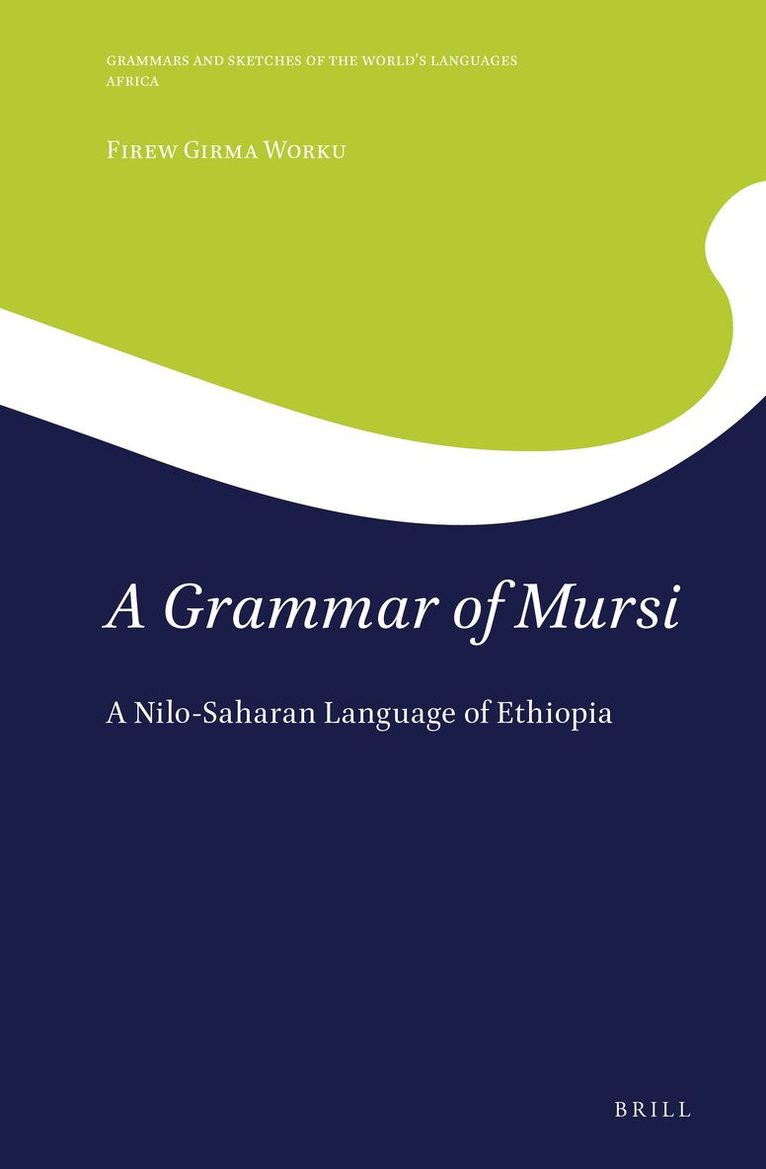
    Grammar of Mursi

    A Nilo-Saharan Language of Ethiopia

    AvFirew Girma Worku

    Inbunden, Engelska, 2021

    Del 15 i serien Africa

    3 642 kr

    Beställningsvara. Skickas inom 5-8 vardagar. Fri frakt över 249 kr.

    Beskrivning

    Mursi is a Nilo-Saharan language spoken by a small group of people who live in the Lower Omo Valley, Ethiopia, and is one of the most endangered languages of the country.Based on the fieldwork that the author conducted in beautiful villages of the Mursi community, this descriptive grammar is organized into fourteen chapters rich in examples and an appendix containing four transcribed texts. The readers are thus provided with a clear and useful tool, which constitutes and important addition to our knowledge of Mursi and of other related languages spoken in the area.Besides being an empirical data source for linguists interested in typology and endangered language description and documentation, the grammar constitutes an invaluable gift to the speech community.

    Produktinformation

    • Utgivningsdatum:2021-03-11
    • Mått:155 x 235 x 49 mm
    • Vikt:1 259 g
    • Format:Inbunden
    • Språk:Engelska
    • Serie:Africa
    • Antal sidor:666
    • Förlag:Brill
    • ISBN:9789004449893

    Utforska kategorier

    • Grammatikhandböcker inom Språk och ordböcker

    Mer om författaren

    Firew Girma Worku, Ph.D. (2020), James Cook University, is an Adjunct Research Fellow of the College of Arts, Society and Education at that university. He specializes in Nilo-Saharan languages particularly in Surmic languages. His main interests consist describing and documenting endangered languages, linguistic anthropology, and typology.

    Innehållsförteckning

    • AcknowledgementsList of Tables, Maps, Diagrams, and FiguresAbbreviations and Conventions1 Introduction1.1 The Mursi People: Historical Background1.2 Linguistic Profile of Mursi1.3 Geography and Mursi Neighbours1.4 Economy and Subsistence1.5 Traditional Leadership1.6 Local Groups, Clans, Kinship System and Age Sets1.7 Major Traditional Practices1.8 Cattle, Color Terms and Naming1.9 Linguistic Affiliation1.10 Sociolinguistic Situation1.11 Previous Studies; Ethnographic Exploration in the Lower Omo Valley1.12 Fieldwork Methodology and Language Data2 Phonology2.1 Introduction2.2 Notes on Orthography and Phonetic Transcriptions2.3 Inventory of Phonemes2.4 Syllable Structure2.5 Phonological Processes2.6 Tone2.7 Wordhood2.8 Clitics2.9 Special Phonology2.10 Female Register3 Word Classes3.1 Introduction3.2 Open Word Classes3.3 Closed Word Classes4 Noun Phrase Structure4.1 Introduction4.2 Non-clausal Modifiers of NP4.3 Clausal Modifiers4.4 Nominalizers4.5 Complex Modification4.6 Summary of Head-Modifier Dependency Relation5 Possession5.1 Introduction5.2 Juxtaposed System5.3 Possessive Construction with A and B Possessors5.4 Possessive Construction with C-type (Possessive Pronouns)5.5 Pertensive5.6 Noun Modification Constructions5.7 Predicative Possessive Construction5.8 Summary6 Number6.1 Introduction6.2 The Realization of Number6.3 Suffixation6.4 Suppletion6.5 Number Marking by Tone6.6 n/g Alternation6.7 The Bound Number/Aspect Marking Forms -t/-ɗ6.8 Additional Suffixes6.9 Number-Determined Suppletive Verb Forms6.10 Reduplication6.11 Number Words6.12 Number and Agreement7 The Verb and Predicate Structure7.1 Introduction7.2 Phonological Properties of Verb Roots7.3 Morphological Properties8 Adjectives8.1 Introduction8.2 Phonological Properties of Adjectives8.3 Morphological Properties of Adjectives8.4 Syntactic Properties8.5 Semantic Properties8.6 Summary9 Valency Changing Operations9.1 Introduction9.2 Valency Decreasing Derivations9.3 Valency-Increasing Derivations10 Grammatical Relations10.1 Introduction10.2 Constituent Order10.3 Case Markers10.4 Adpositions10.5 Verb-Final Suffix11 Comparative Constructions11.1 Introduction11.2 Mono-clausal Comparative Construction11.3 Phrasal plus Mono-clausal Construction11.4 Bi-clausal Construction Type I11.5 Bi-clausal Construction Type II11.6 ɓá Construction11.7 Other Types of Comparative Constructions11.8 Equality Construction12 Questions12.1 Introduction12.2 Content Questions12.3 Non-interrogative Particles12.4 Tag Questions12.5 Polar Questions12.6 Other Question Strategies13 Negation13.1 Introduction13.2 Bound Negators13.3 Negating a Copula Clause13.4 Negative Existential Verb níŋɛ ‘Not Present’13.5 Inherently Negative Verb ímág13.6 Indefinite-Like Words13.7 Interjection ɪmm ɪmm ‘no’13.8 Tracing and Linking Negators14 Clause Types, Clause Combining and Coordination14.1 Introduction14.2 Clause Types14.3 Clause CoordinationAppendix: Transcribed TextsBibliographySubject Index