• Fri frakt över 249 kr
  • •
  • Snabba leveranser
  • •
  • Billiga böcker
Kundservice

Du är på sajten för privatpersoner.

Företag, bibliotek eller offentlig verksamhet?

Du handlar på classic.bokus.com, där alla dina funktioner finns intakta.
Till classic.bokus.com
Bokus logotyp. Gå till startsidan.
  • Erbjudanden
  • Nyheter
  • Student
  • Topplistor
  • Barn & ungdom
  • Bokus Play
  • E-böcker
  • Pocketböcker
  • Spel & pussel

10% rabatt på allt med kod: NYSTART10 →

Sidfot

Mina sidor

    Hjälp

    • Kundservice
    • Vanliga frågor och svar
    • Frakt och leverans
    • Retur vid ångerrätt
    • Reklamera vara
    • Betalning
    • Köpvillkor
    • Allmänna villkor
    • Information om webbplatsens tillgänglighet

    Om Bokus

    • Om oss
    • Pressrum
    • För studenter
    • För företag
    • För bibliotek och offentlig verksamhet
    • För leverantörer
    • Hållbarhet

    Populärt

    • Aktuella erbjudanden
    • Presentkort
    • Studentlitteratur
    • Nya böcker
    • Topplistor
    • Signerade böcker
    • Engelska böcker

    Inspiration

    • Boktips
    • BookTok
    • Populära bokserier
    • Barnbokskaraktärer
    • Populära författare
    Logotyp för Bokus
    Följ oss på Facebook (extern länk)Följ oss på Instagram (extern länk)Följ oss på YouTube (extern länk)Följ oss på TikTok (extern länk)
    bokus @ CookiesAnpassa cookiesIntegritetspolicyKöpvillkor
    Till Citymail hemsida (extern länk)Till Budbee hemsida (extern länk)Till Postnord hemsida (extern länk)Till Schenker hemsida (extern länk)Till Early Bird hemsida (extern länk)Till Walleys hemsida (extern länk)
    1. Skönlitteratur
    2. Litteraturvetenskap
    3. Litteraturvetenskap

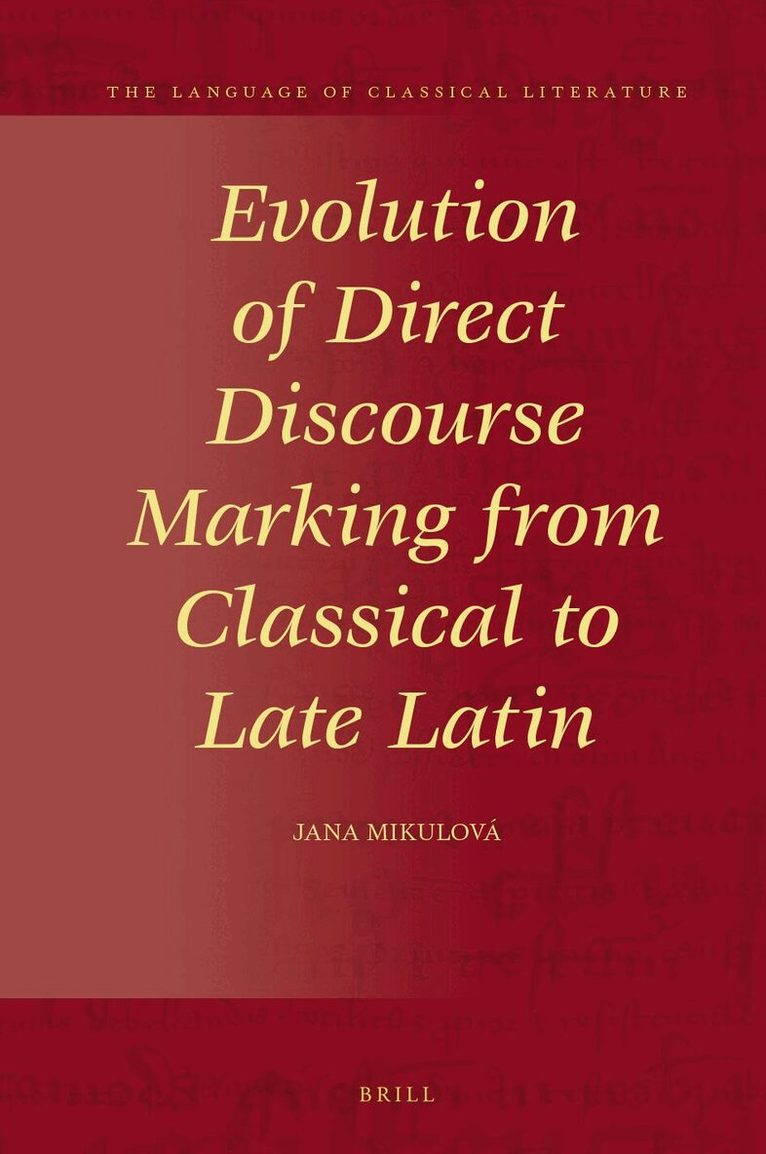
    Evolution of Direct Discourse Marking from Classical to Late Latin

    AvJana Mikulová

    Inbunden, Engelska, 2022

    Del 37 i serien Language of Classical Literature

    2 173 kr

    Beställningsvara. Skickas inom 5-8 vardagar. Fri frakt över 249 kr.

    Beskrivning

    If you read a work by Cicero or Seneca and then open The Pilgrimage of Egeria, Augustine, or Gregory of Tours, you will soon notice that Late Latin authors quote authorities differently. They provide a perfect example of synthesising two potentially conflicting traditions – “classical” and “biblical”. This book examines how the system of direct discourse marking developed over the centuries. It focuses on selecting marking means, presents the dynamics of change and suggests factors that might have been at play. The author guides the reader on the path that goes from the Classical prevalence of inquit to the Late innovative mix of marking words including the very classical inquit, an increased use of dico, the newly recruited ait, and dicens, influenced by biblical translations. The book suggests that Late authors tried to make reading and understanding easier by putting quotative words before quotations and increasing the use of redundant combinations (e.g. “he answered saying”).

    Produktinformation

    • Utgivningsdatum:2022-09-22
    • Mått:155 x 235 x 11 mm
    • Vikt:393 g
    • Format:Inbunden
    • Språk:Engelska
    • Serie:Language of Classical Literature
    • Antal sidor:172
    • Förlag:Brill
    • ISBN:9789004524996

    Utforska kategorier

    • Litteraturvetenskap inom Skönlitteratur

    Mer om författaren

    Jana Mikulová, Ph.D., Masaryk University, Brno, Czech Republic, is interested in the Latin language, especially its development from the Classical to the Late period.

    Innehållsförteckning

    • List of Figures and TablesAcknowledgements1 Introduction1.1 Corpus of Examined Texts1.2 Data Set for the Analysis2 Theoretical Preliminaries2.1 Direct Discourse2.2 Structures Similar to Direct Discourse2.3 Direct Discourse Markers2.4 Grammaticalization: How New Quotative Markers Arise3 The Marking of Direct Discourse in the Examined Texts3.1 Verbal Markers3.2 Non-verbal Markers3.3 Zero Markers3.4 Multiple Marking and Redundancy4 Discussion4.1 Overview of the Use and Characteristics of Direct Discourse Markers4.2 Factors in Use and Development4.3 Grammaticalization5 ConclusionsReferencesIndex Locorum