• Fri frakt över 249 kr
  • •
  • Snabba leveranser
  • •
  • Billiga böcker
Kundservice

Du är på sajten för privatpersoner.

Företag, bibliotek eller offentlig verksamhet?

Du handlar på classic.bokus.com, där alla dina funktioner finns intakta.
Till classic.bokus.com
Bokus logotyp. Gå till startsidan.
  • Erbjudanden
  • Nyheter
  • Student
  • Topplistor
  • Barn & ungdom
  • Bokus Play
  • E-böcker
  • Pocketböcker
  • Spel & pussel

10% rabatt på allt med kod: NYSTART10 →

Sidfot

Mina sidor

    Hjälp

    • Kundservice
    • Vanliga frågor och svar
    • Frakt och leverans
    • Retur vid ångerrätt
    • Reklamera vara
    • Betalning
    • Köpvillkor
    • Allmänna villkor
    • Information om webbplatsens tillgänglighet

    Om Bokus

    • Om oss
    • Pressrum
    • För studenter
    • För företag
    • För bibliotek och offentlig verksamhet
    • För leverantörer
    • Hållbarhet

    Populärt

    • Aktuella erbjudanden
    • Presentkort
    • Studentlitteratur
    • Nya böcker
    • Topplistor
    • Signerade böcker
    • Engelska böcker

    Inspiration

    • Boktips
    • BookTok
    • Populära bokserier
    • Barnbokskaraktärer
    • Populära författare
    Logotyp för Bokus
    Följ oss på Facebook (extern länk)Följ oss på Instagram (extern länk)Följ oss på YouTube (extern länk)Följ oss på TikTok (extern länk)
    bokus @ CookiesAnpassa cookiesIntegritetspolicyKöpvillkor
    Till Citymail hemsida (extern länk)Till Budbee hemsida (extern länk)Till Postnord hemsida (extern länk)Till Schenker hemsida (extern länk)Till Early Bird hemsida (extern länk)Till Walleys hemsida (extern länk)
    1. Språk och ordböcker
    2. Språkvetenskap och lingvistik

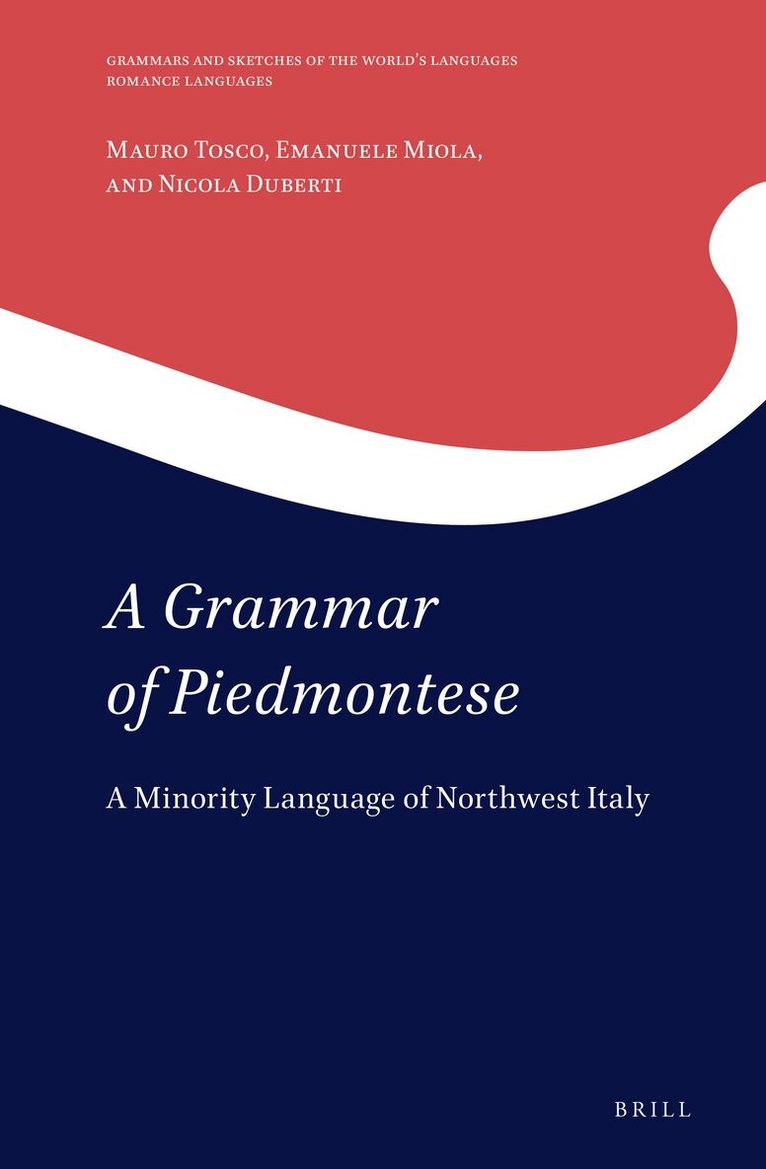
    Grammar of Piedmontese

    A Minority Language of Northwest Italy

    AvMauro Tosco,Emanuele Miola

    Inbunden, Engelska, 2023

    Del 19 i serien Romance Languages

    2 706 kr

    Beställningsvara. Skickas inom 5-8 vardagar. Fri frakt över 249 kr.

    Beskrivning

    Cerea, madamin, andoma bin? Less than a century ago, this was one of the most frequent greetings heard in Piedmont, a region in northwest Italy. Today, however, Piedmontese is severely endangered. This volume presents the first widely accessible and comprehensive grammatical description of the contemporary koine, covering its phonetics, phonology, morphology, syntax, pragmatics and typology, and drawing examples from both oral and written sources. Data on the history of the language and the local dialects and notes on revitalization efforts are also included.

    Produktinformation

    • Utgivningsdatum:2023-06-08
    • Mått:155 x 235 x 43 mm
    • Vikt:1 118 g
    • Format:Inbunden
    • Språk:Engelska
    • Serie:Romance Languages
    • Antal sidor:572
    • Förlag:Brill
    • ISBN:9789004544055

    Utforska kategorier

    • Språkvetenskap och lingvistik inom Språk och ordböcker

    Mer om författaren

    Mauro Tosco is professor of African Linguistics at the University of Turin. His main area of research is the Horn of Africa. He also works on the revitalization of minority languages and language policy and ideology.Emanuele Miola is Associate Professor of Linguistics at the University of Bologna. His research interests include sociolinguistics, Italo-Romance and Piedmontese dialectology, and typology.Nicola Duberti is Adjunct Professor of Piedmontese at the University of Turin. His main areas of research are the dialectology of Piedmontese varieties and the history of Piedmontese literature. He also works on the revitalization of minority languages in schools.

    Recensioner i media

    "This comprehensive, brilliantly clear, and fascinating description of Piedmontese is a real treasure, both for linguists and members of the Piedmontese community. In terms of organization and the breadth of topics covered, this volume can serve as a model for any scholar working to describe a minority language." - Prof. Aaron Rubin, University of Georgia

    Innehållsförteckning

    • Conventions, Glosses and SymbolsMaps of Place Names in Piedmont Mentioned in the GrammarList of Maps, Tables and Figures1 The Language and Its History, Classification and Variation1.1 Overview: Language and Speakers1.2 Disentangling Classification and Ideology1.3 The Dialects of Piedmontese: Features and Classification1.4 The Internal Classification of the Piedmontese Varieties1.5 Social Varieties in Old Piedmontese1.6 The Speech of the Piedmontese Jews, Sinti and Waldensians1.7 A Short Linguistic History of Piedmont1.8 An Outline of the Piedmontese Literature2 Phonetics and Phonology2.1 Default Articulation of Phonemes2.2 Loan Phonemes, Borrowing and Adaptation2.3 Previous Accounts of the Phonology of Piedmontese2.4 Phonetic Processes2.5 Positional Restrictions on the Occurrence of Phonemes2.6 Syllables2.7 Clusters2.8 Length2.9 Stress2.10 Pitch and Intonation3 Writing System and Orthography3.1 Overview3.2 History3.3 Evaluation4 Words, Word Constituents and Word Classes4.1 Roots, Stems, Words, Affixes and Clitics4.2 Morphological Mechanisms4.3 Suppletion4.4 Syncretism4.5 Word Classes5 Nouns5.1 Overview5.2 Gender5.3 Number5.4 Derivational Morphology of Nouns6 Adjectives6.1 Overview6.2 Semantics of Adjectives6.3 Morphology of Adjectives6.4 Comparative Constructions6.5 Adjectives as Nouns6.6 Derivational Morphology of Adjectives7 Personal Pronouns7.1 Overview7.2 Independent Personal Pronouns7.3 Subject Personal Pronouns7.4 Non-subject Personal Pronouns: Object and Indirect Object7.5 Interrogative Subject Clitics7.6 Reflexive, Reciprocal and Impersonal Personal Pronouns7.7 Attributive Pronoun7.8 Lexicalized Verb-Clitic Constructions7.9 Post-Tonic Vowel Dropping7.10 Sequences of Clitics8 Grounding and Deixis8.1 Overview8.2 Determiners and Classifiers8.3 Deixis8.4 Possessives9 Quantifiers9.1 Numerals9.2 Generic Quantifiers9.3 Negative Quantifiers9.4 Interrogative Quantifiers9.5 Quantificational Quantifiers10 Verbs10.1 Semantic Overview10.2 Morphological Overview10.3 Affixes, Allomorphy and Syncretism10.4 Historical and Comparative Notes10.5 Moods and Tenses10.6 Use of the Auxiliaries10.7 Verbal Derivation11 Verbal Periphrases and Modalities11.1 Valency-Increasing Operation, 1: Causative11.2 Valency-Increasing Operation, 2: Permissive11.3 Valency-Increasing Operation, 3: Middle11.4 Modal Verbs11.5 Progressive and Continuous11.6 Imminential11.7 Inchoative11.8 Durative11.9 Terminative11.10 Immediative11.11 Iterative12 Adverbs12.1 Overview12.2 Predicate Adverbs12.3 Degree Adverbs and Focalizers12.4 Sentence Adverbs12.5 Linking Adverbs12.6 Adverb Formation Rules and Productivity13 Prepositions and Prepositional Phrases13.1 The Expression of Location and Movement13.2 Basic Prepositions13.3 Non-basic Prepositions13.4 Prepositional Use of Adverbs13.5 Attributive Phrases and Binominal Constructions14 Phrases14.1 The Structure of the Noun Phrase14.2 Grounding and Ordering of Phrases14.3 Adjectival Phrases14.4 Temporal Phrases and Telling the Time15 Clauses15.1 Non-verbal Predication15.2 Declarative Clauses15.3 Introducing the Ubiquitous che15.4 “Bare” che in Non-verbal Predication15.5 Relative Clauses15.6 Imperative Clauses15.7 Exhortative Clauses15.8 Mirative and Exclamative Clauses15.9 Questions15.10 The Expression of Atmospheric Events16 Linkage16.1 Coordination16.2 Subordination17 Negation17.1 Overview17.2 Sentence Negators17.3 Negation with Scope over Smaller Units17.4 Other Negative Items17.5 Negative Concord17.6 Holophrastic Negation18 Pragmatics and Discourse18.1 Information Structure and Sentence Word Order18.2 Hanging Topics and Clefts18.3 Discourse Markers19 Piedmontese in a Typological Perspective19.1 Genealogy and Overview19.2 Phonology19.3 Morphosyntax19.4 Lexical Typology19.5 Piedmontese, Standard Average European, and Other Romance Languages20 Use, Contact and Care: Codeswitching, Endangerment, Enrichment and Standardization20.1 Language Ideology through Language Use20.2 The Long Road toward Resurgence20.3 EnvoiAppendix: TextReferencesIndex