• Fri frakt över 249 kr
  • •
  • Snabba leveranser
  • •
  • Billiga böcker
Kundservice

Du är på sajten för privatpersoner.

Företag, bibliotek eller offentlig verksamhet?

Du handlar på classic.bokus.com, där alla dina funktioner finns intakta.
Till classic.bokus.com
Bokus logotyp. Gå till startsidan.
  • Erbjudanden
  • Nyheter
  • Student
  • Topplistor
  • Barn & ungdom
  • Bokus Play
  • E-böcker
  • Pocketböcker
  • Spel & pussel

10% rabatt på allt med kod NYSTART10 →

Sidfot

Mina sidor

    Hjälp

    • Kundservice
    • Vanliga frågor och svar
    • Frakt och leverans
    • Retur vid ångerrätt
    • Reklamera vara
    • Betalning
    • Köpvillkor
    • Allmänna villkor
    • Information om webbplatsens tillgänglighet

    Om Bokus

    • Om oss
    • Pressrum
    • För studenter
    • För företag
    • För bibliotek och offentlig verksamhet
    • För leverantörer
    • Hållbarhet

    Populärt

    • Aktuella erbjudanden
    • Presentkort
    • Studentlitteratur
    • Nya böcker
    • Topplistor
    • Signerade böcker
    • Engelska böcker

    Inspiration

    • Boktips
    • BookTok
    • Populära bokserier
    • Barnbokskaraktärer
    • Populära författare
    Logotyp för Bokus
    Följ oss på Facebook (extern länk)Följ oss på Instagram (extern länk)Följ oss på YouTube (extern länk)Följ oss på TikTok (extern länk)
    bokus @ CookiesAnpassa cookiesIntegritetspolicyKöpvillkor
    Till Citymail hemsida (extern länk)Till Budbee hemsida (extern länk)Till Postnord hemsida (extern länk)Till Schenker hemsida (extern länk)Till Early Bird hemsida (extern länk)Till Walleys hemsida (extern länk)
    1. Språk och ordböcker
    2. Språkvetenskap och lingvistik

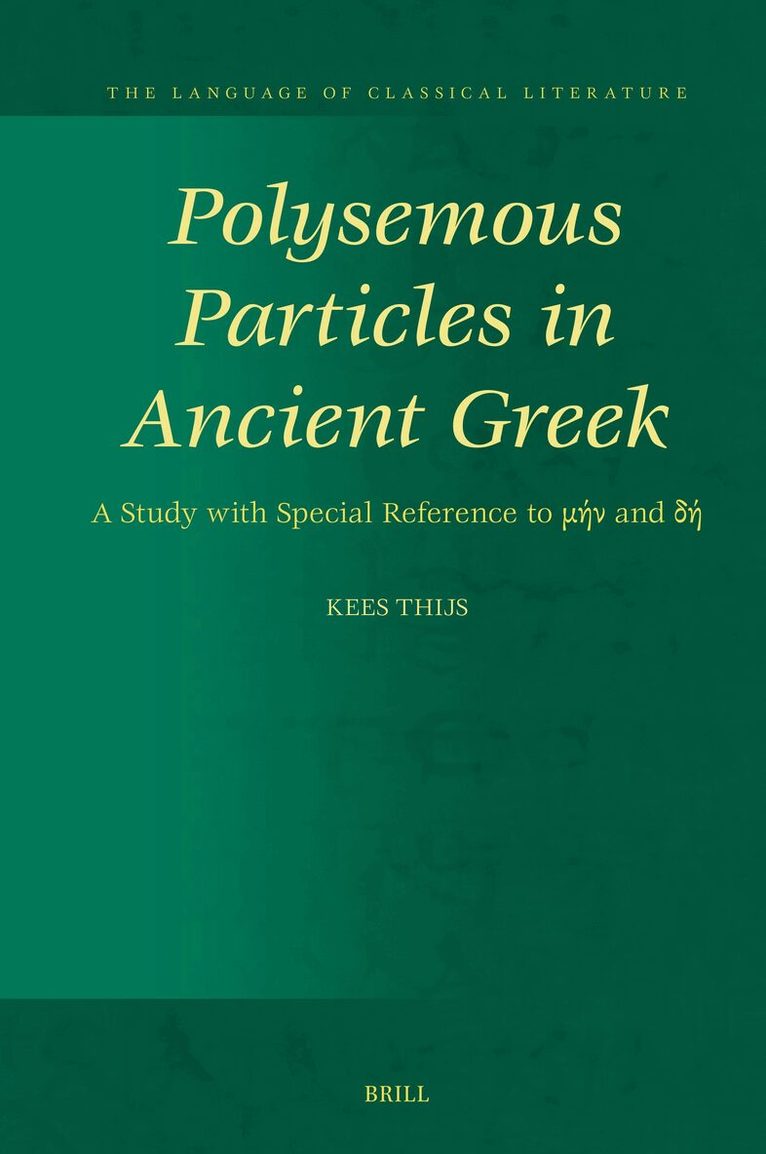
    Polysemous Particles in Ancient Greek

    A Study with Special Reference to μήν and δή

    AvKees Thijs

    Inbunden, Engelska, 2025

    Del 39 i serien Language of Classical Literature

    2 254 kr

    Beställningsvara. Skickas inom 3-6 vardagar. Fri frakt över 249 kr.

    Beskrivning

    Anyone reading an Ancient Greek text will notice the abundance of pragmatic particles (e.g. ἄρα, γάρ, γε, δέ, δή, μέν, μήν, οὖν), a much-debated and challenging class of expressions. What are their semantic contributions, and how should we account for their notorious polyfunctionality? In this book, Kees Thijs provides a state of the art of modern particle theory, which he then applies to two of the most versatile Greek particles, μήν and δή. Using a diachronically oriented polysemy approach and a large-scale, varied research corpus, Thijs offers a new, unified account that significantly improves on both traditional handbooks (e.g. Denniston) and more recent particle studies.

    Produktinformation

    • Utgivningsdatum:2025-03-06
    • Mått:155 x 235 x 35 mm
    • Vikt:890 g
    • Format:Inbunden
    • Språk:Engelska
    • Serie:Language of Classical Literature
    • Antal sidor:446
    • Förlag:Brill
    • ISBN:9789004714984

    Utforska kategorier

    • Språkvetenskap och lingvistik inom Språk och ordböcker

    Mer om författaren

    Kees Thijs (PhD 2021) is a lecturer in logic and Ancient Greek at Radboud University Nijmegen. His research is at the crossroads of Ancient Greek, linguistics, and philosophy of language, with a focus on pragmatic particles and Greek word order.

    Innehållsförteckning

    • AcknowledgementsList of tables and figuresAbbreviations, symbols, and translations1 General introduction1.1 Setting the scene1.2 Earlier scholarship1.3 Data1.4 Methodology1.5 Outline of the present studyPart1 Theoretical background2 Pragmatic particles2.1 Introduction2.2 Preliminaries on linguistic categorization2.3 Particles2.4 Pragmatic markers2.5 Conclusion3 Outline of the functional spectrum3.1 Introduction3.2 Connectives3.3 Attitudinal-interactional markers3.4 Focus modifiers3.5 Intensifiers3.6 Markers of non-straightforward communication3.7 Conclusion4 Polyfunctionality and diachronic change4.1 Introduction4.2 Diachronic change4.3 Homonymy, monosemy, and polysemy4.4 Methodological reflections4.5 Conclusion5 Position and scope of Greek particles5.1 Introduction5.2 Greek syntax and word order5.3 Prepositives5.4 Postpositives5.5 Conclusion: the position of particles as linguistic evidencePart2 Case studies6 Μήν6.1 Setting the scene6.2 Earlier accounts6.3 Μήν as an attitudinal-interactional particle6.4 Μήν as a discourse-connective particle6.5 Conclusion7 Δή7.1 Setting the scene7.2 Earlier accounts7.3 Δή as an attitudinal-interactional particle7.4 Δή as a discourse-connective particle7.5 Δή as a phrasal modifier7.6 Conclusion8 General conclusion8.1 Summary overview8.2 Suggestions for further researchAppendix A: Quantitative dataBibliographyIndex Locorum