• Fri frakt över 249 kr
  • •
  • Snabba leveranser
  • •
  • Billiga böcker
Kundservice

Du är på sajten för privatpersoner.

Företag, bibliotek eller offentlig verksamhet?

Du handlar på classic.bokus.com, där alla dina funktioner finns intakta.
Till classic.bokus.com
Bokus logotyp. Gå till startsidan.
  • Erbjudanden
  • Nyheter
  • Student
  • Topplistor
  • Barn & ungdom
  • Bokus Play
  • E-böcker
  • Pocketböcker
  • Spel & pussel

10% rabatt på allt med kod NYSTART10 →

Sidfot

Mina sidor

    Hjälp

    • Kundservice
    • Vanliga frågor och svar
    • Frakt och leverans
    • Retur vid ångerrätt
    • Reklamera vara
    • Betalning
    • Köpvillkor
    • Allmänna villkor
    • Information om webbplatsens tillgänglighet

    Om Bokus

    • Om oss
    • Pressrum
    • För studenter
    • För företag
    • För bibliotek och offentlig verksamhet
    • För leverantörer
    • Hållbarhet

    Populärt

    • Aktuella erbjudanden
    • Presentkort
    • Studentlitteratur
    • Nya böcker
    • Topplistor
    • Signerade böcker
    • Engelska böcker

    Inspiration

    • Boktips
    • BookTok
    • Populära bokserier
    • Barnbokskaraktärer
    • Populära författare
    Logotyp för Bokus
    Följ oss på Facebook (extern länk)Följ oss på Instagram (extern länk)Följ oss på YouTube (extern länk)Följ oss på TikTok (extern länk)
    bokus @ CookiesAnpassa cookiesIntegritetspolicyKöpvillkor
    Till Citymail hemsida (extern länk)Till Budbee hemsida (extern länk)Till Postnord hemsida (extern länk)Till Schenker hemsida (extern länk)Till Early Bird hemsida (extern länk)Till Walleys hemsida (extern länk)
    1. Naturvetenskap och teknik
    2. Geovetenskap
    3. Geovetenskap
    4. Meteorologi och klimatologi

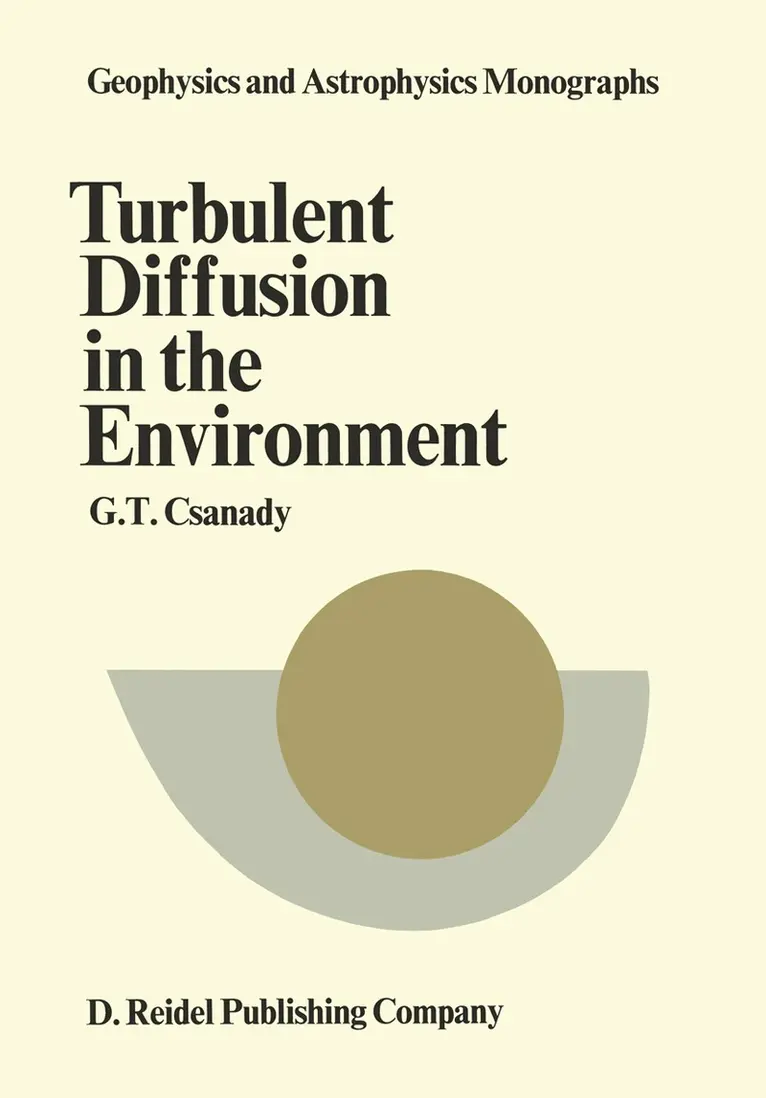
    Turbulent Diffusion in the Environment

    AvG.T. Csanady

    Häftad, Engelska, 1973

    Del i serien Geophysics and Astrophysics Monographs

    1 192 kr

    Beställningsvara. Skickas inom 10-15 vardagar. Fri frakt över 249 kr.

    Fler format och utgåvor

    E-bok

    1 575 kr

    Beskrivning

    The rather excessive public preoccupation of the immediate past with what has been labeled the 'environmental crisis' is now fortunately being replaced by a more sus­ tained and rational concern with pollution problems by public administrators, engineers, and scientists. It is to be expected that members of the engineering profes­ sion will in the future widely be called upon to design disposal systems for gaseous and liquid wastes which meet strict pollution control regulations and to advise on possible improvements to existing systems of this kind. The engineering decisions involved will have to be based on reasonably accurate quantitative predictions of the effects of pollutants introduced into the atmosphere, ocean, lakes and rivers. A key input for such calculations comes from the theory of turbulent diffusion, which enables the prediction of the concentrations in which pollutants may be found in the neighborhood of a release duct, such as a chimney or a sewage outfall. Indeed the role of diffusion theory in pollution prediction may be likened to the role of applied mechanics (,strength of materials') in the design of structures for adequate strength. At least a certain group of engineers will have to be proficient in applying this particular branch of science to practical problems. At present, training in the theory of turbulent diffusion is available only at the gra­ duate level and then only in a very few places.

    Produktinformation

    • Utgivningsdatum:1973-02-28
    • Mått:170 x 244 x 15 mm
    • Vikt:462 g
    • Format:Häftad
    • Språk:Engelska
    • Serie:Geophysics and Astrophysics Monographs
    • Antal sidor:249
    • Förlag:Springer
    • ISBN:9789027702616

    Utforska kategorier

    • Meteorologi och klimatologi inom Naturvetenskap och teknik

    Innehållsförteckning

    • I. Molecular Diffusion.- 1.1. Introduction.- 1.2. Concentration.- 1.3. Flux.- 1.4. Fick’s Law.- 1.5. Conservation of Mass.- 1.6. Instantaneous Plane Source.- 1.7. Some Simple Examples.- 1.8. Diffusion of Finite Size Cloud.- 1.9. ‘Reflection’ at Boundary.- 1.10. Two- and Three-Dimensional Problems.- 1.11. Continuous Sources.- 1.12. Source in Uniform Wind.- Appendix to Chapter I.- Exercises.- References.- II. Statistical Theory of Diffusion and Brownian Motion.- 2.1. Introduction.- 2.2. Dispersion Through Random Movements.- 2.3. Diffusion with Stationary Velocities.- 2.4. Brownian Motion.- 2.5. Dispersion of Brownian Particles.- 2.6. Simple Random Walk Model.- 2.7. Reflecting Barrier.- 2.8. Absorbing Barrier.- 2.9. Connection of Random Walk to Diffusion Equation.- 2.10. Deposition on Vertical Surfaces.- 2.11. Deposition on Horizontal Surfaces.- Exercises.- References.- III. Turbulent Diffusion: Elementary Statistical Theory and Atmospheric Applications.- 3.1. Fundamental Concepts of Turbulence.- 3.2. Field Measurements of Concentration and Dosage.- 3.3. The Statistical Approach to Environmental Diffusion.- 3.4. ‘Lagrangian’ Properties of Turbulence.- 3.5. Consequences of Taylor’s Theorem.- 3.6. The Form of the Particle-Displacement Probability Distribution.- 3.7. Mean Concentration Field of Continuous Sources.- 3.8. Apparent Eddy Diffusivity.- 3.9. Application to Laboratory Experiments.- 3.10. Application to Atmospheric Diffusion.- 3.11. Initial Phase of Continuous Plumes.- 3.12. Atmospheric Cloud Growth far from Concentrated Sources.- 3.13. The Non-Stationary Character of Atmospheric Turbulence.- 3.14. The Hay-Pasquill Method of Cloud-Spread Prediction.- Exercise.- References.- IV. ‘Relative’ Diffusion and Oceanic Applications.- 4.1. Experimental Basis.-4.2. Mean Concentration Field in a Frame of Reference Attached to the Center of Gravity.- 4.3. Probability Distributions of Particle Displacements.- 4.4. Kinematics of Particle Movements in a Moving Frame.- 4.5. Phases of Cloud Growth.- 4.6. History of a Concentrated Puff.- 4.7. Initially Finite Size Cloud.- 4.8. Use of the Diffusion Equation.- 4.9. Horizontal Diffusion in the Ocean and Large Lakes.- 4.10. Application to Diffusion of Sewage Plumes.- 4.11. Vertical Diffusion in Lakes and Oceans.- Exercise.- References.- V. Dispersion in Shear Flow.- 5.1. Introduction.- 5.2. Properties of the Planetary Boundary Layer.- 5.3. Particle Displacements in a Wall Layer.- 5.4. Continuous Ground-Level Line Source.- 5.5. Flux and Eddy Diffusivity.- 5.6. Comparison with Experiment.- 5.7. Continuous Point Source at Ground Level.- 5.8. Use of the Diffusion Equation.- 5.9. Elevated Sources.- 5.10. Longitudinal Dispersion in Shear Flow.- 5.11. Shear-Augmented Diffusion in a Channel.- 5.12. Dispersion in Natural Streams.- 5.13. Shear-Augmented Dispersion in Unlimited Parallel Flow.- 5.14. Diffusion in Skewed Shear Flow.- References.- VI. Effects of Density Differences on Environmental Diffusion.- 6.1. Introduction.- 6.2. Fundamental Equations.- 6.3. Approximate Forms of the Equations.- 6.4. Equations for Turbulent Flow.- 6.5. Turbulent Energy Equation.- 6.6. Diffusion Floors and Ceilings.- 6.7. Diffusion in a Continuously Stratified Fluid.- 6.8. Velocity Autocorrelation and Particle Spread in Stratified Fluid Model.- 6.9. Bodily Motion of Buoyant and Heavy Plumes.- 6.10. Dynamics of a Line Thermal.- 6.11. Similarity Theory.- 6.12. Bent-Over Chimney Plumes.- 6.13. Theory of Buoyancy Dominated Plumes in a Neutral Atmosphere.- 6.14. Comparison with Observation.- 6.15. Flow Pattern within aPlume.- 6.16. Effect of Atmospheric Stratification.- 6.17. Approximate Arguments for Plumes in Stratified Surroundings.- 6.18. Engineering Assessment of Ground Level Pollution from Buoyancy Dominated Plumes.- 6.19. Effects of Plume Rise on Ground-Level Concentration.- Appendix to Chapter VI.- A6.1. Momentum Plumes.- Exercise.- References.- VII. The Fluctuation Problem in Turbulent Diffusion.- 7.1. Introduction.- 7.2. Probability Distribution of Concentration.- 7.3. The Functional Form of the Probability Distribution.- 7.4. Hazard Assessment on the Basis of Concentration Probabilities.- 7.5. The Variance of Concentration Fluctuations.- 7.6. Self-Similar Fluctuation Intensity Distribution.- 7.7. Fluctuating Plume Model.- References.