• Fri frakt över 249 kr
  • •
  • Snabba leveranser
  • •
  • Billiga böcker
Kundservice

Du är på sajten för privatpersoner.

Företag, bibliotek eller offentlig verksamhet?

Du handlar på classic.bokus.com, där alla dina funktioner finns intakta.
Till classic.bokus.com
Bokus logotyp. Gå till startsidan.
  • Erbjudanden
  • Nyheter
  • Student
  • Topplistor
  • Barn & ungdom
  • Bokus Play
  • E-böcker
  • Pocketböcker
  • Spel & pussel

10% rabatt på allt med kod NYSTART10 →

Sidfot

Mina sidor

    Hjälp

    • Kundservice
    • Vanliga frågor och svar
    • Frakt och leverans
    • Retur vid ångerrätt
    • Reklamera vara
    • Betalning
    • Köpvillkor
    • Allmänna villkor
    • Information om webbplatsens tillgänglighet

    Om Bokus

    • Om oss
    • Pressrum
    • För studenter
    • För företag
    • För bibliotek och offentlig verksamhet
    • För leverantörer
    • Hållbarhet

    Populärt

    • Aktuella erbjudanden
    • Presentkort
    • Studentlitteratur
    • Nya böcker
    • Topplistor
    • Signerade böcker
    • Engelska böcker

    Inspiration

    • Boktips
    • BookTok
    • Populära bokserier
    • Barnbokskaraktärer
    • Populära författare
    Logotyp för Bokus
    Följ oss på Facebook (extern länk)Följ oss på Instagram (extern länk)Följ oss på YouTube (extern länk)Följ oss på TikTok (extern länk)
    bokus @ CookiesAnpassa cookiesIntegritetspolicyKöpvillkor
    Till Citymail hemsida (extern länk)Till Budbee hemsida (extern länk)Till Postnord hemsida (extern länk)Till Schenker hemsida (extern länk)Till Early Bird hemsida (extern länk)Till Walleys hemsida (extern länk)
    1. Naturvetenskap och teknik
    2. Matematik och naturvetenskap
    3. Naturvetenskap:allmänt
    4. Naturvetenskapens filosofi

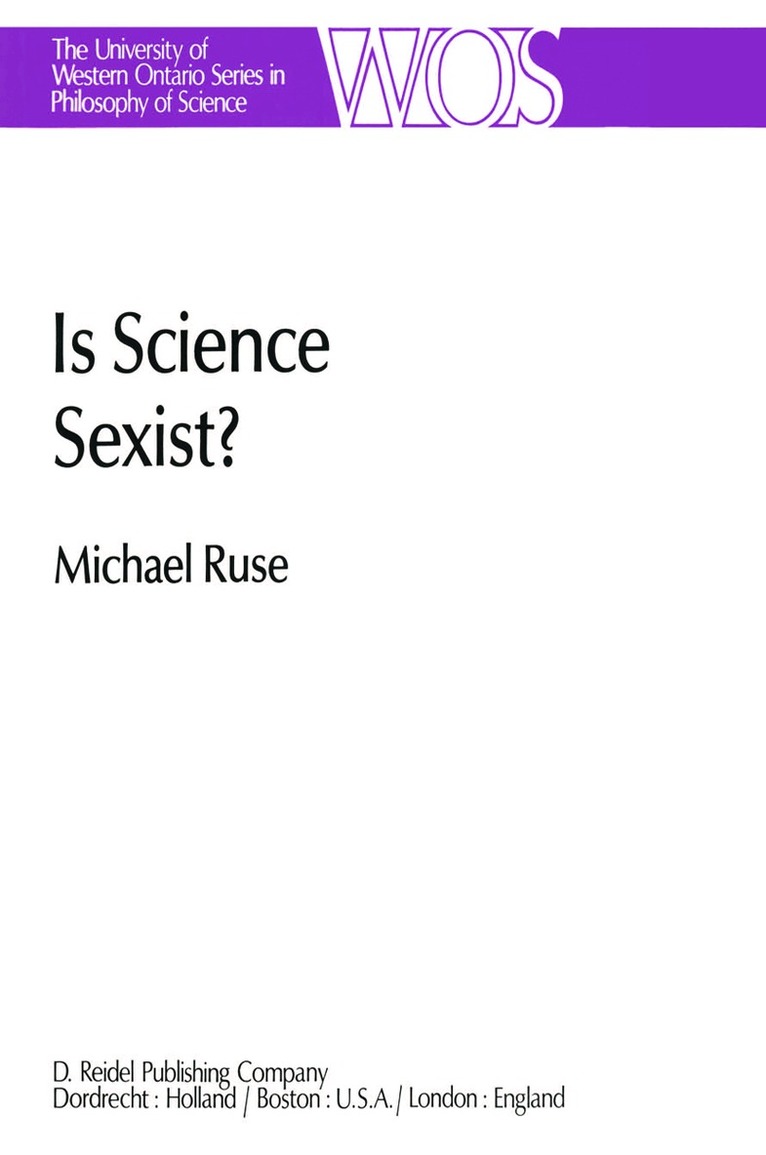
    Is Science Sexist?

    And Other Problems in the Biomedical Sciences

    AvM. Ruse

    Häftad, Engelska, 1981

    Del i serien Western Ontario Series in Philosophy of Science

    1 086 kr

    Beställningsvara. Skickas inom 10-15 vardagar. Fri frakt över 249 kr.

    Fler format och utgåvor

    Inbunden

    1 086 kr

    E-bok

    1 413 kr

    Beskrivning

    Philosophy of biology has a long and honourable history. Indeed, like most of the great intellectual achievements of the Western World, it goes back to the Greeks. However, until recently in this century, it was sadly neglected. With a few noteworthy exceptions, someone wishing to delve into the subject had to choose between extremes of insipid vitalism on the one hand, and sterile formalizations of the most elementary biological principles on the other. Whilst philosophy of physics pushed confidently ahead, the philosophy of biology languished. In the past decade, however, things have changed dramatically. A number of energetic and thoughtful young philosophers have made real efforts to master the outlines and details of contemporary biology. They have shown that many stimulating problems emerge when analytic skills are turned towards the life-sciences, particularly if one does not feeI con­ strained to stay only with theoretical parts of biology, but can range over to more medical parts of the spectrum. At the same time, biology itself has had one of the most fruitful yet turbulent periods in its whole history, and more and more biologists have grown to see that many of the problems they face take them beyond the narrow confines of empiric al science: a broader perspective is needed.

    Produktinformation

    • Utgivningsdatum:1981-07-31
    • Mått:155 x 235 x 18 mm
    • Vikt:493 g
    • Format:Häftad
    • Språk:Engelska
    • Serie:Western Ontario Series in Philosophy of Science
    • Antal sidor:299
    • Förlag:Springer
    • ISBN:9789027712509

    Utforska kategorier

    • Naturvetenskapens filosofi inom Naturvetenskap och teknik

    Innehållsförteckning

    • 1. The Structure of Evolutionary Theory.- 1.1. Three features of physico-chemical theories.- 1.2. Evolutionary theory and the observational/theoretical dichotomy.- 1.3. Is evolutionary theory hypothetico-deductive?.- 1.4. But is genetics really part of evolutionary theory?.- 1.5. The consilient nature of evolutionary theory.- 1.6. Conclusion.- Notes.- 2. The Evidence for Evolutionary Theory.- 2.1. Evidence for the synthetic theory’s core.- 2.2. Evidence for the whole theory.- 2.3. Rivals: The first chapter of Genesis.- 2.4. Rivals: Lamarckism.- 2.5. Rivals: Saltationism.- 2.6. Rivals: Orthogenesis.- 2.7. Evolutionary logic.- Notes.- 3. Karl Popper and Evolutionary Biology.- 3.1. Evolutionary theory as a metaphysical research programme.- 3.2. The problem of speciation.- 3.3. Is natural selection a tautology?.- 3.4. The problem of gradual change.- 3.5. Popperian saltationism.- 3.6. Evolutionary biology and evolutionary epistemology.- 4. The Last Word on Teleology, or Optimality Models Vindicated.- 4.1. The teleology of biology.- 4.2. Artifacts and adaption.- 4.3. Consequences and amplifications.- Notes.- 5. The Molecular Revolution in Genetics.- 5.1. Scientific advance: reduction or replacement?.- 5.2. What kind of revolution occurred in genetics?.- 5.3. But did ‘strong’ reduction really occur?.- 5.4. David Hull objects.- Notes.- 6. Does Genetic Counselling Really Raise The Quality of Life?.- 6.1. Genetic counseling.- 6.2. The John F. Kennedy Institute Tay-Sachs programme.- 6.3. The limitations to genetic counseling.- 6.4. The problem of abortion.- 6.5. The problem of the poor.- 6.6. The problem of minorities.- 6.7. What is genetic disease?.- 6.8. Conclusion.- Notes.- 7. The Recombinant Dna Debate: A Tempest in A Test Tube?.- 7.1. The recombinant DNA debate.- 7.2.The nature of recombinant DNA research.- 7.3. The positive case for recombinant DNA research.- 7.4. The negative case against recombinant DNA research.- 7.5. Do the benefits outweight the risks?.- 7.6. The dangers of recombinant DNA research.- 7.7. The argument from epidemiology.- 7.8. Recombinant DNA research considered as science.- 7.9. Can one really separate science and technology?.- 7.10. Epilogue.- Notes.- 8. Sociobiology: Sound Science or Muddled Metaphysics?.- 8.1. What is sociobiology.- 8.2. Humans as seen through the lens of sociobiology.- 8.3. Other sociobiological claims.- 8.4. Is human sociobiology facist?.- 8.5. Is sociobiology prejudiced against homosexuals?.- 8.6. The testability of sociobiology.- 8.7. The falsity of sociobiology.- 8.8. Sociobiology and philosophy.- Notes.- 9. Is Science Sexist? The Case of Sociobiology.- 9.1. How science can show bias.- 9.2. Freudian psychoanalytic theory.- 9.3. The sociobiology of human sexuality: Wilson.- 9.4. The sociobiology of human sexuality: Symons.- 9.5. Is sociobiology sexist? The lesser charges.- 9.6. Is sociobiology sexist? The major charge.- 9.7. Concluding reflections for the feminist.- Notes.- 10. Are Homosexuals Sick?.- 10.1.Two models of health and sickness.- 10.2. The empirical facts about homosexuality.- 10.3. Psychoanalytic causal explanations.- 10.4. Endocrinal causal explanations of homosexuality.- 10.5. Sociobiological causal explanations.- 10.6. Conclusion.- Appendix 1. Matrix comparing sickness models against putative facts about homosexuality.- Appendix 2. Freud’s letter to an American Mother.- Notes.- Name Index.