• Fri frakt över 249 kr
  • •
  • Snabba leveranser
  • •
  • Billiga böcker
Kundservice

Du är på sajten för privatpersoner.

Företag, bibliotek eller offentlig verksamhet?

Du handlar på classic.bokus.com, där alla dina funktioner finns intakta.
Till classic.bokus.com
Bokus logotyp. Gå till startsidan.
  • Erbjudanden
  • Nyheter
  • Student
  • Topplistor
  • Barn & ungdom
  • Bokus Play
  • E-böcker
  • Pocketböcker
  • Spel & pussel

10% rabatt på allt med kod NYSTART10 →

Sidfot

Mina sidor

    Hjälp

    • Kundservice
    • Vanliga frågor och svar
    • Frakt och leverans
    • Retur vid ångerrätt
    • Reklamera vara
    • Betalning
    • Köpvillkor
    • Allmänna villkor
    • Information om webbplatsens tillgänglighet

    Om Bokus

    • Om oss
    • Pressrum
    • För studenter
    • För företag
    • För bibliotek och offentlig verksamhet
    • För leverantörer
    • Hållbarhet

    Populärt

    • Aktuella erbjudanden
    • Presentkort
    • Studentlitteratur
    • Nya böcker
    • Topplistor
    • Signerade böcker
    • Engelska böcker

    Inspiration

    • Boktips
    • BookTok
    • Populära bokserier
    • Barnbokskaraktärer
    • Populära författare
    Logotyp för Bokus
    Följ oss på Facebook (extern länk)Följ oss på Instagram (extern länk)Följ oss på YouTube (extern länk)Följ oss på TikTok (extern länk)
    bokus @ CookiesAnpassa cookiesIntegritetspolicyKöpvillkor
    Till Citymail hemsida (extern länk)Till Budbee hemsida (extern länk)Till Postnord hemsida (extern länk)Till Schenker hemsida (extern länk)Till Early Bird hemsida (extern länk)Till Walleys hemsida (extern länk)
    1. Naturvetenskap och teknik
    2. Geovetenskap
    3. Geovetenskap
    4. Meteorologi och klimatologi

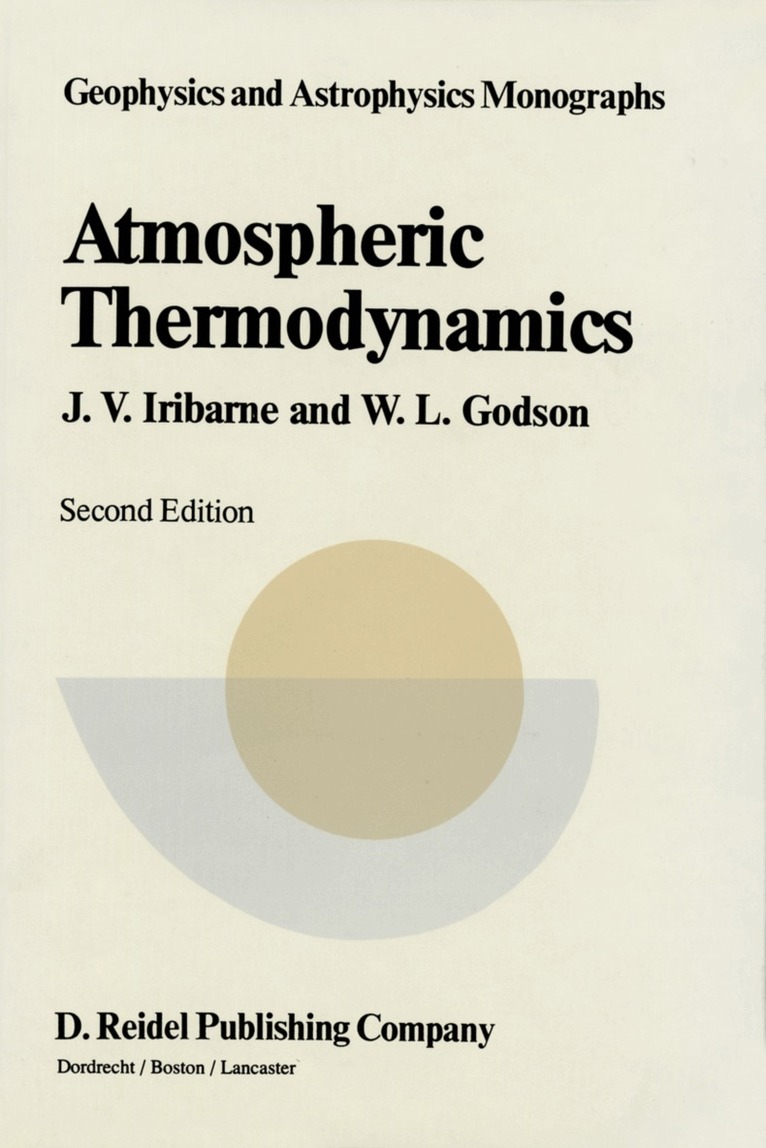
    Atmospheric Thermodynamics

    AvJulio V. Iribarne,W.L. Godson

    Häftad, Engelska, 1981

    Del i serien Geophysics and Astrophysics Monographs

    1 623 kr

    Beställningsvara. Skickas inom 10-15 vardagar. Fri frakt över 249 kr.

    Beskrivning

    The thermodynamics of the atmosphere is the subject of severai chapters in most textbooks on dynamic meteorology, but there is no work in English to give the subject a specific and more extensive treatment. In writing the present textbook, we have tried to fiII this rather remarkable gap in the literature related to atmospheric sciences. Our aim has been to provide students of meteorology with a book that can play a role similar to the textbooks on chemical thermodynamics for the chemists. This implies a previous knowledge of general thermodynamics, such as students acquire in general physics courses; therefore, although the basic principles are reviewed (in the urst four chapters), they are only briefly discussed, and emphasis is laid on those topics that wilI be useful in later chapters, through their application to atmospheric problems. No attempt has been made to introduce the thermodynamics ofirreversible processes; on the other hand, consideration of heterogeneous and open homogeneous systems permits a rigorous formulation of the thermodynamic functions of c10uds (exclusive of any consideration of microphysical effects) and a better understanding of the approx­ imations usually implicit in practical applications.

    Produktinformation

    • Utgivningsdatum:1981-07-31
    • Mått:160 x 240 x 16 mm
    • Vikt:452 g
    • Format:Häftad
    • Språk:Engelska
    • Serie:Geophysics and Astrophysics Monographs
    • Antal sidor:260
    • Upplaga:2
    • Förlag:Springer
    • ISBN:9789027712974

    Utforska kategorier

    • Meteorologi och klimatologi inom Naturvetenskap och teknik

    Innehållsförteckning

    • I. Review of Basic Concepts and Systems of Units.- 1.1 Systems.- 1.2 Properties.- 1.3 Composition and State of a System.- 1.4 Equilibrium.- 1.5 Temperature. Temperature Scales.- 1.6 Systems of Units.- 1.7 Work of Expansion.- 1.8 Modifications and Processes. Reversibility.- 1.9 State Variables and State Functions. Equation of State.- 1.10 Equation of State for Gases.- 1.11 Mixture of Ideal Gases.- 1.12 Atmospheric Air Composition.- Problems.- II. The First Principle of Thermodynamics.- 2.1. Internal Energy.- 2.2 Heat.- 2.3 The First Principle. Enthalpy.- 2.4 Expressions of Q. Heat Capacities.- 2.5 Calculation of Internal Energy and Enthalpy.- 2.6 Latent Heats of Pure Substances. Kirchhoff’s Equation.- 2.7 Adiabatic Processes in Ideal Gases. Potential Temperature.- 2.8 Polytropic Processes.- Problems.- III. The Second Principle of Thermodynamics.- 3.1 The Entropy.- 3.2 Thermodynamic Scale of Absolute Temperature.- 3.3 Formulations of the Second Principle.- 3.4 Lord Kelvin’s and Clausius’ Statements of the Second Principle.- 3.5 Joint Mathematical Expressions of the First and Second Principles. Thermodynamic Potentials.- 3.6 Equilibrium Conditions and the Sense of Natural Processes.- 3.7 Calculation of Entropy.- 3.8 Thermodynamic Equations of State. Calculation of Internal Energy and Enthalpy.- 3.9 Thermodynamic Functions of Ideal Gases.- 3.10 Entropy of Mixing for Ideal Gases.- 3.11 Difference Between Heat Capacities at Constant Pressure and at Constant Volume.- Problems.- IV. Water-Air Systems.- 4.1 Heterogeneous Systems.- 4.2 Fundamental Equations for Open Systems.- 4.3 Equations for the Heterogeneous System. Internal Equilibrium.- 4.4 Summary of Basic Formulas for Heterogeneous Systems.- 4.5 Number of Independent Variables.- 4.6 Phase-Transition Equilibria forWater.- 4.7 Thermodynamic Surface for Water Substance.- 4.8 Clausius-Clapeyron Equation.- 4.9 Variation of Latent Heat Along the Equilibrium Curve.- 4.10 Water Vapor and Moist Air.- 4.11 Humidity Variables.- 4.12 Heat Capacities of Moist Air.- 4.13 Moist Air Adiabats.- 4.14 Enthalpy, Internal Energy and Entropy of Moist Air and of a Cloud.- Problems.- V. Equilibrium with Small Droplets and Crystals.- 5.1 Vapor Pressure of Small Droplets of a Pure Substance.- 5.2 Vapor Pressure of Solution Droplets.- 5.3 Sublimation and Freezing of Small Crystals.- Problems.- VI. Aerological Diagrams.- 6.1 Purpose of Aerological Diagrams and Selection of Coordinates.- 6.2 Clapeyron Diagram.- 6.3 Tephigram.- 6.4 Curves for Saturated Adiabatic Expansion. Relative Orientation of Fundamental Lines.- 6.5 Emagram or Neuhoff Diagram.- 6.6 Refsdal Diagram.- 6.7 Pseudoadiabatic or Stüve Diagram.- 6.8 Area Equivalence.- 6.9 Summary of Diagrams.- 6.10 Determination of Mixing Ratio from the Relative Humidity.- 6.11 Area Computation and Energy Integrals.- Problems.- VII. Thermodynamic Processes in the Atmosphere.- 7.1 Isobaric Cooling. Dew and Frost Points.- 7.2 Condensation in the Atmosphere by Isobaric Cooling.- 7.3 Adiabatic Isobaric (Isenthalpic) Processes. Equivalent and Wet-Bulb Temperatures.- 7.4 Adiabatic Isobaric Mixing (Horizontal Mixing) Without Condensation.- 7.5 Adiabatic Isobaric Mixing with Condensation.- 7.6 Adiabatic Expansion in the Atmosphere.- 7.7 Saturation of Air by Adiabatic Ascent.- 7.8 Reversible Saturated Adiabatic Process.- 7.9 Pseudoadiabatic Process.- 7.10 Effect of Freezing in a Cloud.- 7.11 Polytropic Expansion.- 7.12 Vertical Mixing.- 7.13 Pseudo- or Adiabatic Equivalent and Wet-Bulb Temperatures.- 7.14 Summary of Temperature and Humidity Parameters. ConservativeProperties.- Problems.- VIII. Atmospheric Statics.- 8.1 The Geopotential Field.- 8.2 The Hydrostatic Equation.- 8.3 Equipotential and Isobaric Surfaces. Dynamic and Geopotential Height.- 8.4 Thermal Gradients.- 8.5 Constant-Lapse-Rate Atmospheres.- 8.6 Atmosphere of Homogeneous Density.- 8.7 Dry-Adiabatic Atmosphere.- 8.8 Isothermal Atmosphere.- 8.9 Standard Atmosphere.- 8.10 Altimeter.- 8.11 Integration of the Hydrostatic Equation.- Problems.- IX. Vertical Stability.- 9.1 The Parcel Method.- 9.2 Stability Criteria.- 9.3 Lapse Rates for Atmospheric Ascents.- 9.4 The Lapse Rates of the Parcel and of the Environment.- 9.5 Stability Criteria for Adiabatic Processes.- 9.6 Conditional Instability.- 9.7 Oscillations in a Stable Layer.- 9.8 The Layer Method for Analyzing Stability.- 9.9 Entrainment.- 9.10 Potential or Convective Instability.- 9.11 Processes Producing Stability Changes for Dry Air.- 9.12 Stability Parameters of Saturated and Unsaturated Air, and Their Time Changes.- 9.13 Radiative Processes and Their Thermodynamic Consequences.- 9.14 Maximum Rate of Precipitation.- 9.15 Internal and Potential Energy in the Atmosphere.- 9.16 Internal and Potential Energy of a Layer with Constant Lapse Rate.- 9.17 Margules’ Calculations on Overturning of Air Masses.- 9.18 Transformations of a Layer with Constant Lapse Rate.- 9.19 The Available Potential Energy.- Problems.- Appendix I: Table of Physical constants.- Answers to Problems.