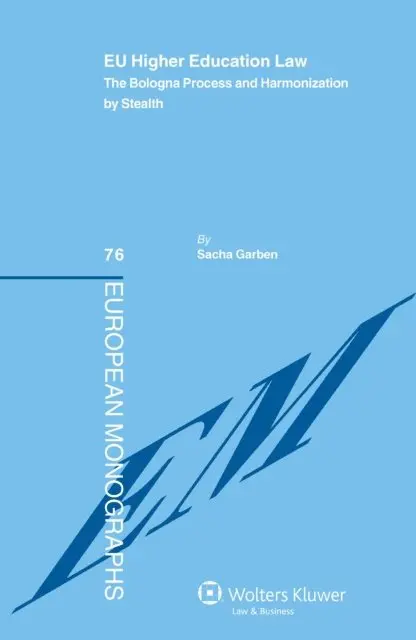
E-bok, Engelska, 2011
EU Higher Education Law
Av Sacha Garben
1807 kr
Läs direkt i Bokus Reader – eller ladda ned till din enhet (PDF kräver ofta zoom och scroll på små skärmar).
Beskrivning
In March 2010, the European Higher Education Area was officially launched, proclaiming the culmination of a ten-year timeframe projected at Bologna in 1999, when the education ministers of 29 European states signed a declaration that would fundamentally influence the future of their higher education systems. Forty-seven countries, including all EU Member States and other countries as far afield as Kazakhstan, now take part in the so-called ‘Bologna Process’. Remarkably, this vast enterprise, which has led to rapid and sweeping changes in almost all higher education systems in Europe, has taken place outside the framework of the European Union and the Council of Europe. In fact, as this important legal analysis shows, it appears that with the Bologna Process the Member States have tried to sidestep the EU’s growing influence on higher education. Although the Bologna Process has generated an impressive literature addressing what it might mean, where it suddenly came from, and how it has become so powerful, until now the legal implications of the process, and its tense relationship with EU law, have been left almost entirely unexamined. This work fills that gap. Among the often controversial issues raised are the following: ; avoidance of the democratically legitimate procedures of the EU’s institutional framework for cultural reasons connected with state sovereignty; the scope of EU legal competence for various kinds of activities in the educational sector; specific areas of overlap between EU law and the Bologna Process and their implications; voluntary intergovernmental cooperation as a paradigmatic global shift of internationalization policies in education; the idea that the university is being redefined, from a social institution to an industry; the increasingly influential role in the process, by means of funding and coordination, of the European Commission; financial support programmes and devices to enhance credit and degree recognition; students as recipients of services; and teachers and the free movement of workers. The author describes how the scope of the Bologna Process was significantly broadened during a series of meetings during the decade, analyses the relevance of the case law of the European Court of Justice and provides a detailed description of the adoption of the process into the national laws of France, Germany and the United Kingdom. A concluding normative assessment scrutinizes the process on the basis of democracy, transparency and accountability. As the first study of the legitimacy of Bologna from a European law perspective – and by extension of the ‘Europeanization’ of higher education, including the role of the EU, EU law, and law in general – this is a critically important contribution to a contentious debate that clearly holds great significance for the future of law and society. Educators and education policymakers are sure to read and study it with interest.
Produktinformation
- Utgivningsdatum: 2011-02-24
- Språk: Engelska
- Filformat: PDF
- Kopieringsskydd: LCP
- ISBN: 9789041155276
- Förlag: Wolters Kluwer
Utforska kategorier
Betyg & recensioner
0 recensioner
Inga recensioner tillgängliga.