• Fri frakt över 249 kr
  • •
  • Snabba leveranser
  • •
  • Billiga böcker
Kundservice

Du är på sajten för privatpersoner.

Företag, bibliotek eller offentlig verksamhet?

Du handlar på classic.bokus.com, där alla dina funktioner finns intakta.
Till classic.bokus.com
Bokus logotyp. Gå till startsidan.
  • Erbjudanden
  • Nyheter
  • Student
  • Topplistor
  • Barn & ungdom
  • Bokus Play
  • E-böcker
  • Pocketböcker
  • Spel & pussel

10% rabatt på allt med kod: NYSTART10 →

Sidfot

Mina sidor

    Hjälp

    • Kundservice
    • Vanliga frågor och svar
    • Frakt och leverans
    • Retur vid ångerrätt
    • Reklamera vara
    • Betalning
    • Köpvillkor
    • Allmänna villkor
    • Information om webbplatsens tillgänglighet

    Om Bokus

    • Om oss
    • Pressrum
    • För studenter
    • För företag
    • För bibliotek och offentlig verksamhet
    • För leverantörer
    • Hållbarhet

    Populärt

    • Aktuella erbjudanden
    • Presentkort
    • Studentlitteratur
    • Nya böcker
    • Topplistor
    • Signerade böcker
    • Engelska böcker

    Inspiration

    • Boktips
    • BookTok
    • Populära bokserier
    • Barnbokskaraktärer
    • Populära författare
    Logotyp för Bokus
    Följ oss på Facebook (extern länk)Följ oss på Instagram (extern länk)Följ oss på YouTube (extern länk)Följ oss på TikTok (extern länk)
    bokus @ CookiesAnpassa cookiesIntegritetspolicyKöpvillkor
    Till Citymail hemsida (extern länk)Till Budbee hemsida (extern länk)Till Postnord hemsida (extern länk)Till Schenker hemsida (extern länk)Till Early Bird hemsida (extern länk)Till Walleys hemsida (extern länk)
    1. Skönlitteratur
    2. Litteraturvetenskap
    3. Litteraturvetenskap

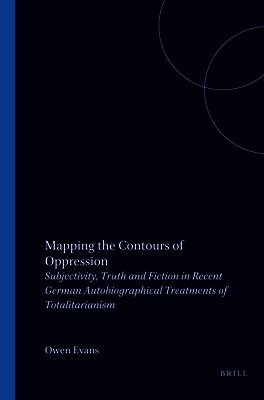
    Mapping the Contours of Oppression

    Subjectivity, Truth and Fiction in Recent German Autobiographical Treatments of Totalitarianism

    AvOwen Evans

    Häftad, Engelska, 2006

    Del 156 i serien Amsterdamer Publikationen zur Sprache und Literatur

    1 832 kr

    Beställningsvara. Skickas inom 5-8 vardagar. Fri frakt över 249 kr.

    Beskrivning

    Despite all the assertions towards the end of the twentieth century that the literary subject had expired along with the author, the wave of autobiographies published in German after the Wende was a clear indication that, on the contrary, life stories were very much alive. In this study, Owen Evans examines the work of eight authors – Ludwig Harig, Uwe Saeger, Ruth Klüger, Günter de Bruyn, Günter Kunert, Christoph Hein, Grete Weil and Monika Maron – who all published personal texts after 1989 dealing either with life in Nazi Germany or the GDR, and in some cases both. By means of close textual analysis, Evans explores the impact these regimes had on the individuals concerned and the contrasting ways in which the authors handle the autobiographical project. They adopt varying textual strategies to render the self on the page, with some employing overt fiction, and yet in each case, the project was clearly motivated by the need to treat psychological wounds inflicted on the self by totalitarianism. In their mapping of the contours of oppression, the texts at the heart of this study combine to offer a powerful defence of literary autobiography, in Germany at least, as a valuable means of tackling the legacy of totalitarianism.

    Produktinformation

    • Utgivningsdatum:2006-01-01
    • Mått:150 x 220 x 21 mm
    • Vikt:624 g
    • Format:Häftad
    • Språk:Engelska
    • Serie:Amsterdamer Publikationen zur Sprache und Literatur
    • Antal sidor:356
    • Förlag:Brill
    • ISBN:9789042017191

    Utforska kategorier

    • Litteraturvetenskap inom Skönlitteratur

    Innehållsförteckning

    • AcknowledgementsAbbreviationsIntroduction1 ‘Auch ich hatte die Finger im Spiel’: Ludwig Harig, Weh dem, der aus der Reihe tanzt (1990)2 ‘Das Ich liegt immer jenseits der Worte’: Uwe Saeger, Die Nacht danach und der Morgen (1991)3 ‘Für jeden war es einmalig’: Ruth Klüger, weiter leben: Eine Jugend (1992)4 ‘Taktieren mit der Macht’: Günter de Bruyn, Zwischenbilanz: Eine Jugend in Berlin (1992) and Vierzig Jahre: Ein Lebensbericht (1996)5 ‘Die Katalyse des Schreibens’: Günter Kunert, Erwachsenenspiele: Erinnerungen (1997)6 ‘“Man soll nie lügen. Oder nur, wenn es nicht anders geht”’: Christoph Hein, Von allem Anfang an (1997)7 ‘Es gab nur noch die eine Aufgabe: Gegen das Vergessen anzuschreiben’: Grete Weil, Leb ich denn, wenn andere leben (1998)8 ‘Mutmaßungen über Pawel’: Monika Maron, Pawels Briefe: Eine Familiengeschichte (1999)ConclusionBibliographyIndex