• Fri frakt över 249 kr
  • •
  • Snabba leveranser
  • •
  • Billiga böcker
Kundservice

Du är på sajten för privatpersoner.

Företag, bibliotek eller offentlig verksamhet?

Du handlar på classic.bokus.com, där alla dina funktioner finns intakta.
Till classic.bokus.com
Bokus logotyp. Gå till startsidan.
  • Erbjudanden
  • Student
  • Topplistor
  • Barn & ungdom
  • Bokus Play
  • E-böcker
  • Ljudböcker
  • Pocketböcker
  • Spel och pussel

Skapa nya rutiner – hälsoböcker upp till 50% →

Sidfot

Mina sidor

    Hjälp

    • Kundservice
    • Vanliga frågor och svar
    • Frakt och leverans
    • Retur vid ångerrätt
    • Reklamera vara
    • Betalning
    • Köpvillkor
    • Allmänna villkor
    • Information om webbplatsens tillgänglighet

    Om Bokus

    • Om oss
    • Pressrum
    • För studenter
    • För företag
    • För bibliotek och offentlig verksamhet
    • För leverantörer
    • Hållbarhet

    Populärt

    • Aktuella erbjudanden
    • Presentkort
    • Studentlitteratur
    • Nya böcker
    • Topplistor
    • Signerade böcker
    • Engelska böcker

    Inspiration

    • Boktips
    • BookTok
    • Barnbokskaraktärer
    • Populära författare
    Logotyp för Bokus
    Följ oss på Facebook (extern länk)Följ oss på Instagram (extern länk)Följ oss på YouTube (extern länk)Följ oss på TikTok (extern länk)
    bokus @ CookiesAnpassa cookiesIntegritetspolicyKöpvillkor
    Till Citymail hemsida (extern länk)Till Budbee hemsida (extern länk)Till Postnord hemsida (extern länk)Till Schenker hemsida (extern länk)Till Early Bird hemsida (extern länk)Till Walleys hemsida (extern länk)
    1. Skönlitteratur
    2. Litteraturvetenskap
    3. Litteraturvetenskap

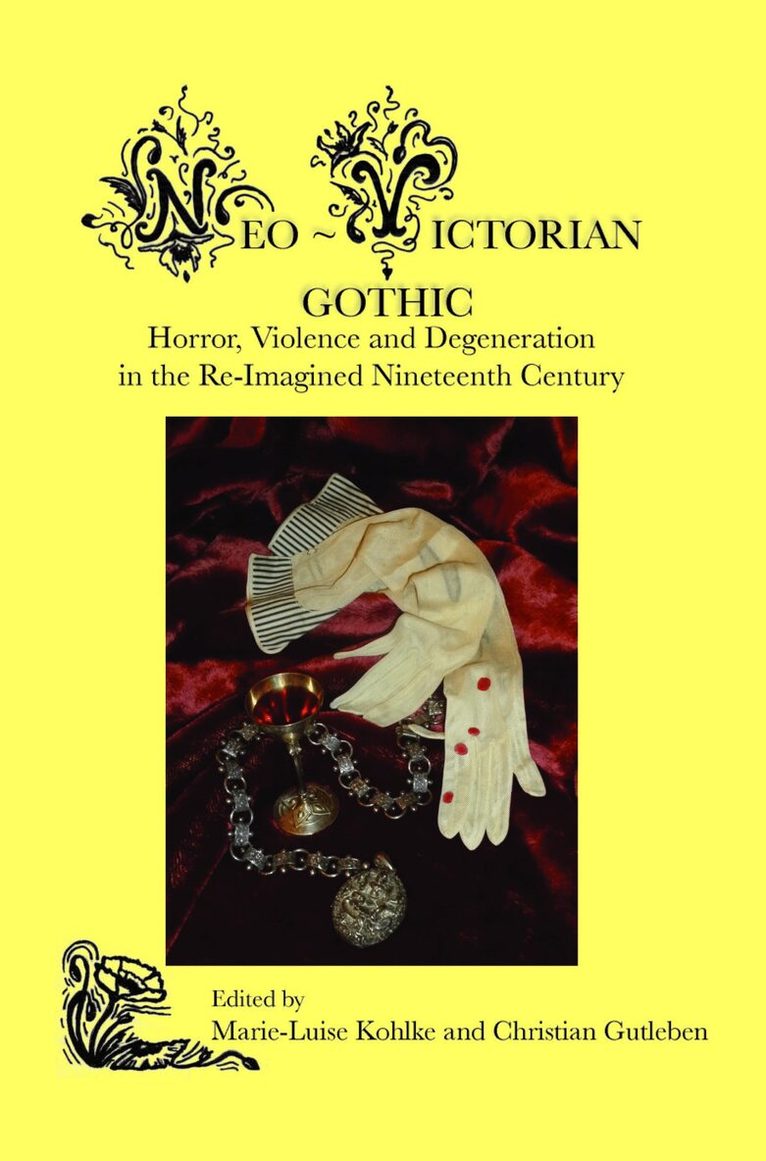
    Neo-Victorian Gothic

    Horror, Violence and Degeneration in the Re-Imagined Nineteenth Century

    Häftad, Engelska, 2012

    Del 3 i serien Neo-Victorian Series

    2 131 kr

    Beställningsvara. Skickas inom 5-8 vardagar. Fri frakt över 249 kr.

    Beskrivning

    This volume, the third in Rodopi’s Neo-Victorian Series, reassesses neo-Victorianism as a quintessentially Gothic movement. Through their revival of bygone spectres, their obsession with forgotten skeletons in the cupboard, and their exploration of nineteenth-century extremities, neo-Victorian works not only reflect our contemporary Gothic culture but also reactivate it and even enrich it with new variations such as postcolonial, eco or steampunk Gothic. Addressed to scholars and students of both Gothic and Neo-Victorian Studies, this volume will also interest contemporary literature specialists, cultural theorists, and those working on popular historical memory, as it explores the paradox of culture’s coincident turn to ethics and sensationalism. As exemplified in its generic variety and hybridity, neo-Victorian Gothic resorts to the spectacularisation of horror while simultaneously demonstrating the hyperreal, textual and self-reflexive nature of these spectacles, just as it resorts to the exploitation of hyperbolic and violent sexuality at the same time as challenging sexual norms and identity politics. In spite of these apparent contradictions, the Gothic forms of neo-Victorianism demonstrate their fundamentally ethical goal of interrogating the uncertain limits between self and other, orthodoxy and heterodoxy, past and present.

    Produktinformation

    • Utgivningsdatum:2012-01-01
    • Mått:155 x 235 x 18 mm
    • Vikt:547 g
    • Format:Häftad
    • Språk:Engelska
    • Serie:Neo-Victorian Series
    • Antal sidor:342
    • Förlag:Brill
    • ISBN:9789042036253

    Utforska kategorier

    • Litteraturvetenskap inom Skönlitteratur

    Recensioner i media

    “Marie-Luise Kohlke and Christian Gutleben have edited a formidable collection of essays, which establishes neo-Victorian gothic as a serious field of study in itself rather than a subgenre of gothic. […] Overall, I have to admit that Kohlke and Gutleben’s Neo-Victorian Gothic is a thorough piece of scholarship which enhances and opens up the fields of gothic, Victorianism, and neo-Victorianism.” – Edwina Keown, in: The Irish Journal of Gothic and Horror Studies 13 (2014), pp. 101-105 [Full text available: http://irishgothichorrorjournal.homestead.com/IJGHS_Issue__13.pdf]“This volume is an important landmark in the growing field of Neo-Victorian studies, as it engages with the question of the nineteenth century as the contemporary era’s Doppelgänger, exploring recent novels as well as performance art, graphic and interactive fiction in order to address the ghosts of a dual fin de siècle. By mapping both the past and the present, this study leads the reader through a labyrinth of echoes, highlighting the mutations of myth from Dracula to Jack the Ripper. Neo-Victorian Gothic offers fascinating insights into hybrid anxieties and generic miscegenation, ranging from cross-over myths to feminist and post-colonial attempts to reclaim the bare bones of their past. It presents conceptual readings of the politics of intertextual revision and the dynamics of neo-Victorian fiction, subtly qualifying its subversive impact as ambivalent.” – Catherine Lanone, University of Paris 3 (Sorbonne Nouvelle), France“In its chapters, Neo-Victorian Gothic provides an important and varied exploration of the many ways in which the Gothic continues to haunt contemporary fiction. The collection suggests that it may not be possible to “pin down” the Gothic, yet it offers an essential examination of the neo-Victorian novel and its contemporary “apparitions” and “manifestations” of the forever-haunting Gothic genre. As such, Neo-Victorian Gothic reveals how the neo-Victorian genre may be considered a new typology of the Gothic or its contemporary “heir”, suggesting a genealogy that stretches back more than two centuries.” – Tammy Ho Lai-Ming, in: Australasian Journal of Victorian Studies 18.3 (2013), pp.115-7“‘[N]eo-Victorianism is by nature quintessentially Gothic’ assert Marie-Luise Kohlke and Christian Gutleben in their introduction to the latest volume in Rodopi’s Neo-Victorian Series (p. 4, original emphasis). This is a bold claim, but a convincing one. […] Ultimately, then, the question of what the neo-Victorians can do for Gothic is too new to answer yet in any full or definitive way, but one thing is for sure: future scholars will uncouple the neo-Victorian from the Gothic at their peril. Its “quintessentially Gothic” nature will henceforth be difficult to ignore. […] Christian Gutleben’s chapter breaks new ground by taking on the tricky but important topic of neo-Victorian humour. He stresses that the ‘comic turn’ is not new to Gothic, but has specific applications and effects in contemporary neo-Victorian fiction. He hypothesises three effects: humour provides an anti-nostalgic distancing device; it encourages “a reconsideration of key neo-Victorian Gothic concepts such as otherness, the uncanny and monstrosity” (p. 303); and it enables the renewal of the genre through aesthetic diversification. He later goes so far as to argue that the combination of fear and fun is at the heart of neo-Victorianism, essentially one of its defining features, and this is its creative innovation: humour in neo-Victorian Gothic surpasses the destructive effects of parody to create “a new generic blend” (p. 320).” – Catherine Spooner, in: Neo-Victorian Studies 6:3 (2013), pp. 181-190 [Full text online at: www.neovictorianstudies.com]“…in neo-Victorianism how do literary, popular and visual culture relate to one another, and how do different art forms and media interact? Why does literature take up such a dominant position? And, which works of art and cultural products come into the picture when we let go of the idea that neo-Victorianism should be breaking the norms? Neo-Victorian Gothic has been accessibly written. It is a diverse book on a subject which has not exhausted its discussion. Neo-Victorianism does not belong to the past as is evident from the Booker Prize won by Eleanor Catton. Attesting to the sort of follow up questions arising from this volume we can safely say as a field of research it has a future.” [Original Dutch text: “…hoe verhouden literaire, populaire en visuele cultuur zich tot elkaar binnen het neo-Victorianisme, en hoe pakt de interactie tussen verschillende kunstvormen en media precies uit? Waarom neemt literatuur zo’n dominante positie in? En welke kunstwerken en cultuurproducten komen in beeld wanneer minder stellig wordt vastgehouden aan het idee dat neo-Victorianisme normdoorbrekend moet zijn? Neo-Victorian Gothic is een toegankelijk geschreven, gevarieerd boek over een onderwerp waar de rek nog niet uit lijkt. Het neo-Victorianisme behoort nog lang niet tot het verleden, getuige de Booker Prize van Eleanor Catton. En met het soort vervolgvragen dat deze bundel oproept, heeft het ook als onderzoeksveld overduidelijk toekomst.”] – Dennis Kersten, in: Vooys: tijdschrift voor letteren 32.1 (2014), pp.74-77

    Innehållsförteckning

    • Marie-Luise Kohlke and Christian Gutleben: The (Mis)Shapes of Neo-Victorian Gothic: Continuations, Adaptations, TransformationsImperial Impostures and ImproprietiesAndrew Smith: The Limits of Neo-Victorian History: Elizabeth Kostova’s The Historian and The Swan ThievesCheryl D. Edelson: Reclaiming Plots: Albert Wendt’s ‘Prospecting’ and Victoria Nalani Kneubuhl’s Ola Nā Iwi as Postcolonial Neo-Victorian GothicSebastian Domsch: Monsters against Empire: The Politics and Poetics of Neo-Victorian Metafiction in The League of Extraordinary GentlemenJeanne Ellis: A Bodily Metaphorics of Unsettlement: Leora Farber’s Dis-Location/Re-Location as Neo-Victorian GothicThe Horrid and the SexyPatricia Pulham: Neo-Victorian Gothic and Spectral Sexuality in Colm Tóibín’s The MasterMax Duperray: ‘Jack the Ripper’ as Neo-Victorian Gothic Fiction: Twentieth-Century and Contemporary Sallies into a Late Victorian Case and MythSarah E. Maier: Chasing the Dragon: Bangtails, Toffs, Jack and Johnny in Neo-Victorian FictionMarie-Luise Kohlke: Neo-Victorian Female Gothic: Fantasies of Self-AbjectionHybrid FormsVan Leavenworth: Epistemological Rupture and the Gothic Sublime in Slouching Towards BedlamKym Brindle: Dead Words and Fatal Secrets: Rediscovering the Sensational Document in Neo-Victorian GothicChristian Gutleben: ‘Fear Is Fun and Fun Is Fear’: A Reflexion on Humour in Neo-Victorian GothicContributorsIndex
    Hoppa över listan

    Du kanske också är intresserad av

    Marie-Luise Kohlke - Neo-Victorian Humour, Inbunden
    Del 5

    Neo-Victorian Humour

    Marie-Luise Kohlke

    Inbunden, 2017

    2 325 kr

    Martin A. Danahay - Neo-Victorianism and Medievalism, Inbunden
    Del 9

    Neo-Victorianism and Medievalism

    Martin A. Danahay

    Inbunden, 2024

    1 694 kr

    Felipe Espinoza Garrido - Black Neo-Victoriana, Inbunden
    Del 8

    Black Neo-Victoriana

    Felipe Espinoza Garrido

    Inbunden, 2021

    2 021 kr

    Benjamin Poore - Neo-Victorian Villains, Inbunden
    Del 7

    Neo-Victorian Villains

    Benjamin Poore

    Inbunden, 2017

    2 532 kr

    Marie-Luise Kohlke - Neo-Victorian Cities, Häftad
    Del 4

    Neo-Victorian Cities

    Marie-Luise Kohlke

    Häftad, 2015

    1 855 kr

    Neo-Victorian Decadence, Inbunden
    Del 10

    Neo-Victorian Decadence

    Brill

    Inbunden, 2026

    2 198 kr

    Neo-Victorian Tropes of Trauma, Häftad
    Del 1

    Neo-Victorian Tropes of Trauma

    Brill

    Häftad, 2010

    2 422 kr

    Neo-Victorian Families, Häftad
    Del 2

    Neo-Victorian Families

    Brill

    Häftad, 2011

    2 422 kr

    Marie-Luise Kohlke - Neo-Victorian Biofiction, Inbunden
    Del 6

    Neo-Victorian Biofiction

    Marie-Luise Kohlke

    Inbunden, 2020

    2 670 kr

    Klara Ingemyr - SIGNERAD - Klaras husman, Kartonnage
    • Signerad!

    SIGNERAD - Klaras husman

    Klara Ingemyr

    Kartonnage, 2026

    269 kr