• Fri frakt över 249 kr
  • •
  • Snabba leveranser
  • •
  • Billiga böcker
Kundservice

Du är på sajten för privatpersoner.

Företag, bibliotek eller offentlig verksamhet?

Du handlar på classic.bokus.com, där alla dina funktioner finns intakta.
Till classic.bokus.com
Bokus logotyp. Gå till startsidan.
  • Erbjudanden
  • Nyheter
  • Student
  • Topplistor
  • Barn & ungdom
  • Bokus Play
  • E-böcker
  • Pocketböcker
  • Spel & pussel

10% rabatt på allt med kod: NYSTART10 →

Sidfot

Mina sidor

    Hjälp

    • Kundservice
    • Vanliga frågor och svar
    • Frakt och leverans
    • Retur vid ångerrätt
    • Reklamera vara
    • Betalning
    • Köpvillkor
    • Allmänna villkor
    • Information om webbplatsens tillgänglighet

    Om Bokus

    • Om oss
    • Pressrum
    • För studenter
    • För företag
    • För bibliotek och offentlig verksamhet
    • För leverantörer
    • Hållbarhet

    Populärt

    • Aktuella erbjudanden
    • Presentkort
    • Studentlitteratur
    • Nya böcker
    • Topplistor
    • Signerade böcker
    • Engelska böcker

    Inspiration

    • Boktips
    • BookTok
    • Populära bokserier
    • Barnbokskaraktärer
    • Populära författare
    Logotyp för Bokus
    Följ oss på Facebook (extern länk)Följ oss på Instagram (extern länk)Följ oss på YouTube (extern länk)Följ oss på TikTok (extern länk)
    bokus @ CookiesAnpassa cookiesIntegritetspolicyKöpvillkor
    Till Citymail hemsida (extern länk)Till Budbee hemsida (extern länk)Till Postnord hemsida (extern länk)Till Schenker hemsida (extern länk)Till Early Bird hemsida (extern länk)Till Walleys hemsida (extern länk)
    1. Skönlitteratur
    2. Litteraturvetenskap
    3. Litteraturvetenskap

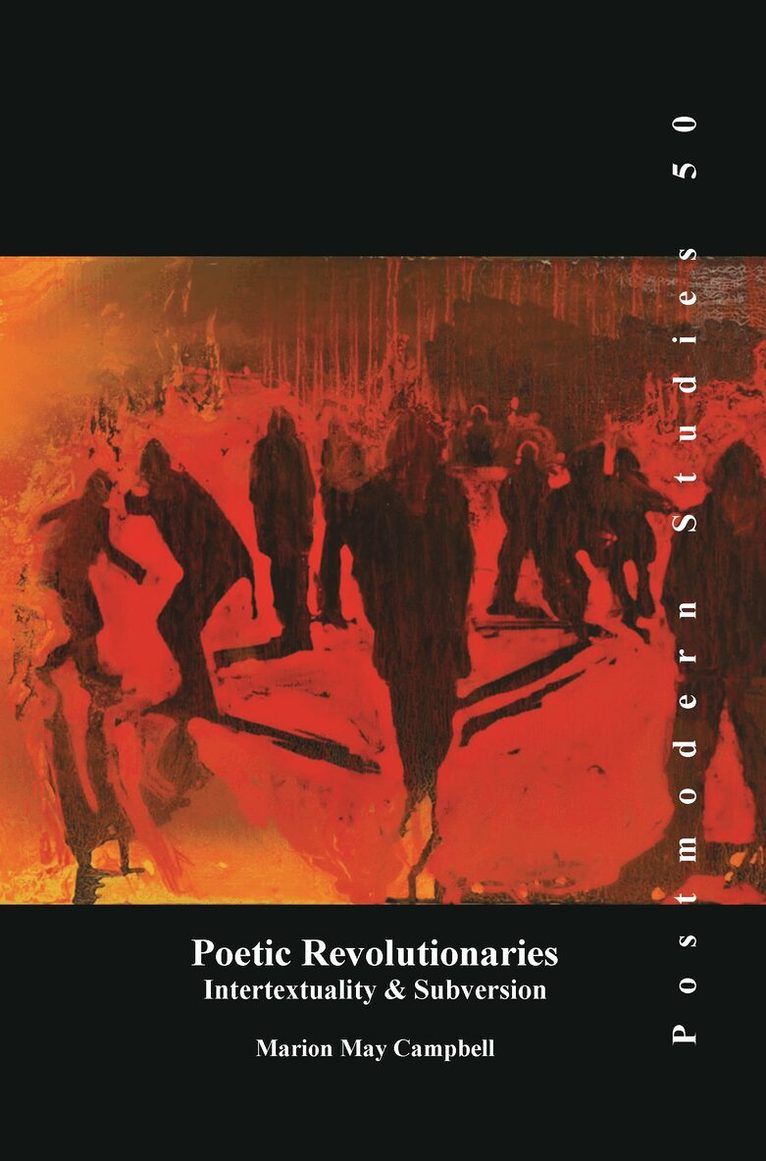
    Poetic Revolutionaries

    Intertextuality & Subversion

    AvMarion May Campbell

    Häftad, Engelska, 2014

    Del 50 i serien Postmodern Studies

    1 703 kr

    Beställningsvara. Skickas inom 5-8 vardagar. Fri frakt över 249 kr.

    Beskrivning

    Poetic Revolutionaries is an exploration of the relationship between radical textual practice, social critique and subversion. From an introduction considering recent debates regarding the cultural politics of intertextuality allied to avant-garde practice, the study proceeds to an exploration of texts by a range of writers for whom formal and poetic experimentation is allied to a subversive politics: Jean Genet, Monique Wittig, Angela Carter, Kathy Acker, Kathleen Mary Fallon, Kim Scott and Brian Castro. Drawing on theories of avant-garde practice, intertextuality, parody, representation, and performance such as those of Mikhaïl Bakhtin, Julia Kristeva, Gérard Genette, Margaret A. Rose, Linda Hutcheon, Fredric Jameson, Ross Chambers and Judith Butler, these readings explore how a confluence of writing strategies – covering the structural, narratological, stylistic and scenographic – can work to boost a text’s subversive power.

    Produktinformation

    • Utgivningsdatum:2014-01-01
    • Mått:155 x 235 x 17 mm
    • Vikt:502 g
    • Format:Häftad
    • Språk:Engelska
    • Serie:Postmodern Studies
    • Antal sidor:324
    • Förlag:Brill
    • ISBN:9789042037861

    Utforska kategorier

    • Litteraturvetenskap inom Skönlitteratur

    Recensioner i media

    “Poetic Revolutionaries is an exemplary textbook study on leading Australian and international experimental fiction writers. It is a scholarly work of broad, encompassing literary theory and criticism. […] Amid early twenty-first century crises – climate change and global warming, peak oil, widespread poverty and injustice, mass migration and species extinction – I think of Campbell’s texts, creative and critical, as lifeboats, hovercraft with air-borne capacity, passenger-full and powering-up for a new creative departure.” - Moya Costello, Southern Cross University, Australia, in: textjournal, Vol. 20.1 [Full text available: http://www.textjournal.com.au/april16/costello_rev.htm]"Marion May Campbell has long been one of Australia’s leading experimental writers, and one of the most innovative feminist writers to have emerged in the 1980s when Australian women’s writing became a significant presence in Australian publishing. Having studied in France, the influence of French critical theory on her development of an écriture féministe is marked by rigour and critique only gained by being part of the context of production. Indeed, if one were to trace the configurations of poststructuralism in Australia, Campbell’s work would be a good place to start. So it is an important event when she publishes a major work of literary criticism such as Poetic Revolutionaries: Intertextuality and Subversion […] Regardless of this structural issue, the readings are excellent and the scholarschip is exhaustive, with Campbell able to access many sources in French–you definitely don’t want to skim the footnotes. Cambell’s close reading analyses one or two techniques used in combination with intertextuality by each writer, but she is also careful to contextualize each work and their transgressive shock when first published/performed." – Margaret Henderson, University of Queensland, in: JASAL: Journal of the Association for the Study of Australian Literature, 12.5"Campbell’s work is rooted in the relativist revolution […] and her intense, erudite study addresses a state of disunion that has loosely bound the dwindling body of progressives ever since. [It] is rich and compelling, and deeply intelligent. Ultimately, its rhythms and precision present a kind of musical clarity. […] It is not only Campbell’s analysis that is trenchant and compelling. In many places she employs some exquisite turns of expression that light up the page."- John Kendall Hawkins (writer), in: Cordite Poetry Review 1 August 2014.A short video-interview with Marion May Campbell, who refuses to be pessimistic about the power of literature to modify perception. She focuses on 3 Australian authors who continue in the avant-garde tradition and all have an interest in the metamorphic body; in becoming an animal. []

    Innehållsförteckning

    • AcknowledgementsIntroduction: The fetishised coupling: poetics and revolutionChapter One: Jean Genet’s transgressive scenographyChapter Two: Monique Wittig’s Le corps lesbien/The Lesbian BodyChapter Three: Re-materialising the disappearing body in Angela Carter’s The Bloody ChamberChapter Four: Kathy Acker or Catheter the HackChapter Five: Textual intercourse: Kathleen Mary Fallon’s Working HotChapter Six: Kim Scott’s Benang: From the HeartChapter Seven: Radical disorientation in Brian Castro’s Shanghai DancingIn guise of conclusionAppendix: ironic trans-contextualisation in a work of postmodern parodyWorks citedIndex