• Fri frakt över 249 kr
  • •
  • Snabba leveranser
  • •
  • Billiga böcker
Kundservice

Du är på sajten för privatpersoner.

Företag, bibliotek eller offentlig verksamhet?

Du handlar på classic.bokus.com, där alla dina funktioner finns intakta.
Till classic.bokus.com
Bokus logotyp. Gå till startsidan.
  • Erbjudanden
  • Nyheter
  • Student
  • Topplistor
  • Barn & ungdom
  • Bokus Play
  • E-böcker
  • Pocketböcker
  • Spel & pussel

10% rabatt på allt med kod NYSTART10 →

Sidfot

Mina sidor

    Hjälp

    • Kundservice
    • Vanliga frågor och svar
    • Frakt och leverans
    • Retur vid ångerrätt
    • Reklamera vara
    • Betalning
    • Köpvillkor
    • Allmänna villkor
    • Information om webbplatsens tillgänglighet

    Om Bokus

    • Om oss
    • Pressrum
    • För studenter
    • För företag
    • För bibliotek och offentlig verksamhet
    • För leverantörer
    • Hållbarhet

    Populärt

    • Aktuella erbjudanden
    • Presentkort
    • Studentlitteratur
    • Nya böcker
    • Topplistor
    • Signerade böcker
    • Engelska böcker

    Inspiration

    • Boktips
    • BookTok
    • Populära bokserier
    • Barnbokskaraktärer
    • Populära författare
    Logotyp för Bokus
    Följ oss på Facebook (extern länk)Följ oss på Instagram (extern länk)Följ oss på YouTube (extern länk)Följ oss på TikTok (extern länk)
    bokus @ CookiesAnpassa cookiesIntegritetspolicyKöpvillkor
    Till Citymail hemsida (extern länk)Till Budbee hemsida (extern länk)Till Postnord hemsida (extern länk)Till Schenker hemsida (extern länk)Till Early Bird hemsida (extern länk)Till Walleys hemsida (extern länk)
    1. Psykologi och pedagogik
    2. Psykologi
    3. Psykologiska teorier och skolor

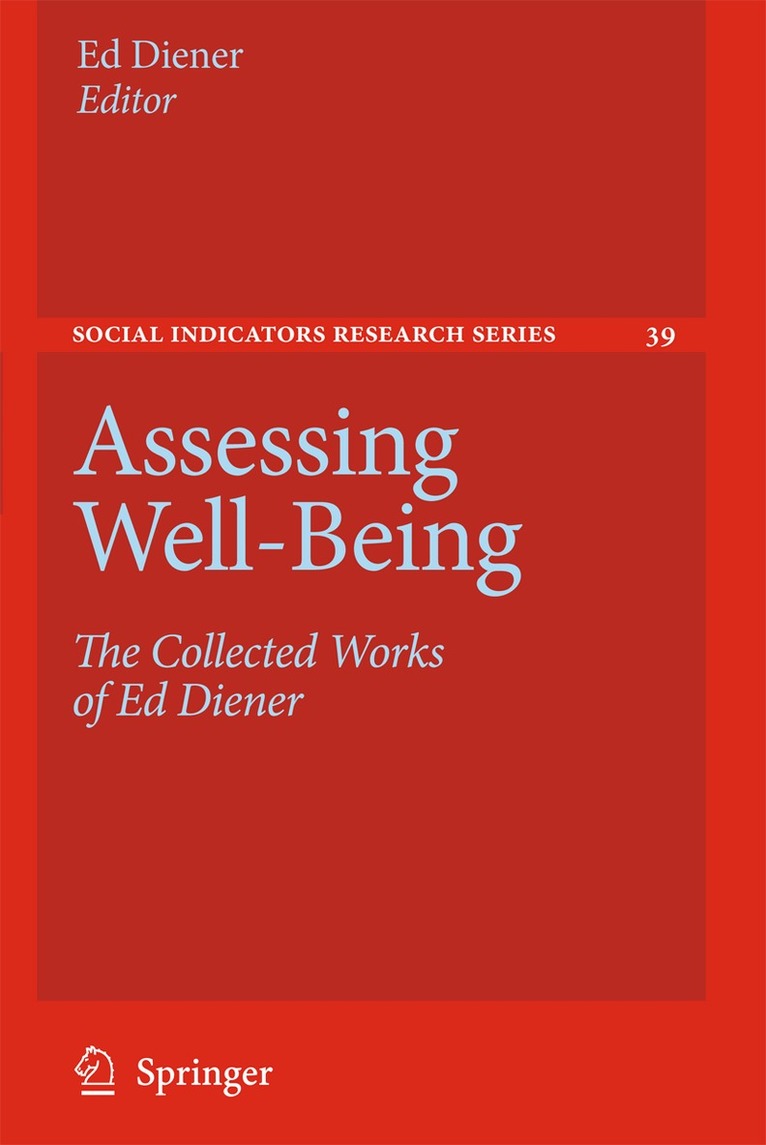
    Assessing Well-Being

    The Collected Works of Ed Diener

    AvEd Diener

    Häftad, Engelska, 2009

    Del i serien Social Indicators Research Series

    1 368 kr

    Beställningsvara. Skickas inom 10-15 vardagar. Fri frakt över 249 kr.

    Beskrivning

    The Sandvik, Diener, and Seidlitz (1993) paper is another that has received widespread attention because it documented the fact that self-report well-being scales correlate with a number of other methods of measuring the same concepts, such as with reports by knowledgeable “informants” (family and friends), expe- ence sampling measurement, and the memory for good versus bad life events. A single factor was found to underlie measures using different methods, and a n- ber of different well-being self-report measures were found to correlate with the non-self-report measures. Thus, although the self-report measures of well-being are imperfect, and can be in uenced by response artifacts, they have substantial validity as shown by their correlations with measurements based on alternative methods. Whereas the Pavot and Diener article reviewed the Satisfaction with Life Scale, the Lucas, Diener, and Larsen (2003) paper reviews various approaches to assessing positive emotions. As we wrote in the chapter in this volume in which we present new measures, we do not consider any of the existing measures of positive affect to be entirely acceptable for measuring subjective well-being in the affect area, and that is why we have created and validated a new measure.

    Produktinformation

    • Utgivningsdatum:2009-06-09
    • Mått:155 x 235 x 16 mm
    • Vikt:412 g
    • Format:Häftad
    • Språk:Engelska
    • Serie:Social Indicators Research Series
    • Antal sidor:274
    • Upplaga:2009
    • Förlag:Springer
    • ISBN:9789048123537

    Utforska kategorier

    • Psykologiska teorier och skolor inom Psykologi och pedagogik

    Mer om författaren

    Ed Diener is the Joseph R. Smiley Distinguished Professor of Psychology at the University of Illinois. He received his doctorate at the University of Washington in 1974, and has been a faculty member at the University of Illinois for the past 34 years. Dr. Diener was the president of both the International Society of Quality of Life Studies and the Society of Personality and Social Psychology. Currently he is the president of the International Positive Psychology Association. Dr. Diener was the editor of the Journal of Personality and Social Psychology and the Journal of Happiness Studies, and he is the founding editor of Perspectives on Psychological Science. Diener has over 240 publications, with about 190 being in the area of the psychology of well-being, and is listed as one of the most highly cited psychologists by the Institute of Scientific Information with over 12,000 citations to his credit. He won the Distinguished Researcher Award from the International Society of Quality of Life Studies, the first Gallup Academic Leadership Award, and the Jack Block Award for Personality Psychology. Dr. Diener also won several teaching awards, including the Oakley-Kundee Award for Undergraduate Teaching at the University of Illinois.

    Recensioner i media

    From the reviews: "Assessing Well-Being, is concerned with the measurement of life satisfaction. ... Also, newly written, they point the way for future research. ... Certainly academic researchers interested in well-being will find them extremely useful. ... The reprinted book chapters are not so readily available, so their inclusion is a real plus. The audience should extend beyond research psychologists and include policy makers as well as interested members of the general public. ... the collected works of Ed Diener are timely, impressive, and useful." (Christopher Peterson, PsycCRITIQUES, Vol. 54 (50), 2009)

    Innehållsförteckning

    • – Measuring Well-Being: Collected Theory and Review Works.- Temporal Stability and Cross-Situational Consistency of Affective, Behavioral, and Cognitive Responses.- Assessing Subjective Well-Being: Progress and Opportunities.- The Evolving Concept of Subjective Well-Being: The Multifaceted Nature of Happiness.- Review of the Satisfaction With Life Scale.- Subjective Well-Being: The Convergence and Stability of Self-Report and Non-Self-Report Measures.- Measuring Positive Emotions.- Experience Sampling: Promises and Pitfalls, Strength and Weaknesses.- Life-Satisfaction Is a Momentary Judgment and a Stable Personality Characteristic: The Use of Chronically Accessible and Stable Sources.- Happiness is the Frequency, Not the Intensity, of Positive Versus Negative Affect.- Income’s Differential Influence on Judgments of Life Versus AffectiveWell-Being.- New Measures of Well-Being.- Conclusion: Future Directions in Measuring Well-Being.