• Fri frakt över 249 kr
  • •
  • Snabba leveranser
  • •
  • Billiga böcker
Kundservice

Du är på sajten för privatpersoner.

Företag, bibliotek eller offentlig verksamhet?

Du handlar på classic.bokus.com, där alla dina funktioner finns intakta.
Till classic.bokus.com
Bokus logotyp. Gå till startsidan.
  • Erbjudanden
  • Nyheter
  • Student
  • Topplistor
  • Barn & ungdom
  • Bokus Play
  • E-böcker
  • Pocketböcker
  • Spel & pussel

10% rabatt på allt med kod: NYSTART10 →

Sidfot

Mina sidor

    Hjälp

    • Kundservice
    • Vanliga frågor och svar
    • Frakt och leverans
    • Retur vid ångerrätt
    • Reklamera vara
    • Betalning
    • Köpvillkor
    • Allmänna villkor
    • Information om webbplatsens tillgänglighet

    Om Bokus

    • Om oss
    • Pressrum
    • För studenter
    • För företag
    • För bibliotek och offentlig verksamhet
    • För leverantörer
    • Hållbarhet

    Populärt

    • Aktuella erbjudanden
    • Presentkort
    • Studentlitteratur
    • Nya böcker
    • Topplistor
    • Signerade böcker
    • Engelska böcker

    Inspiration

    • Boktips
    • BookTok
    • Populära bokserier
    • Barnbokskaraktärer
    • Populära författare
    Logotyp för Bokus
    Följ oss på Facebook (extern länk)Följ oss på Instagram (extern länk)Följ oss på YouTube (extern länk)Följ oss på TikTok (extern länk)
    bokus @ CookiesAnpassa cookiesIntegritetspolicyKöpvillkor
    Till Citymail hemsida (extern länk)Till Budbee hemsida (extern länk)Till Postnord hemsida (extern länk)Till Schenker hemsida (extern länk)Till Early Bird hemsida (extern länk)Till Walleys hemsida (extern länk)
    1. Ekonomi och Ledarskap
    2. Industrier och branscher
    3. Media och underhållning

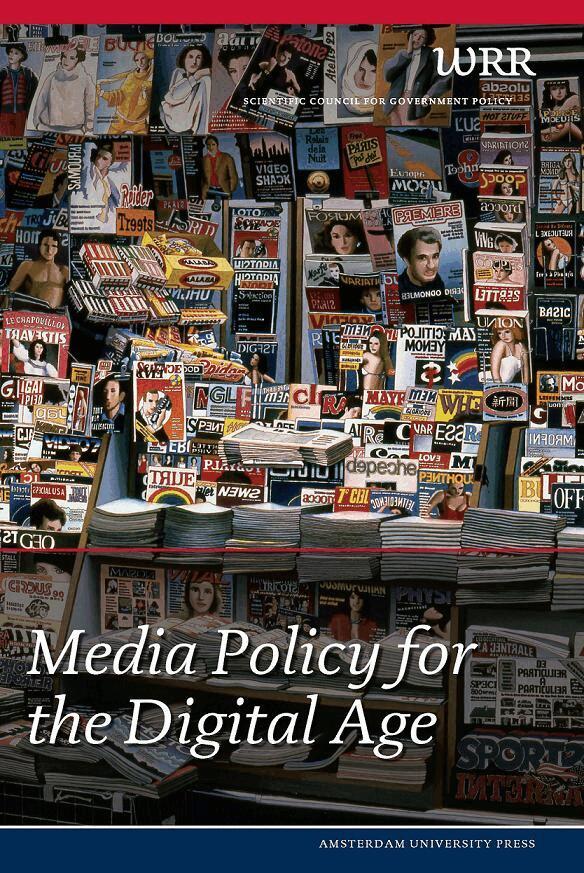
    Media Policy for the Digital Age

    AvNetherlands

    Häftad, Engelska, 2005

    Del i serien WRR

    615 kr

    Beställningsvara. Skickas inom 10-15 vardagar. Fri frakt över 249 kr.

    Beskrivning

    Traditionally, the Netherlands has enjoyed being a test market for many ideas in the media. But over the last decade, progress has been severely hampered by lengthy discussions on the future structure of just one sector of media, namely public broadcasting via radio and television. The narrow approach results in a lot of paper, speeches and theories, but little in the way of definitive policy making.In a report to the government, published in February 2005, the Scientific Council for Government Policy (WRR) argued for very different approaches to policy making. The recommendations are not only much broader than “broadcasting”; they tackle the challenges of making robust policy from new angles. Instead of trying to repair the old compass, the approach has been to find new instruments to help policymakers navigate the stormy and often confusing waters ahead. Perhaps the problem in the Netherlands is not accepting the new media, but rather accepting that the role “old” media has undergone a paradigm shift.Since the bulk of the WRR findings were published in the Dutch language, this summary is intended to provide readers outside the Netherlands with an insight into the issues at stake – and the solutions suggested by the WRR.Also available in DutchFocus op functies

    Produktinformation

    • Utgivningsdatum:2005-11-10
    • Mått:160 x 240 x 5 mm
    • Vikt:174 g
    • Format:Häftad
    • Språk:Engelska
    • Serie:WRR
    • Antal sidor:84
    • Förlag:Amsterdam University Press
    • ISBN:9789053568262

    Utforska kategorier

    • Media och underhållning inom Ekonomi och Ledarskap

    Mer om författaren

    Alinda A. Lamein works as the program manager at WRR.

    Innehållsförteckning

    • Contents - 6 Preface - 10 1 Introduction and abstract - 12 2 Media and society: some general reflections - 18 2.1 A dynamic but complex media landscape - 18 2.2 Fast commercial marketplace, slow government response - 19 2.3 Aims and scope of the report - 20 2.4 Definitions of the media landscape - 21 2.5 Values that inspire and legitimate the definition of public interests - 21 2.5.1 Freedom and equality - 21 2.5.2 Accessibility - 22 2.5.3 Independence - 22 2.5.4 Pluralism - 22 3 A changing landscape: short overview of the dominant trends - 24 3.1 Major characteristics of the media landscape in the digital age - 25 3.2 Will traditional values do? a fresh look and the need for a broader perspective - 26 4 A short history of the dutch broadcasting policy - 30 4.1 Early commercial days - 30 4.2 Perceived scarcity - 31 4.3 Post second world war - 31 4.4 The 1960s – commercial pressure from the north sea - 32 4.5 New broadcasting law 1967 - 33 4.6 Policy in the 1970s - 34 4.7 Different structure for regional broadcasting - 34 4.8 Pseudo-commercialism and increasing domestic competition - 34 4.9 More competition from abroad - 35 4.10 Scientific council report 1982 - 36 4.11 1987 and further: the new media law and its later modifications - 36 5 Other domains of media policy - 40 5.1 Broadcast policy in 2005 - 40 5.2 Commercial broadcasting - 41 5.3 Press policy in 2005 - 41 5.4 Cable policy in 2005 - 41 5.5 Policy for new media in 2005 - 41 5.6 Media concentration in 2005 - 42 6 Infrastructure in the netherlands: challenges and policy questions - 44 6.1 Digitalisation and technological convergence - 45 6.1.1 Digitalisation - 45 6.1.2 Technological convergence - 46 6.1.3 Spectrum scarcity - 46 6.2 Related policy questions - 47 6.3 Economic consequences - 47 6.4 Summing up: robust trends and uncertain developments - 48 6.5 Conclusions - 49 7 The media landscape: an institutional perspective on change - 52 7.1 International landscape - 52 7.2 National landscape - 54 7.3 The role of the dutch government - 56 7.4 Fragmented supervision - 58 7.5 Content providers to the media landscape - 59 7.5.1 Quality as a public interest - 61 8 a new paradigm: a functional approach to the media landscape - 64 8.1 Reasons for renewal - 65 8.1.1 future-proof policymaking - 65 8.1.2 the relevance of values - 66 8.1.3 hybridisation - 66 8.2 The strategic matrix – combining functions with values - 67 8.3 Defining the functions in detail - 68 8.3.1 News provision - 68 8.3.2 Opinion and debate - 68 8.3.3 Entertainment - 69 8.3.4 Arts and culture (and education) - 69 8.3.5 Specialised information - 69 8.3.6 Advertising and public relations (persuasive information or communication) - 70 8.4 Using a functional approach to develop dutch media policy - 71 8.5 More explicit and precise legitimation for public broadcasting is needed - 73 8.6 Values, risks and priorities: a functional analysis of the media landscape - 74 8.7 Government media policy: the need for selective and cautious involvement - 74 8.8 Specific recommendations - 76 8.9 Rethinking public broadcasting - 77 8.9.1 Questions - 77 8.9.2 Answers - 78 8.9.3 Closing remarks - 80 Bibliography - 84