• Fri frakt över 249 kr
  • •
  • Snabba leveranser
  • •
  • Billiga böcker
Kundservice

Du är på sajten för privatpersoner.

Företag, bibliotek eller offentlig verksamhet?

Du handlar på classic.bokus.com, där alla dina funktioner finns intakta.
Till classic.bokus.com
Bokus logotyp. Gå till startsidan.
  • Erbjudanden
  • Nyheter
  • Student
  • Topplistor
  • Barn & ungdom
  • Bokus Play
  • E-böcker
  • Pocketböcker
  • Spel & pussel

10% rabatt på allt med kod NYSTART10 →

Sidfot

Mina sidor

    Hjälp

    • Kundservice
    • Vanliga frågor och svar
    • Frakt och leverans
    • Retur vid ångerrätt
    • Reklamera vara
    • Betalning
    • Köpvillkor
    • Allmänna villkor
    • Information om webbplatsens tillgänglighet

    Om Bokus

    • Om oss
    • Pressrum
    • För studenter
    • För företag
    • För bibliotek och offentlig verksamhet
    • För leverantörer
    • Hållbarhet

    Populärt

    • Aktuella erbjudanden
    • Presentkort
    • Studentlitteratur
    • Nya böcker
    • Topplistor
    • Signerade böcker
    • Engelska böcker

    Inspiration

    • Boktips
    • BookTok
    • Populära bokserier
    • Barnbokskaraktärer
    • Populära författare
    Logotyp för Bokus
    Följ oss på Facebook (extern länk)Följ oss på Instagram (extern länk)Följ oss på YouTube (extern länk)Följ oss på TikTok (extern länk)
    bokus @ CookiesAnpassa cookiesIntegritetspolicyKöpvillkor
    Till Citymail hemsida (extern länk)Till Budbee hemsida (extern länk)Till Postnord hemsida (extern länk)Till Schenker hemsida (extern länk)Till Early Bird hemsida (extern länk)Till Walleys hemsida (extern länk)
    1. Historia och arkeologi
    2. Arkeologi

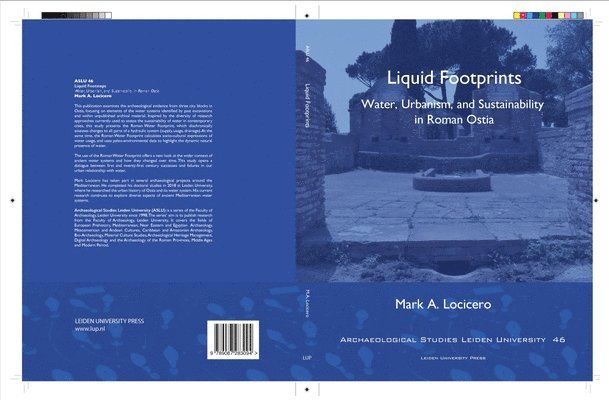
    Liquid Footprints

    Water, Urbanism, and Sustainability in Roman Ostia

    AvMark Locicero

    Häftad, Engelska, 2020

    Del 46 i serien Archaeological Studies Leiden University

    1 248 kr

    Beställningsvara. Skickas inom 5-8 vardagar. Fri frakt över 249 kr.

    Beskrivning

    This study opens a dialogue between first and twenty-first century successes and failures in our urban relationship with water. This publication examines the archaeological evidence from three city blocks in Ostia, focusing on elements of the water systems identified by past excavations and within unpublished archival material. Inspired by the diversity of research approaches currently used to assess the sustainability of water in contemporary cities, this study presents the Roman Water Footprint, which diachronically assesses changes to all parts of a hydraulic system (supply, usage, drainage). At the same time, the Roman Water Footprint calculates socio-cultural expressions of water usage, and uses paleo-environmental data to highlight the dynamic natural presence of water. The use of the Roman Water Footprint offers a new look at the wider context of ancient water systems and how they changed over time. This study opens a dialogue between first and twenty-first century successes and failures in our urban relationship with water.

    Produktinformation

    • Utgivningsdatum:2020-03-04
    • Mått:210 x 273 x undefined mm
    • Format:Häftad
    • Språk:Engelska
    • Serie:Archaeological Studies Leiden University
    • Antal sidor:400
    • Förlag:Leiden University Press
    • ISBN:9789087283230

    Utforska kategorier

    • Arkeologi inom Historia och arkeologi

    Mer om författaren

    Mark Locicero has taken part in several archaeological projects around the Mediterranean. He completed his doctoral studies in 2018 at Leiden University, where he researched the urban history of Ostia and its water system. His current research continues to explore diverse aspects of ancient Mediterranean water systems.

    Innehållsförteckning

    • Table of Contents Acknowledgements Preface Ch1: Introduction • 1.0: General Introduction • 1.1: Literature Review on Roman Water Research • 1.2: Water Research in Ostia • 1.3: History of Excavation • 1.4: Landscape • 1.5: Urban Development of Ostia • 1.6: Overview of Ostian Water Infrastructure • 1.7: Data Collection • 1.8: Insulae in Roman urbanism • 1.9: Conclusion Ch. 2: Theory and Methodology • 2.0: Introduction • 2.1: Water and Culture • 2.2: Sustainability and its Application to Roman Urbanism • 2.3 Methodology: The Roman Water Footprint • 2.4: Indicators of the Roman Water Footprint • 2.5: Conclusion Ch. 3: Insula III, i • 3.0: Introduction to insula III, i • 3.1: Methodology • 3.2: Water Footprints of insula III, i • 3.3: III, i: Diachronic Analysis • 3.4: insula III, i Conclusion Ch. 4: Insula IV, ii • 4.0: Introduction to insula IV, ii • 4.1: Methodology • 4.2: Water Footprints of insula IV, ii § • 4.3: Diachronic Analysis • 4.4: insula IV, ii Conclusion Ch. 5: Insula V, ii • 5.0: Introduction to Insula V, ii • 5.1: Methodology • 5.2: Water Footprints of insula V, ii • 5.3: Diachronic Analysis • 5.4: insula V, ii Conclusion Ch. 6: Diachronic Discussion • 6.0: Introduction • 6.1: Roman Water Footprint #1 (4th century BC – AD 50) in insulae III, i; IV, ii; V, ii • 6.2: Roman Water Footprint #2 (AD 50-200) in insulae III, i; IV, ii; V, ii • 6.3: Roman Water Footprint #3 (AD 200-300) in insulae III, i; IV, ii; V, ii • 6.4: Roman Water Footprint #4 (AD 300-600) in insulae III, i; IV, ii; V, ii • 6.5: Total Hydraulic Histories of insulae III, i; IV, ii; V, ii Ch. 7- Conclusion Appendices • Appendix 1: Definitions of Hydraulic Terms • Appendix 2: Epigraphic Evidence • Appendix 3: Roman Water Footprint Data Bibliography