• Fri frakt över 249 kr
  • •
  • Snabba leveranser
  • •
  • Billiga böcker
Kundservice

Du är på sajten för privatpersoner.

Företag, bibliotek eller offentlig verksamhet?

Du handlar på classic.bokus.com, där alla dina funktioner finns intakta.
Till classic.bokus.com
Bokus logotyp. Gå till startsidan.
  • Erbjudanden
  • Nyheter
  • Student
  • Topplistor
  • Barn & ungdom
  • Bokus Play
  • E-böcker
  • Pocketböcker
  • Spel & pussel

10% rabatt på allt med kod: NYSTART10 →

Sidfot

Mina sidor

    Hjälp

    • Kundservice
    • Vanliga frågor och svar
    • Frakt och leverans
    • Retur vid ångerrätt
    • Reklamera vara
    • Betalning
    • Köpvillkor
    • Allmänna villkor
    • Information om webbplatsens tillgänglighet

    Om Bokus

    • Om oss
    • Pressrum
    • För studenter
    • För företag
    • För bibliotek och offentlig verksamhet
    • För leverantörer
    • Hållbarhet

    Populärt

    • Aktuella erbjudanden
    • Presentkort
    • Studentlitteratur
    • Nya böcker
    • Topplistor
    • Signerade böcker
    • Engelska böcker

    Inspiration

    • Boktips
    • BookTok
    • Populära bokserier
    • Barnbokskaraktärer
    • Populära författare
    Logotyp för Bokus
    Följ oss på Facebook (extern länk)Följ oss på Instagram (extern länk)Följ oss på YouTube (extern länk)Följ oss på TikTok (extern länk)
    bokus @ CookiesAnpassa cookiesIntegritetspolicyKöpvillkor
    Till Citymail hemsida (extern länk)Till Budbee hemsida (extern länk)Till Postnord hemsida (extern länk)Till Schenker hemsida (extern länk)Till Early Bird hemsida (extern länk)Till Walleys hemsida (extern länk)
    1. Naturvetenskap och teknik
    2. Matematik och naturvetenskap
    3. Fysik
    4. Klassisk mekanik

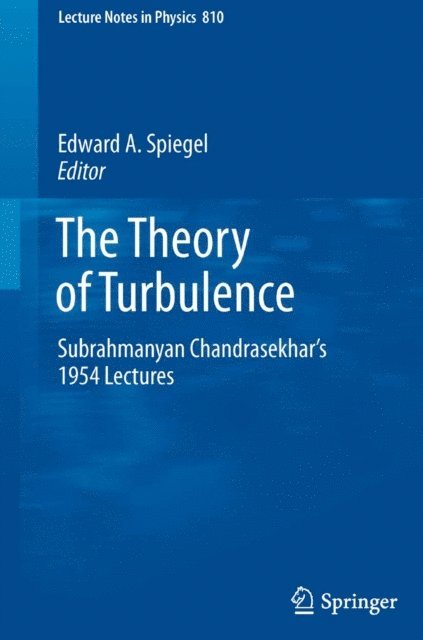
    Theory of Turbulence

    Subrahmanyan Chandrasekhar's 1954 Lectures

    AvEdward A. Spiegel

    Häftad, Engelska, 2010

    Del i serien Lecture Notes in Physics

    493 kr

    Beställningsvara. Skickas inom 10-15 vardagar. Fri frakt över 249 kr.

    Beskrivning

    In January 1937, Nobel laureate in Physics Subrahmanyan Chandrasekhar was recruited to the University of Chicago. He was to remain there for his entire career, becoming Morton D. Hull Distinguished Service Professor of Theoretical Astrophysics in 1952 and attaining emeritus status in 1985. This is where his then student Ed Spiegel met him during the summer of 1954, attended his lectures on turbulence and jotted down the notes in hand. His lectures had a twofold purpose: they not only provided a very elementary introduction to some aspects of the subject for novices, they also allowed Chandra to organize his thoughts in preparation to formulating his attack on the statistical problem of homogeneous turbulence. After each lecture Ed Spiegel transcribed the notes and filled in the details of the derivations that Chandrasekhar had not included, trying to preserve the spirit of his presentation and even adding some of his side remarks. The lectures were rather impromptu and the notes as presented here are as they were set down originally in 1954. Now they are being made generally available for Chandrasekhar’s centennial.

    Produktinformation

    • Utgivningsdatum:2010-10-28
    • Mått:155 x 235 x 15 mm
    • Vikt:208 g
    • Format:Häftad
    • Språk:Engelska
    • Serie:Lecture Notes in Physics
    • Antal sidor:117
    • Förlag:Springer
    • ISBN:9789400701168

    Utforska kategorier

    • Klassisk mekanik inom Naturvetenskap och teknik

    Mer om författaren

    Nobel Laureate Chandrasekhar derived a novel theory of Turbulence in the 1950's. These notes give a first hand account from Chandrasekhar of the development of this theory. Transcribed by his then student Ed Spiegel, these notes provide a unique insight into the development of this theory. Ed Spiegel is a renowned and highly respected expert in the field of astrophysics, and astrophysical fluid dynamics (he coined the term Blazar), and he provides a wonderful introduction describing the course given by Chandrasekhar with some interesting anecdotes from the lectures as well as a short account of how the theory has evolved since Chandrasekhar's unique contributions over half a century ago.

    Recensioner i media

    From the book reviews: "The book under review is part of the Lecture Notes in Physics series, and aims to 'quickly and informally' communicate knowledge in the subject. The book is structured in 25 chapters plus a prologue and epilogue. ... The book is addressed to both the novice and advanced reader, as it provides basic and advanced proofs, as well as different approaches and derivation of classical results." (Iuliana Stanculescu, Mathematical Reviews, May, 2014) "The lecture notes on Turbulence by S. Chandrasekhar are transcribed and filled in with details by Edward Spiegel in the year 1954. ... it is interesting to have a book on these lecture notes for three reasons: 1. The scientific historian will enjoy this compilation. 2. The didactically interested lecturer can learn much about presentations in theoretical physics. 3. Students will find many explicitly calculated details in the presentation of the mathematical formalism." (Johannes Viktor Feitzinger, Zentralblatt MATH, Vol. 1207, 2011)

    Innehållsförteckning

    • 1: The Turbulence Problem.- 2: The Net Energy Balance.- 3: The Interchange of Energy between States of Motion.- 4.- Some Remarks.- 5: The Spectrum of Turbulent Energy.- 6: Some Preliminaries to the Development of a Theory of Turbulence.- 7: Heisenberg's Theory of Turbulence.- 8: Other Derivatives of K-2/3 Law.- 9: An Alternate Approach – Correlations.- 10: The Equations of Isotropic Turbulence.- 11: The Karman-Howarth Equations.- 12: The Meanings of the Defining Scalars.- 13: Some Results from the Karman-Howarth Equation.- 14: The Relation Between Fourth Order and Second Order Correlations when the Velocity Follows a Gaussian Distribution.- 15: Chandrasekhar's Theory of Turbulence.- 16: A More Subjective Approach to the Derivation of Chandrasekhar's Equation.- 17: The Dimensionless Form of Chandrasekhar's Equation.- 18: Some Aspects and Advantages of the New Theory.- 19: The Problem of Introducing the Boundary Conditions.- 20: Discussion of the Case of Negligible Inertial Term.- 21: The Case in which Viscosity is Neglected.- 22: Solution of the Non-Viscous Case near r = 0.- 23: Solution of the Heat Equation.- 24: Solution of the Quasi-Wave Equation.- 25.- The Introduction of Boundary Conditions.- 26.- Epilogue.