• Fri frakt över 249 kr
  • •
  • Snabba leveranser
  • •
  • Billiga böcker
Kundservice

Du är på sajten för privatpersoner.

Företag, bibliotek eller offentlig verksamhet?

Du handlar på classic.bokus.com, där alla dina funktioner finns intakta.
Till classic.bokus.com
Bokus logotyp. Gå till startsidan.
  • Erbjudanden
  • Nyheter
  • Student
  • Topplistor
  • Barn & ungdom
  • Bokus Play
  • E-böcker
  • Pocketböcker
  • Spel & pussel

10% rabatt på allt med kod: NYSTART10 →

Sidfot

Mina sidor

    Hjälp

    • Kundservice
    • Vanliga frågor och svar
    • Frakt och leverans
    • Retur vid ångerrätt
    • Reklamera vara
    • Betalning
    • Köpvillkor
    • Allmänna villkor
    • Information om webbplatsens tillgänglighet

    Om Bokus

    • Om oss
    • Pressrum
    • För studenter
    • För företag
    • För bibliotek och offentlig verksamhet
    • För leverantörer
    • Hållbarhet

    Populärt

    • Aktuella erbjudanden
    • Presentkort
    • Studentlitteratur
    • Nya böcker
    • Topplistor
    • Signerade böcker
    • Engelska böcker

    Inspiration

    • Boktips
    • BookTok
    • Populära bokserier
    • Barnbokskaraktärer
    • Populära författare
    Logotyp för Bokus
    Följ oss på Facebook (extern länk)Följ oss på Instagram (extern länk)Följ oss på YouTube (extern länk)Följ oss på TikTok (extern länk)
    bokus @ CookiesAnpassa cookiesIntegritetspolicyKöpvillkor
    Till Citymail hemsida (extern länk)Till Budbee hemsida (extern länk)Till Postnord hemsida (extern länk)Till Schenker hemsida (extern länk)Till Early Bird hemsida (extern länk)Till Walleys hemsida (extern länk)
    1. Data och IT
    2. Systemvetenskap och AI

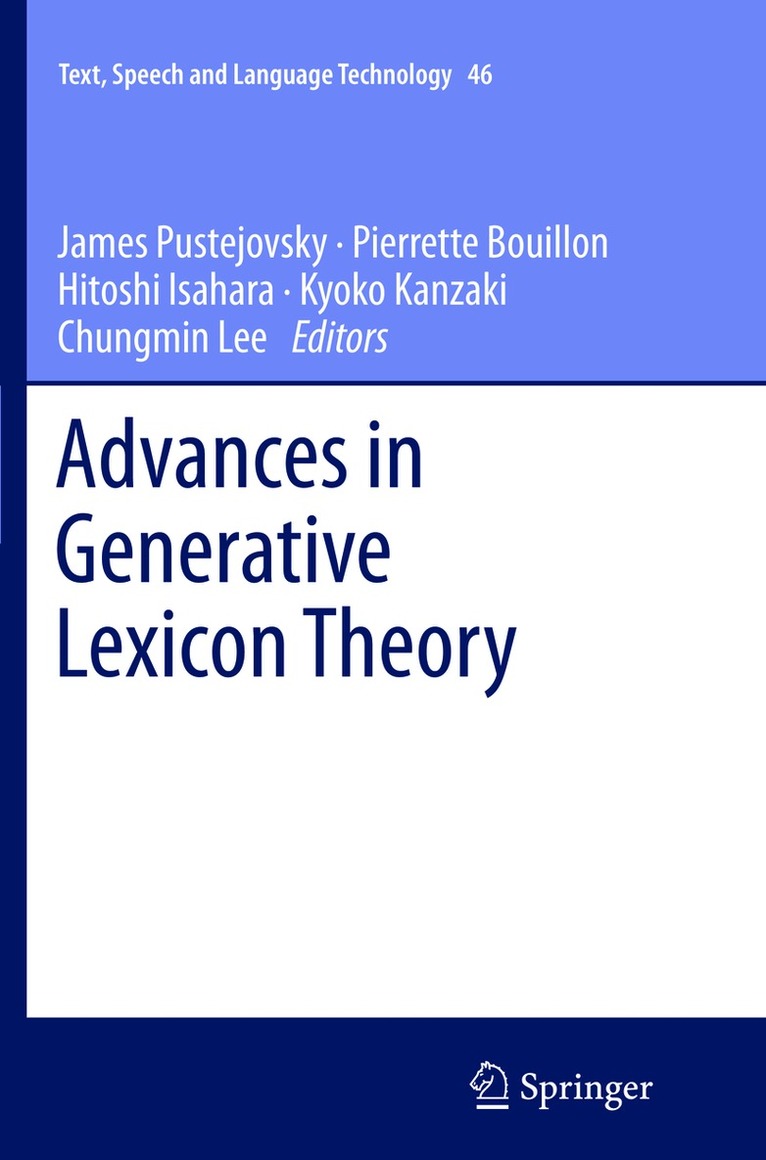
    Advances in Generative Lexicon Theory

    AvJames Pustejovsky,Pierrette Bouillon

    Häftad, Engelska, 2015

    Del 46 i serien Text, Speech and Language Technology

    1 674 kr

    Beställningsvara. Skickas inom 10-15 vardagar. Fri frakt över 249 kr.

    Beskrivning

    This collection of papers takes linguists to the leading edge of techniques in generative lexicon theory, the linguistic composition methodology that arose from the imperative to provide a compositional semantics for the contextual modifications in meaning that emerge in real linguistic usage. Today’s growing shift towards distributed compositional analyses evinces the applicability of GL theory, and the contributions to this volume, presented at three international workshops (GL-2003, GL-2005 and GL-2007) address the relationship between compositionality in language and the mechanisms of selection in grammar that are necessary to maintain this property. The core unresolved issues in compositionality, relating to the interpretation of context and the mechanisms of selection, are treated from varying perspectives within GL theory, including its basic theoretical mechanisms and its analytical viewpoint on linguistic phenomena.

    Produktinformation

    • Utgivningsdatum:2015-01-29
    • Mått:155 x 235 x 27 mm
    • Vikt:744 g
    • Format:Häftad
    • Språk:Engelska
    • Serie:Text, Speech and Language Technology
    • Antal sidor:488
    • Upplaga:2013
    • Förlag:Springer
    • ISBN:9789400795860

    Utforska kategorier

    • Systemvetenskap och AI inom Data och IT
    • Språkvetenskap och lingvistik inom Språk och ordböcker

    Innehållsförteckning

    • Chapter 1: Introduction .- Chapter 2: Type Theory and Lexical Decomposition .- Chapter 3: A Type Composition Logic for Generative Lexicon  .- Chapter 4: Lexical Representation, Co-composition, and Linking Syntax and Semantics .- Chapter 5: The Telic Relationship in Compounds  .- Chapter 6: Metonymy and Metaphor: Boundary Cases and the Role of a Generative Lexicon  .- Chapter 7: Spanish Clitics, Events and Opposition Structure  .- Chapter 8: Adjective-noun Combinations and the Generative Lexicon  .- Chapter 9: Combination of the Verb Ha- ‘Do’ and Entity Type Nouns in Korean: A Generative Lexicon .- Chapter 10: Generative Lexicon Approach to Derived Inchoative Verbs in Korean .- Chapter 11: Degree Vs. Manner Well: A Case Study in Selective Binding .- Chapter 12: V-concatenation in Japanese .- Chapter 13: Change of Location and Change of State .- Chapter 14: Event Structure and the Japanese Indirect Passive .- Chapter 15: Developing a Generative Lexicon Within HPSG .- Chapter 16: Purpose Verbs .- Chapter 17: Word Formation Rules and the Generative Lexicon: Representing Noun-to-Verb Versus Verb-to-Noun Conversion in French .- Chapter 18: Boosting Lexical Resources for the Semantic Web: Generative Lexicon and Lexicon Interoperability .- Chapter 19: Automatic Acquisition of GL Resources, Using an Explanatory, Symbolic Technique .- Chapter 20: The Semi-generative Lexicon: Limits on Productivity .