• Fri frakt över 249 kr
  • •
  • Snabba leveranser
  • •
  • Billiga böcker
Kundservice

Du är på sajten för privatpersoner.

Företag, bibliotek eller offentlig verksamhet?

Du handlar på classic.bokus.com, där alla dina funktioner finns intakta.
Till classic.bokus.com
Bokus logotyp. Gå till startsidan.
  • Erbjudanden
  • Nyheter
  • Student
  • Topplistor
  • Barn & ungdom
  • Bokus Play
  • E-böcker
  • Pocketböcker
  • Spel & pussel

10% rabatt på allt med kod: NYSTART10 →

Sidfot

Mina sidor

    Hjälp

    • Kundservice
    • Vanliga frågor och svar
    • Frakt och leverans
    • Retur vid ångerrätt
    • Reklamera vara
    • Betalning
    • Köpvillkor
    • Allmänna villkor
    • Information om webbplatsens tillgänglighet

    Om Bokus

    • Om oss
    • Pressrum
    • För studenter
    • För företag
    • För bibliotek och offentlig verksamhet
    • För leverantörer
    • Hållbarhet

    Populärt

    • Aktuella erbjudanden
    • Presentkort
    • Studentlitteratur
    • Nya böcker
    • Topplistor
    • Signerade böcker
    • Engelska böcker

    Inspiration

    • Boktips
    • BookTok
    • Populära bokserier
    • Barnbokskaraktärer
    • Populära författare
    Logotyp för Bokus
    Följ oss på Facebook (extern länk)Följ oss på Instagram (extern länk)Följ oss på YouTube (extern länk)Följ oss på TikTok (extern länk)
    bokus @ CookiesAnpassa cookiesIntegritetspolicyKöpvillkor
    Till Citymail hemsida (extern länk)Till Budbee hemsida (extern länk)Till Postnord hemsida (extern länk)Till Schenker hemsida (extern länk)Till Early Bird hemsida (extern länk)Till Walleys hemsida (extern länk)
    1. Naturvetenskap och teknik
    2. Matematik och naturvetenskap
    3. Astronomi

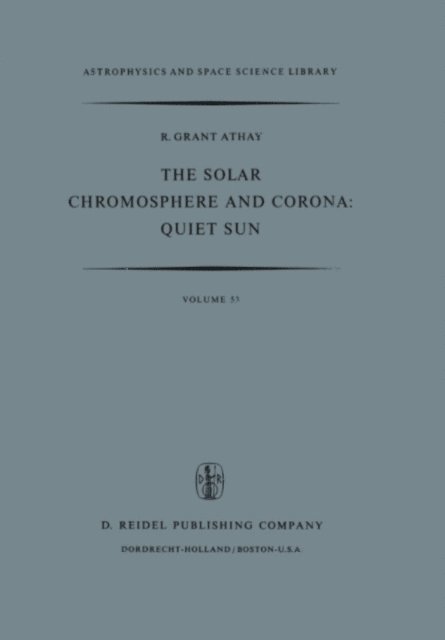
    Solar Chromosphere and Corona: Quiet Sun

    AvR.G. Athay

    Häftad, Engelska, 2011

    Del 53 i serien Astrophysics and Space Science Library

    547 kr

    Beställningsvara. Skickas inom 10-15 vardagar. Fri frakt över 249 kr.

    Fler format och utgåvor

    E-bok

    710 kr

    Beskrivning

    The widespread tendency in solar physics to divide the solar atmosphere into separate layers and to distinguish phenomena of solar activity from phenomena of the quiet Sun emphasizes the wide ranging diversity of physical conditions and events occurring in the solar atmosphere. This diversity spans the range from a neutral, essentially quiescent atmosphere to a highly ionized, violently convective atmosphere; from a domain in which magnetic field effects are unimportant to a domain in which the magnetic pressure exceeds the gas pressure, and from a domain in which the particle motions are Maxwellian to a domain in which an appreciable fraction of the particles is accelerated to relativistic energies. It is now widely recognized that the chromosphere and corona have a common origin in the mechanical energy flux generated in the hydrogen convection zone lying beneath the photosphere. Furthermore, magnetic field phenomena appear to be as vital to the structure of th~ quiet Sun as to the active Sun. For these reasons it appears desirable to present a unified treatment of the entire solar atmosphere, both active and quiet, in a single volume. On the other hand, such a treatise must be very long if it is to avoid being superficial, and it is very difficult for a single author to write authoritatively on such a wide range of topics.
    Produktinformation

    • Utgivningsdatum:2011-10-24
    • Mått:170 x 244 x 29 mm
    • Vikt:894 g
    • Format:Häftad
    • Språk:Engelska
    • Serie:Astrophysics and Space Science Library
    • Antal sidor:515
    • Upplaga:1976
    • Förlag:Springer
    • ISBN:9789401017176

    Utforska kategorier

    • Astronomi inom Naturvetenskap och teknik
    • Tillämpad fysik inom Naturvetenskap och teknik

    Innehållsförteckning

    • I. Introduction.- 1. Chromospheres and Coronas.- 2. Goals for Solar Physics.- 3. Chromosphere and Coronal Boundaries.- 4. Methods of Observation.- 5. The K- and F-Coronas.- 6. Comments on Discrete Geometrical Features.- 7. Depths of Line Formation.- II. Structural Features.- 1. Observational Methods.- 2. The Photospheric Structure.- 3. Chromospheric Network.- 4. Chromospheric Fine Structure on the Disk.- 5. Spicule Structure.- 6. Transition Region Structure.- 7. Non-Spherical Modeling.- 8. Chromospheric Active Region Structure.- 9. Observations of Coronal Structures.- 10. Fine Structure of Inner Corona.- 11. Coronal Streamers.- 12. Coronal Rays and Plumes.- 13. Coronal Disk Structures and Coronal Holes.- 14. Prominences.- 15. Solar Cycle Effects.- III. Macroscopic Motions.- 1. Measuring Systematic Motions.- 2. Photospheric Motions.- 3. Chromospheric Motions.- 4. Small Scale Coronal Motions.- 5. Coronal Expansion: The Solar Wind.- 6. Prominence Motions.- 7. Impulsive Motions.- 8. Mass Balance and Energy Transport in Mass Flow.- IV. Magnetic Fields.- 1. Method of Observation.- 2. Energy Considerations.- 3. Polar Fields and UM Regions.- 4. Evolution of Large Scale Fields.- 5. Structure and Evolution of Small Scale Fields.- 6. Coronal Magnetic Fields.- V. Spectral Characteristics.- 1. Visual and Near Infrared Disk.- 2. Visual and Near Infrared Limb.- 3. Infrared, Radio and XUV Continuum Data.- 4. XUV Emission Lines.- VI. Analytical Methods for Spectroscopic Data.- 1. Scattering Continuum.- 2. Bound-Free Continua: Effectively Thin Case.- 3. Free-Free Continua.- 4. Total Line Intensities: Effectively Thin Case.- 5. Profiles of lines and Bound-Free Continua: Effectively Thick Case.- VII. Empirical Chromospheric and Coronal Models.- 1. Summary Models.- 2. Conditions at the Optical Limb.- 3. The Temperature Minimum Region.- 4. The Low Chromosphere.- 5. The Middle Chromosphere.- 6. The High Chromosphere.- 7. The Chromosphere-Corona Transition Region.- 8. The Corona.- VIII. Chromospheric Structure Inferred from Spectral Lines.- 1. Chromospheres and Coronas as Phenomena of Stellar Atmospheres.- 2. Influence of the Chromospheric Temperature Rise.- 3. Influence of the Chromospheric Increase in Doppler Width.- 4. Ca ii lines.- 5. Mg ii Lines.- 6. Neutral Metal Lines.- 7. Hydrogen Lines.- 8. C ii and O i Lines.- 9. Summary.- IX. Energy and Momentum Balance.- 1. Energy Balance.- 2. Radiation Loss Rates.- 3. Thermal Stability.- 4. Coronal Energy Loss by Thermal Conduction and Evaporation.- 5. Energy Balance Within the Transition Region.- 6. The Base of the Transition Region.- 7. The Effect of Motions.- 8. Energy Losses from the Chromosphere.- 9. The Quiet Sun Solar Wind.- 10. Spicule Mechanisms.- X. Wave Generation and Heating.- 1. Wave Generation.- 2. Interpretation of 5 Minute Oscillations.- 3. Generation of Waves by the Convection Zone.- 4. Heating.- 5. Acoustic Production of Stellar Chromospheres and Coronas.