• Fri frakt över 249 kr
  • •
  • Snabba leveranser
  • •
  • Billiga böcker
Kundservice

Du är på sajten för privatpersoner.

Företag, bibliotek eller offentlig verksamhet?

Du handlar på classic.bokus.com, där alla dina funktioner finns intakta.
Till classic.bokus.com
Bokus logotyp. Gå till startsidan.
  • Erbjudanden
  • Nyheter
  • Student
  • Topplistor
  • Barn & ungdom
  • Bokus Play
  • E-böcker
  • Pocketböcker
  • Spel & pussel

10% rabatt på allt med kod NYSTART10 →

Sidfot

Mina sidor

    Hjälp

    • Kundservice
    • Vanliga frågor och svar
    • Frakt och leverans
    • Retur vid ångerrätt
    • Reklamera vara
    • Betalning
    • Köpvillkor
    • Allmänna villkor
    • Information om webbplatsens tillgänglighet

    Om Bokus

    • Om oss
    • Pressrum
    • För studenter
    • För företag
    • För bibliotek och offentlig verksamhet
    • För leverantörer
    • Hållbarhet

    Populärt

    • Aktuella erbjudanden
    • Presentkort
    • Studentlitteratur
    • Nya böcker
    • Topplistor
    • Signerade böcker
    • Engelska böcker

    Inspiration

    • Boktips
    • BookTok
    • Populära bokserier
    • Barnbokskaraktärer
    • Populära författare
    Logotyp för Bokus
    Följ oss på Facebook (extern länk)Följ oss på Instagram (extern länk)Följ oss på YouTube (extern länk)Följ oss på TikTok (extern länk)
    bokus @ CookiesAnpassa cookiesIntegritetspolicyKöpvillkor
    Till Citymail hemsida (extern länk)Till Budbee hemsida (extern länk)Till Postnord hemsida (extern länk)Till Schenker hemsida (extern länk)Till Early Bird hemsida (extern länk)Till Walleys hemsida (extern länk)
    1. Naturvetenskap och teknik
    2. Matematik och naturvetenskap
    3. Kemi
    4. Fysikalisk kemi

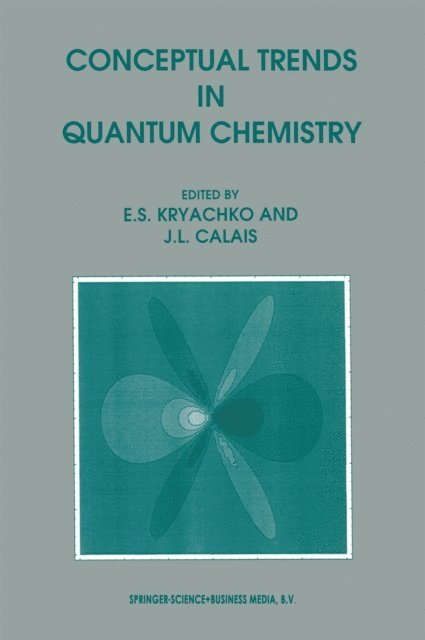
    Conceptual Trends in Quantum Chemistry

    AvEugene S. Kryachko,Jean-Louis Calais

    Häftad, Engelska, 2011

    546 kr

    Beställningsvara. Skickas inom 10-15 vardagar. Fri frakt över 249 kr.

    Beskrivning

    The rivers run into the sea, yet the sea is not full Ecclesiastes What is quantum chemistry? The straightforward answer is that it is what quan­ tum chemists do. But it must be admitted, that in contrast to physicists and chemists, "quantum chemists" seem to be a rather ill-defined category of scientists. Quantum chemists are more or less physicists (basically theoreticians), more or less chemists, and by large, computationists. But first and foremost, we, quantum chemists, are conscious beings. We may safely guess that quantum chemistry was one of the first areas in the natural sciences to lie on the boundaries of many disciplines. We may certainly claim that quantum chemists were the first to use computers for really large scale calculations. The scope of the problems which quantum chemistry wishes to answer and which, by its unique nature, only quantum chemistry can only answer is growing daily. Retrospectively we may guess that many of those problems meet a daily need, or are say, technical in some sense. The rest are fundamental or conceptual. The daily life of most quantum chemists is usually filled with grasping the more or less technical problems. But it is at least as important to devote some time to the other kind of problems whose solution will open up new perspectives for both quantum chemistry itself and for the natural sciences in general.

    Produktinformation

    • Utgivningsdatum:2011-12-09
    • Mått:160 x 240 x 15 mm
    • Vikt:406 g
    • Format:Häftad
    • Språk:Engelska
    • Antal sidor:250
    • Upplaga:1994
    • Förlag:Springer
    • ISBN:9789401043670

    Utforska kategorier

    • Fysikalisk kemi inom Naturvetenskap och teknik

    Recensioner i media

    '... serious research groups in quantum chemistry should have access to this book, and it should be on the shelves of all self-respecting University libraries. The book is recommended for a specialist audience and the second volume is awaited with interest.' Structural Chemistry, 6:4-5, 1995

    Innehållsförteckning

    • Molecules in Magnetic Fields: Fundamental Aspects.- 1. Introduction.- 2. The Hamiltonian and Its Constants of Motion.- 3. The Pseudoseparation of the Center of Mass Motion.- 4. Adiabatic Separation of Electronic and Nuclear Motion in the Presence of a Magnetic Field.- 5. Molecular Symmetries and Crossings of Potential Energy Surfaces in a Magnetic Field.- 6. Atomic Orbital Basis Set for the Numerical Calculation of Properties of Molecules in Strong Magnetic Fields.- 7. Conclusions and Outlook.- References.- The Decoupling of Nuclear from Electronic Motions in Molecules.- 1. Introduction.- 2. The Removal of Translational Motion.- 3. Distinguishing Electronic and Nuclear Motions.- 4. The Body-Fixed Hamiltonian.- 5. Separating Electronic and Nuclear Motions.- 6. The Clamped Nucleus Hamiltonian.- 7. Difficulties and Divergences.- 8. Conclusions.- References.- The Status of Density Functional Theory for Chemical Physics.- 1. Introduction.- 2. Traits and Uses of Density Functional Theory.- 3. Limitations of the DFT-LSDA.- 4. Some Current Issues.- References.- String Model of Chemical Reactions.- 1. Introduction.- 2. Differential Geometry of the String Model.- 3. Quantum Mechanics of the String Model.- 4. Vibronic Hamiltonian.- 5. External Field Effects.- 6. Conclusion.- References.- Molecular Structure — Property Relations. Three Remarks on Reactivity Indices.- 1. Introduction.- 2. Perturbabilities and Density Matrix Elements.- 3. Physical Significance of Atomic Populations.- 4. A Reactivity Index from the Supermolecule Approach.- References.- Hyperspherical Harmonics; Some Properties and Applications.- 1. Introduction.- 2. Harmonic Polynomials.- 3. Generalized Angular Momentum.- 4. Angular Integrations.- 5. Hyperspherical Harmonics.- 6. Gegenbauer Polynomials.- 7. TheHydrogen Atom in Reciprocal Space.- 8. Many-Center Coulomb Potentials.- 9. Hyperspherical Sturmian Basis Functions.- 10. Evaluation of the Z-matrix.- 11. Iteration of the Wave Equation, and “Primary” Harmonics.- References.- The Nature of The Chemical Bond 1993. There Are No Such Things as Orbitals!.- 1. Introduction.- 2. Quantum Laws and Quantum Theories.- 3. Application of Quantum Mechanics to Atomic and Molecular Structure.- 4. Implications for Chemical Education.- Appendix — Interpretation of Photoelectron Spectra.- References.- A Phase Space Essay.- 1. Introduction.- 2. The Classical Phase Space.- 3. Some Aspects of Quantum Mechanics.- 4. Phase — Space Representations.- References.- The Wavelet Transform: A New Mathematical Tool for Quantum Chemistry.- 1. Introduction.- 2. From Fourier Analysis to Wavelet Analysis.- 3. Application of Wavelets in Quantum Chemistry.- 4. Conclusion.- References.