• Fri frakt över 249 kr
  • •
  • Snabba leveranser
  • •
  • Billiga böcker
Kundservice

Du är på sajten för privatpersoner.

Företag, bibliotek eller offentlig verksamhet?

Du handlar på classic.bokus.com, där alla dina funktioner finns intakta.
Till classic.bokus.com
Bokus logotyp. Gå till startsidan.
  • Erbjudanden
  • Nyheter
  • Student
  • Topplistor
  • Barn & ungdom
  • Bokus Play
  • E-böcker
  • Pocketböcker
  • Spel & pussel

10% rabatt på allt med kod NYSTART10 →

Sidfot

Mina sidor

    Hjälp

    • Kundservice
    • Vanliga frågor och svar
    • Frakt och leverans
    • Retur vid ångerrätt
    • Reklamera vara
    • Betalning
    • Köpvillkor
    • Allmänna villkor
    • Information om webbplatsens tillgänglighet

    Om Bokus

    • Om oss
    • Pressrum
    • För studenter
    • För företag
    • För bibliotek och offentlig verksamhet
    • För leverantörer
    • Hållbarhet

    Populärt

    • Aktuella erbjudanden
    • Presentkort
    • Studentlitteratur
    • Nya böcker
    • Topplistor
    • Signerade böcker
    • Engelska böcker

    Inspiration

    • Boktips
    • BookTok
    • Populära bokserier
    • Barnbokskaraktärer
    • Populära författare
    Logotyp för Bokus
    Följ oss på Facebook (extern länk)Följ oss på Instagram (extern länk)Följ oss på YouTube (extern länk)Följ oss på TikTok (extern länk)
    bokus @ CookiesAnpassa cookiesIntegritetspolicyKöpvillkor
    Till Citymail hemsida (extern länk)Till Budbee hemsida (extern länk)Till Postnord hemsida (extern länk)Till Schenker hemsida (extern länk)Till Early Bird hemsida (extern länk)Till Walleys hemsida (extern länk)
    1. Språk och ordböcker
    2. Språkvetenskap och lingvistik

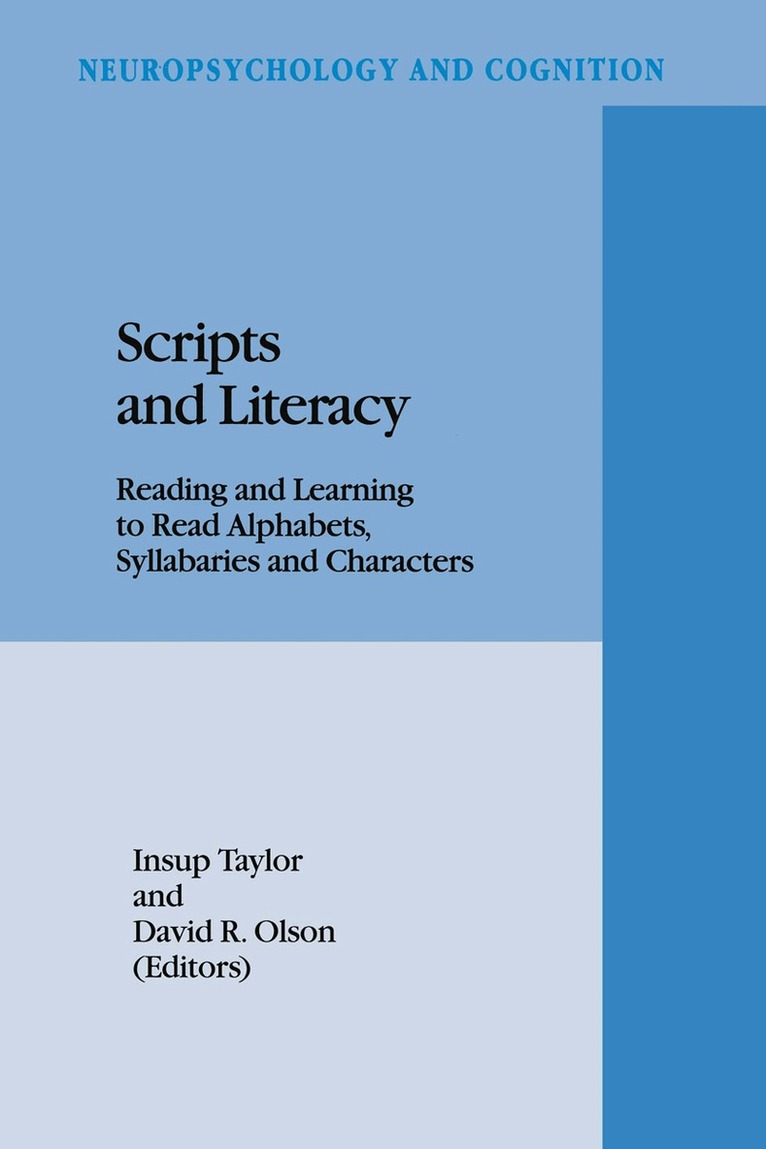
    Scripts and Literacy

    Reading and Learning to Read Alphabets, Syllabaries and Characters

    AvI. Taylor,D.R. Olson

    Häftad, Engelska, 2012

    Del 7 i serien Neuropsychology and Cognition

    562 kr

    Beställningsvara. Skickas inom 10-15 vardagar. Fri frakt över 249 kr.

    Beskrivning

    Literacy is a concern of all nations of the world, whether they be classified as developed or undeveloped. A person must be able to read and write in order to function adequately in society, and reading and writing require a script. But what kinds of scripts are in use today, and how do they influence the acquisition, use and spread of literacy? Scripts and Literacy is the first book to systematically explore how the nature of a script affects how it is read and how one learns to read and write it. It reveals the similarities underlying the world's scripts and the features that distinguish how they are read. Scholars from different parts of the world describe several different scripts, e.g. Japanese, Chinese, Korean, Indian Amerindian -- and how they are learned. Research data and theories are presented. This book should be of primary interest to educators and researchers in reading and writing around the world.

    Produktinformation

    • Utgivningsdatum:2012-10-20
    • Mått:160 x 240 x 22 mm
    • Vikt:637 g
    • Format:Häftad
    • Språk:Engelska
    • Serie:Neuropsychology and Cognition
    • Antal sidor:389
    • Upplaga:1995
    • Förlag:Springer
    • ISBN:9789401045063

    Utforska kategorier

    • Språkvetenskap och lingvistik inom Språk och ordböcker

    Innehållsförteckning

    • 1. An Introduction to Reading the World’s Scripts.- I. Optional and Optimal Scripts.- 2. Scripts and Writing Systems: A Historical Perspective.- 3. Optimal Orthographies.- 4. Logographic and Semasiographic Writing Systems: A Critique of Sampson’s Classification.- 5. The Cree Syllabary and the Writing System Riddle: A Paradigm in Crisis.- 6. Developing Orthographies: The Athapaskan Languages of the Northwest Territories, Canada.- 7. Orthography and Reading in Kannada: A Dravidian Language.- II: Reading Processes for Different Scripts.- 8. How English is Read: Grapheme-Phoneme Regularity and Orthographic Structure in Word Recognition.- 9. Getting at the Sound and Meaning of Logographic and Alphabetic Scripts.- 10. Script Factors that Affect Literacy: Alphabetic vs. Logographic Languages.- 11. Orthographic and Psycholinguistic Considerations in Developing Literacy in Chinese.- 12. Differential Processing of Content Words and Function Words: Chinese Characters vs. Phonetic Scripts.- III: Early Stage of Learning to Read.- 13. Teaching Japanese Toddlers to Read Kanji and Kana.- 14. Asymmetries between Reading and Writing for Japanese Children.- 15. Reading Disabilities in Japan: Implications from the Study of Hemisphere Functioning.- 16. Writing Systems and Acquisition of Reading in American, Chinese and Japanese First-Graders.- 17. Brahmi Scripts, Orthographic Units and Reading Acquisition.- 18. Orthographic and Cognitive Processing in Learning to Read English and Hebrew.- IV: Cognitive and Metalinguistic Implications of Learning to Read.- 19. Script Directionality Affects Nonlinguistic Performance: Evidence from Hindi and Urdu.- 20. Cognitive Consequences of L1 and L2 Orthographies.- 21. Lexical Representation of Script Variation: Evidence from Korean Biscriptals.- 22.Syllabic Literacy and Cognitive Performance among the Cree and Ojibwe People of Northern Canada.- 23. Orthography, Vision, and Phonemic Awareness.